Best AP Physics C Score Calculator 2026: Estimate Your 1–5 Score
AP Physics C Score Calculator
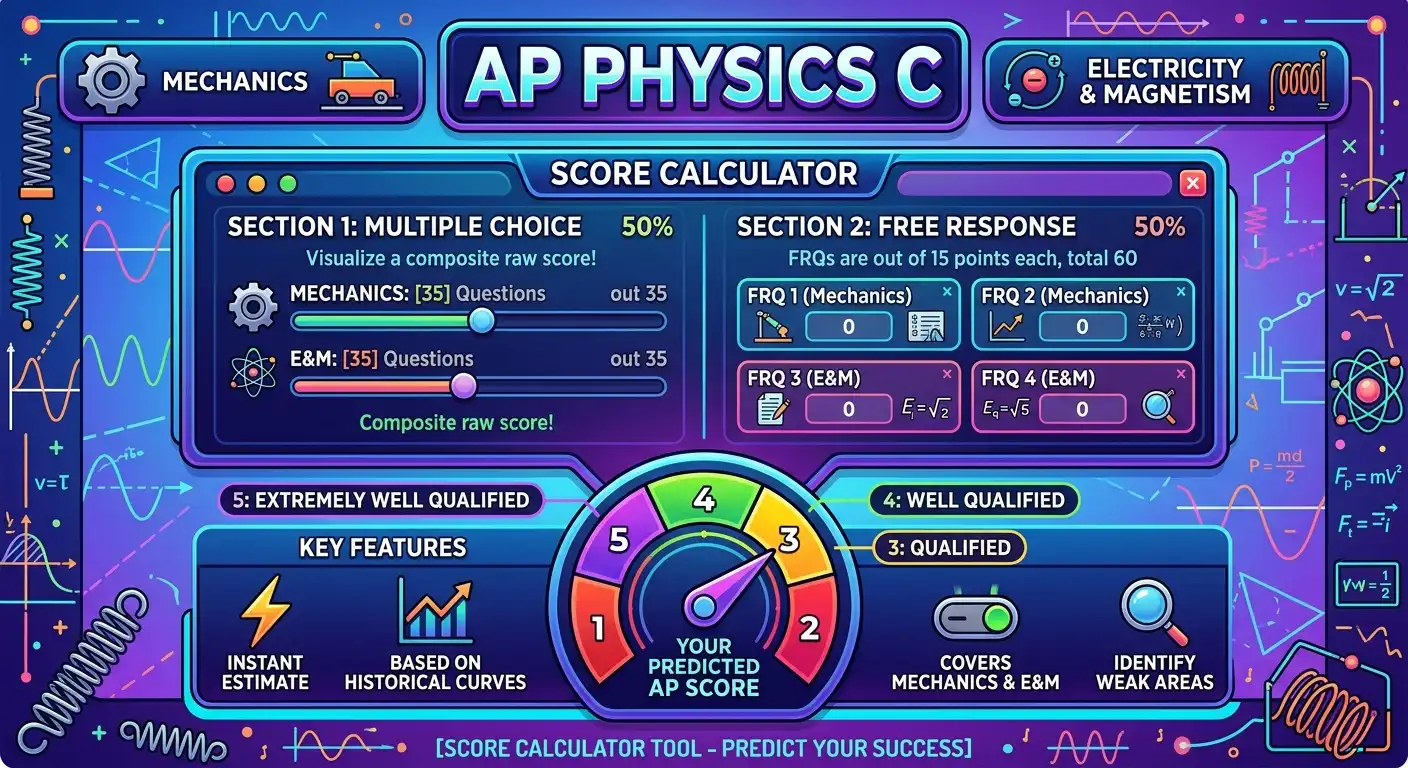
Estimate your AP Physics C score from multiple-choice and free-response performance. This free calculator supports AP Physics C: Mechanics and AP Physics C: Electricity and Magnetism.
Calculate Your Estimated AP Physics C Score
2026 Exam FormatStudents preparing for calculus-based physics often want to know how their practice-test performance may translate to the familiar 1–5 AP scale.
This AP Physics C Score Calculator estimates that result by combining your 40 multiple-choice points with up to 40 free-response rubric points.
It is useful for AP Physics C: Mechanics and AP Physics C: Electricity and Magnetism students who have completed a practice exam or want to measure their readiness.
Because AP scoring uses equating and standard setting rather than a permanently fixed conversion chart, the calculator should be treated as a planning estimate.
How This Calculator Works
The current AP Physics C format gives equal weight to the two exam sections. Section I contains 40 multiple-choice questions and represents 50% of the exam score.
Section II contains four free-response questions and represents the other 50%. The four FRQs have maximum scores of 10, 12, 10, and 8 points, giving 40 possible FRQ rubric points.
Maximum Composite = 40 + 10 + 12 + 10 + 8 = 80
Composite Percentage = (Raw Composite ÷ 80) × 100
For example, 25 correct MCQs plus FRQ scores of 7, 8, 6, and 5 produce a raw composite of 51/80. That equals 63.75% of the available composite points.
The calculator then compares the composite with estimated AP-score planning bands.
Step-by-Step Example Calculation
- Multiple choice: 25/40
- Mathematical Routines: 7/10
- Translation Between Representations: 8/12
- Experimental Design & Analysis: 6/10
- Qualitative/Quantitative Translation: 5/8
51 ÷ 80 × 100 = 63.75%
This produces an estimated composite of 51/80. Because raw-to-AP conversion can vary, a student close to a score boundary should treat the prediction as a range rather than a guarantee.
What Affects Your AP Physics C Score?
AP Physics C Raw Score Conversion
The most important distinction is between a raw practice score and an official AP score. Your raw score represents points earned on questions and FRQ rubric elements.
The final AP result is reported from 1 through 5 after College Board applies its scoring process. Therefore, an AP Physics C raw score conversion should not be treated as a universal formula where one percentage always produces the same AP score.
For planning purposes, this calculator uses approximate composite benchmarks around 52/80 for a 5, 40/80 for a 4, 31/80 for a 3, and 21/80 for a 2. These are estimates rather than official permanent College Board cutoffs.
AP Physics C Score Calculator Inputs
A useful AP Physics C calculator separates multiple-choice performance from FRQ performance. The current FRQs have different maximum point values, so entering each FRQ separately provides a more useful breakdown than entering one overall percentage.
It also helps students identify exactly where points are being lost.
AP Physics C Exam Score Calculator: Mechanics
AP Physics C: Mechanics is a calculus-based course covering kinematics, dynamics, work and energy, momentum, rotational motion, and oscillations.
The current exam contains 40 multiple-choice questions and four free-response questions. Each section contributes 50% of the overall exam score.
Mechanics students should analyze both MCQ accuracy and FRQ rubric performance. Strong algebra alone is not enough: derivations, graphs, physical relationships, experimental reasoning, and explanations can all contribute to FRQ points.
AP Physics C Exam Calculator: Electricity & Magnetism
AP Physics C: Electricity and Magnetism follows the same current overall scoring structure while testing electric fields, electric potential, conductors and capacitors, circuits, magnetic fields, and electromagnetic induction.
For E&M practice, enter your actual rubric points after grading the FRQs rather than estimating your FRQ percentage. This produces a more informative estimate of your total composite.
Practice-Test Difficulty and Score Boundaries
Practice exams can differ in difficulty. A difficult test can produce a lower raw score without necessarily indicating weaker preparation, while an easy practice test can make readiness look better than it really is.
Take several realistic full-length tests and look for a stable composite range.
FRQ Rubric Points Matter
The free-response section tests more than final numerical answers. Students can earn points through appropriate mathematical reasoning, representation, experimental design, analysis, and qualitative explanation.
This makes careful FRQ grading essential when using an AP Physics C score calculator.
AP Physics C Score Ranges and Benchmarks
| Estimated AP Score | Approx. Composite | Approx. Percentage | Planning Interpretation |
|---|---|---|---|
| 5 | 52–80 | 65%–100% | Very strong benchmark |
| 4 | 40–51 | 50%–64% | Strong benchmark |
| 3 | 31–39 | 39%–49% | Qualified benchmark |
| 2 | 21–30 | 26%–38% | Possible qualifying range |
| 1 | 0–20 | 0%–25% | Below estimated qualifying range |
These are planning estimates, not an official permanent College Board raw-score conversion table.
How Accurate Is an AP Physics C Score Calculator?
The raw composite calculation is reliable when you enter the correct number of MCQ answers and actual FRQ rubric points. The uncertain component is converting that composite into the official 1–5 score.
College Board can establish score standards for each administration, so the raw-point requirement for a particular AP score can vary.
The best approach is to use this calculator with several realistic practice exams. Record your composite scores and look for a consistent range.
If your scores remain above your target boundary across multiple tests, that is stronger evidence of readiness than one unusually high practice result.
AP Physics C Score Calculator FAQs
How is AP Physics C scored?
The current AP Physics C exams use 40 multiple-choice questions worth 50% and four free-response questions worth the other 50%. The FRQs total 40 rubric points: 10, 12, 10, and 8 points respectively.
What is the maximum AP Physics C raw score?
The current structure has a maximum raw composite of 80 points: 40 possible multiple-choice points plus 40 free-response rubric points.
What raw score do I need for a 5 on AP Physics C?
A commonly used planning benchmark places an estimated AP 5 around 52 or more composite points out of 80. That is approximately 65% of available points. It is not a guaranteed official College Board cutoff.
Is AP Physics C Mechanics scored differently from E&M?
The current Mechanics and Electricity and Magnetism exams use the same overall 50/50 section weighting and 40-MCQ plus 40-FRQ-point structure, although their physics content is different.
How many FRQ points are on AP Physics C?
There are 40 possible FRQ rubric points: 10 for Mathematical Routines, 12 for Translation Between Representations, 10 for Experimental Design and Analysis, and 8 for Qualitative/Quantitative Translation.
Does AP Physics C have a penalty for wrong answers?
Incorrect multiple-choice answers do not receive a negative-point penalty. The calculator therefore only requires the number of correct multiple-choice answers.
Can a strong MCQ score make up for weak FRQs?
Yes. Both sections contribute 50%, so stronger performance in one section can offset weaker performance in the other when calculating the composite. However, FRQs remain important because they provide 40 possible rubric points.
Is this AP Physics C score conversion official?
No. The 80-point composite calculation follows the current exam structure, but the estimated 1–5 boundaries are planning benchmarks. College Board’s official scoring process can change score standards between administrations.
Official AP Physics C Resources
For authoritative information about the current exam structure, scoring, released questions, and AP score distributions, use College Board resources.
Related Calculators
Written by Asrar Ahmad for CalculatorSuiteHub.com.

Asrar Ahmad
Founder of CalculatorSuiteHub.com and Rankify SEO & AI Agency. Specializes in SEO, technical content writing, WordPress development, and AI-powered digital solutions. Builds accurate calculators and helps businesses grow online.