Timing of Meeting Spouse Vedic Astrology Calculator 2026
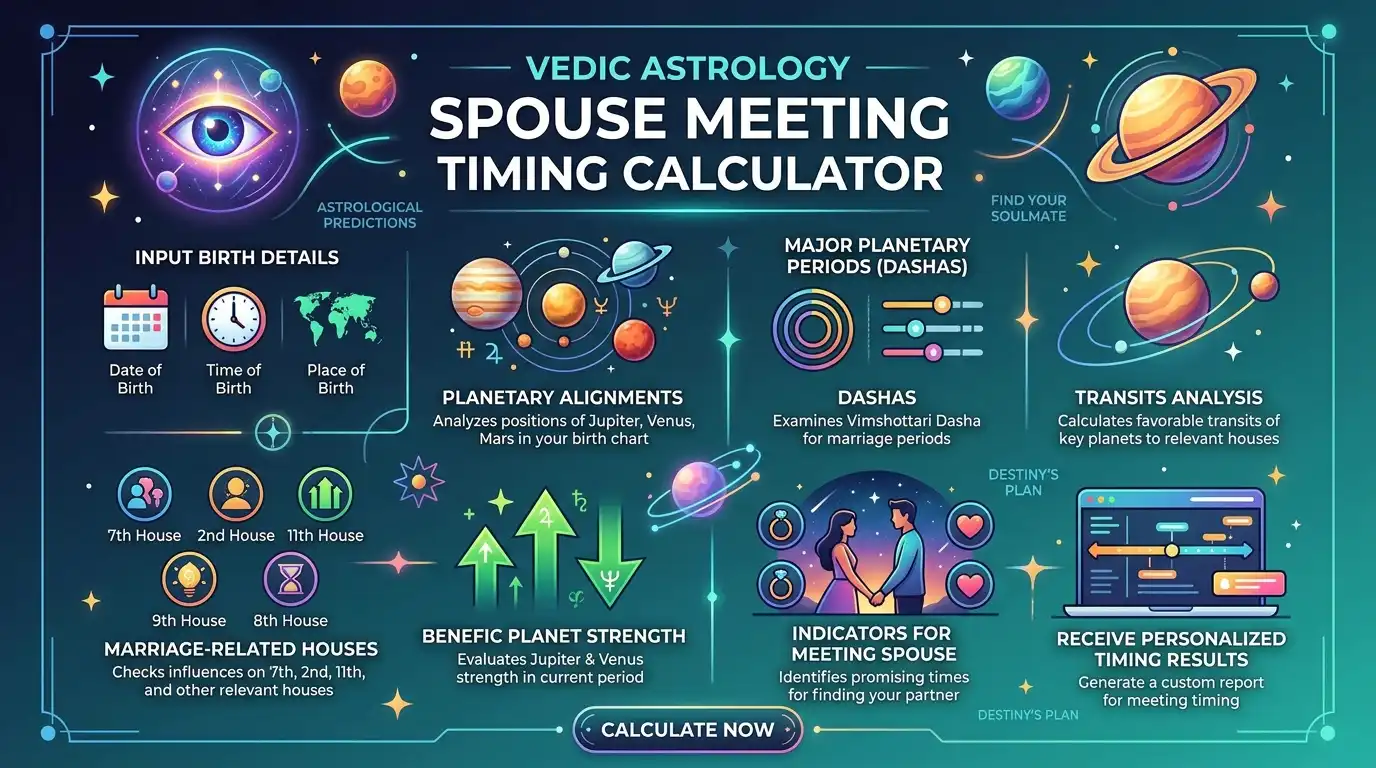
Timing of Meeting Spouse Vedic Astrology Calculator
By Asrar Ahmad, Founder & Lead Editor | Updated 27 November 2026
Many people ask when they will meet their spouse. This timing of meeting spouse Vedic astrology calculator gives you a clear starting point. It uses your Moon position at birth and the Vimshottari dasha system.
Then it scores each dasha period for the planets linked with marriage. The result is a timeline of periods that are more or less supportive. It is a traditional guide, not a promise.
Check Your Marriage Timing Windows
Your birth date, time and UTC offset are enough. Nothing leaves your browser.
How This Calculator Works
This tool joins real astronomy with a traditional timing system. It works in three steps.
Step 1: It finds the Moon position. The calculator turns your birth date, time and UTC offset into a Julian day. Then it computes the Moon longitude with the main terms of Jean Meeus’s lunar series.
Step 2: It reads your nakshatra. The tool subtracts the Lahiri ayanamsa to get the sidereal longitude. Each of the 27 nakshatras covers 13°20′. Your nakshatra sets your first dasha lord and how much of that period was left at birth.
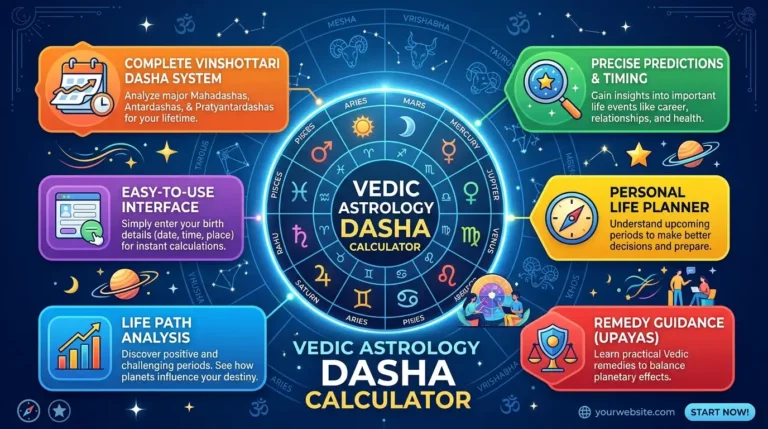
Step 3: It scores every sub-period. The Vimshottari system splits life into nine planetary periods called mahadashas. Together they last 120 years. Each mahadasha has nine sub-periods called antardashas.
| Planet | Mahadasha length (years) |
|---|---|
| Ketu | 7 |
| Venus | 20 |
| Sun | 6 |
| Moon | 10 |
| Mars | 7 |
| Rahu | 18 |
| Jupiter | 16 |
| Saturn | 19 |
| Mercury | 17 |
An antardasha lasts mahadasha years × antardasha lord years ÷ 120. For example, Venus–Mercury lasts 20 × 17 ÷ 120 = 2.83 years.
The Scoring Formula
Period score = weight of the antardasha lord + 0.5 × weight of the mahadasha lord
The weights below come from classical significators. They are our own simplified reading, not an official standard. Astrologers weigh planets in different ways, so treat the bands as relative.
| Planet | Wife (male chart) | Husband (female chart) | Life partner (neutral) |
|---|---|---|---|
| Venus | 3 | 2 | 3 |
| Jupiter | 1 | 3 | 2 |
| Moon | 1 | 1 | 1 |
| Mercury | 1 | 1 | 1 |
| Sun, Mars, Saturn, Rahu, Ketu | 0 | 0 | 0 |
The highest possible score is 4.5. The bands are Strong (3.5 or more), Good (2.5 to 3.4), Supportive (1.5 to 2.4) and Low (below 1.5).
Consecutive Good and Strong periods are merged into one favourable window.
Step-by-Step Example
Here is a full example with a made-up birth. The date is 15 August 1995 at 08:30, UTC+05:30, with the neutral life partner setting. The example treats 27 November 2026 as today.
- Convert to UTC. 08:30 minus 5 hours 30 minutes gives 03:00 UTC.
- Find the Moon. The sidereal longitude is 353.86°. That is 23.86° in Pisces (Meena).
- Find the nakshatra. 353.86 ÷ 13.333 = 26.54, so the Moon is in Revati, the 27th nakshatra. About 53.9% of it had passed at birth.
- Find the balance. Revati belongs to Mercury, which lasts 17 years. The balance is (1 − 0.539) × 17 = 7.83 years. Therefore the Mercury mahadasha ended on 15 June 2003. Ketu followed for 7 years, and then Venus ran from 14 June 2010 to 14 June 2030.
- Score the Venus sub-periods. Venus–Mercury scores 1 + 0.5 × 3 = 2.5, which is Good. It runs from 14 June 2026 to 14 April 2029. Venus–Ketu scores 0 + 1.5 = 1.5, which is Supportive, and it runs until 14 June 2030.
- Read the result. On 27 November 2026 this person is inside a Good window that ends on 14 April 2029. The next Good window is Sun–Venus, from 15 June 2035 to 14 June 2036 (score 3 + 0 = 3.0).
You can enter the same details to compare. Your own numbers will shift as today’s date changes.
What Each Planet Means for Marriage Timing
Venus is the main significator of marriage, love and partnership in classical texts. Venus periods are therefore the most watched.
Jupiter is the traditional significator of the husband in a woman’s chart. It also stands for growth and good fortune in general.
The Moon relates to the mind and emotional bonding. Moon periods can support emotional readiness.
Mercury rules communication and meeting people. It adds a small boost for introductions.
Other planets get zero weight in this tool. That does not mean they block marriage. Many astrologers read them through the seventh house, which this calculator does not use.
What This Calculator Cannot Do
- It does not calculate the ascendant or the seventh house. Those need your exact birth place and time.
- It does not include transits of Jupiter or Saturn, which many astrologers combine with dashas.
- It does not use the navamsa (D9) chart, which is the usual chart for marriage analysis.
- It cannot fix a wrong birth time. The Moon moves about 13 degrees a day, so a 6-hour error shifts it by roughly 3 degrees.
Astrology is a traditional belief system. Scientific studies have not shown that it predicts life events.
How to Get a Better Result
- Use the birth time printed on your birth certificate.
- Pick the UTC offset that applied on your birth date, including daylight saving time.
- If you tick the unknown time box, read the nakshatra warning before you trust the dates.
- Treat a Good window as a time to stay open to meeting people. It is not a reason to wait.
- Show the result to a qualified Jyotish astrologer, who can read the full chart.
Frequently Asked Questions
How accurate is this timing of meeting spouse Vedic astrology calculator?
The astronomy is precise. The Moon position matches a published reference value to well under 0.01 degrees. The interpretation is a different matter.
Dasha timing is a traditional method, and scientific studies have not shown that astrology predicts life events. Use the result as a tool for reflection and planning, not as a forecast.
Do I need my birth place?
No. This method needs only your birth date, birth time and UTC offset. The Moon position changes by at most about one degree with location. Birth place matters for the ascendant and the houses, and this tool does not calculate those.
What if I do not know my birth time?
Tick the box that says you do not know it. The tool then uses 12:00 local time. It also checks whether the Moon could sit in a different nakshatra within 12 hours of that time, and it shows a warning when it could.
What is Vimshottari dasha?
It is a 120-year cycle of nine planetary periods. It is the most widely used dasha system in Vedic astrology. Your Moon nakshatra decides where you enter the cycle at birth.
Why does the calculator use the Moon and not the ascendant?
Vimshottari dasha starts from the Moon nakshatra, so the Moon is enough to build the full timeline. The ascendant would add seventh house analysis, but that needs your exact birth place and a very exact birth time.
Can the calculator give an exact date?
No. It gives windows that last months or years. Meeting someone also depends on many real-life factors, such as where you live, who you meet and what you choose to do.
What do Strong, Good, Supportive and Low mean?
They are labels for the period score. Strong means 3.5 or more. Good means 2.5 to 3.4. Supportive means 1.5 to 2.4. Low means below 1.5. The labels compare periods inside your own chart, so they are relative.
Is my birth data stored?
No. The calculation runs in your browser, and the tool does not send your birth details to a server.
Related Calculators
Sources and Method Notes
- Meeus, J. Astronomical Algorithms, 2nd edition, Willmann-Bell, 1998 (chapter 47, position of the Moon).
- Brihat Parashara Hora Shastra, the classical text for Vimshottari dasha periods and planetary significators.
- The Lahiri (Chitrapaksha) ayanamsa, the standard sidereal offset used in India.
- For background on dasha systems, see this overview of dasha systems.

Asrar Ahmad
Founder of CalculatorSuiteHub.com and Rankify SEO & AI Agency. Specializes in SEO, technical content writing, WordPress development, and AI-powered digital solutions. Builds accurate calculators and helps businesses grow online.