Dave Ramsey Retirement Calculator Tool 2026
Dave Ramsey Retirement Calculator
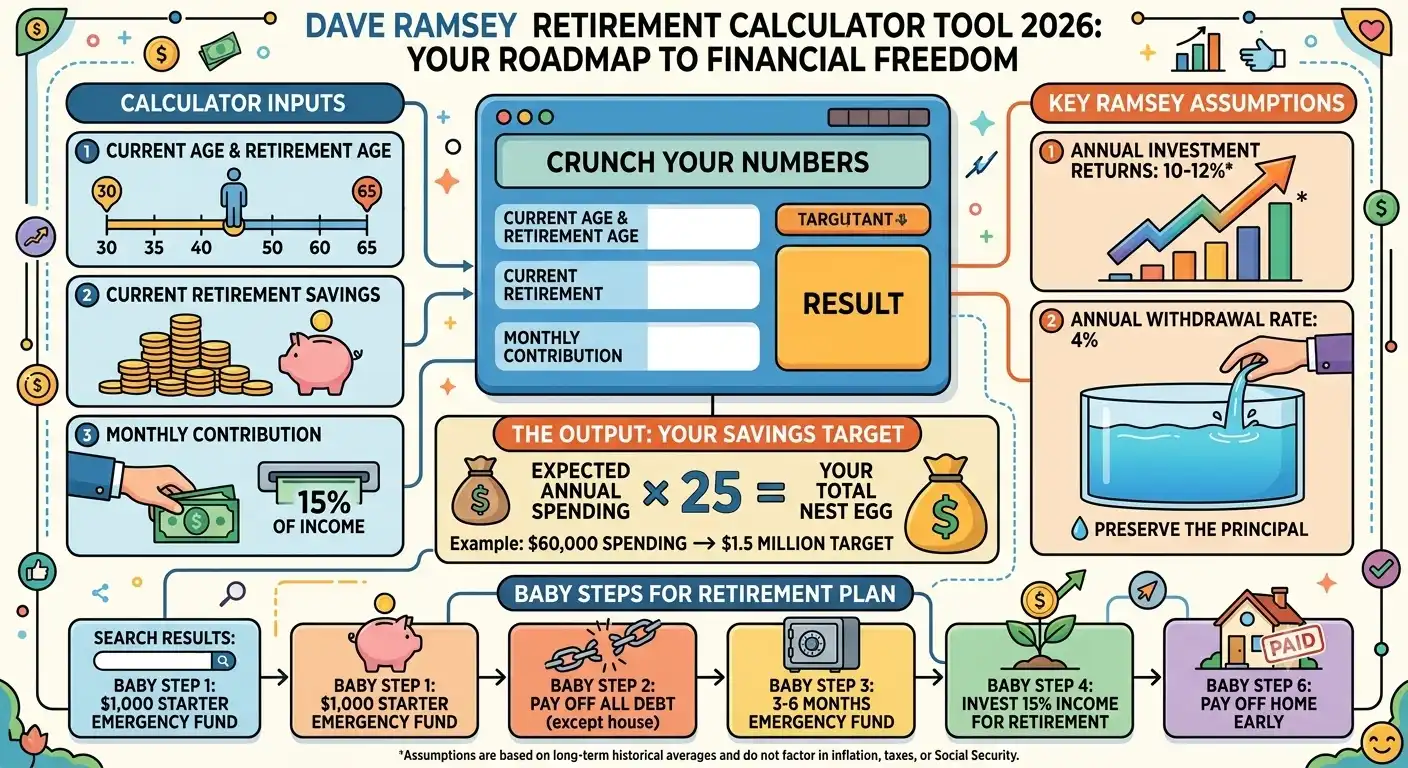
If you’ve searched for a dave ramsey retirement calculator, you’re probably trying to answer one question: will 15% of your income, invested consistently, actually be enough? This free tool runs the real math behind Ramsey’s Baby Step 4 — a 15% savings rate, compound growth at your chosen return, and retirement income calculated using both his 8% withdrawal assumption and the more conservative 4% rule most planners recommend. You’ll see exact numbers, not vague ranges, and a full breakdown of where your final nest egg actually comes from — your contributions, your employer’s match, and pure investment growth — so you know what you’re really relying on.
How This Dave Ramsey Retirement Calculator Works
This calculator doesn’t guess — it runs the same three formulas Dave Ramsey teaches on his show and in Baby Steps Millionaires, then adds the honest context most versions of this tool leave out.
1. The 15% Contribution Rule
Ramsey recommends investing 15% of gross household income into retirement accounts, but only after Baby Steps 1–3 are complete (starter emergency fund, all non-mortgage debt paid off, and a fully funded 3–6 month emergency fund). Employer match is tracked separately in this calculator because it doesn’t count toward your personal 15%.
2. Compound Growth
Where P is your current balance, PMT is your combined monthly contribution (personal + employer match), r is your annual return rate, and t is years until retirement. This is standard future-value-of-an-annuity math, the same formula used by CFP professionals — Ramsey’s contribution to it is the 10–12% return assumption he applies, based on the long-run nominal average of the S&P 500.
3. The Withdrawal Rate — Where Ramsey Diverges From Most Planners
This is the single most debated number in any retirement calculator dave ramsey style tool. Ramsey pairs a 12% return assumption with 4% expected inflation to arrive at an 8% “real” withdrawal rate. William Bengen’s 1994 research and the later Trinity Study both landed on a 4% safe withdrawal rate using historical market sequences, including bad ones. This calculator shows you both numbers side by side instead of picking one for you.
Step-by-Step Example Calculation
Sarah is 30, earns $80,000/year gross, has $15,000 already saved, gets a 3% employer 401(k) match, and plans to retire at 65 (35 years to go). She invests Ramsey’s recommended 15%.
Personal monthly contribution: $80,000 × 0.15 ÷ 12 = $1,000/month
Employer match: $80,000 × 0.03 ÷ 12 = $200/month
Combined monthly investment: $1,200/month
Running this through the compound growth formula at Ramsey’s 10% moderate assumption over 35 years × 12 = 420 compounding periods: her $15,000 starting balance grows to roughly $489,600 on its own, and her $1,200/month contributions grow to roughly $4.56 million, for a projected nest egg near $5.05 million in nominal dollars at retirement.
At Ramsey’s 8% withdrawal rule, that supports about $33,640/month in retirement income. At the more conservative 4% rule, it’s closer to $16,820/month — still a comfortable outcome, but half of Ramsey’s number. Adjusted for 3.5% average inflation over 35 years, that $5.05 million is worth about $1.51 million in today’s purchasing power — which is the number that actually matters for planning your lifestyle.
What Affects Your Dave Ramsey Retirement Calculator Result
Retirement Calculator Dave Ramsey: Return Rate Assumptions
Every extra percentage point of return compounds dramatically over 30+ years. A 30-year-old investing $1,000/month grows to roughly $2.28 million at 7%, $3.98 million at 10%, or $6.19 million at 12% by age 65 on contributions alone. This is why the return assumption you choose matters more than almost any other input — and why this calculator lets you toggle between all three instead of locking you into Ramsey’s optimistic 12%.
Mortgage Calculator Dave Ramsey and Debt-Free Timing
Ramsey’s Baby Steps only start 15% retirement investing in Baby Step 4 — after your mortgage-free-adjacent debt payoff (Baby Step 2) and emergency fund (Baby Step 3) are done. If you’re still paying off a mortgage aggressively using a mortgage calculator dave ramsey style extra-payment plan, your retirement contributions should wait or run in parallel only after non-mortgage debt is cleared, per his framework.
Dave Ramsey Calculator Retirement: Starting Age Impact
Starting at 25 instead of 35 with identical inputs can nearly double your final balance, because that decade sits at the front of the compounding curve where growth compounds on growth the longest. If you’re behind, increasing your contribution rate — not just chasing a higher return assumption — is the more reliable fix.
Dave Ramsey Loan Calculator and Dave Ramsey Pay Off Calculator Considerations
Any consumer debt carrying 15–25% interest outweighs the 10–12% return you’re targeting here. Before increasing retirement contributions past your employer match, run your balances through a dave ramsey loan calculator or dave ramsey pay off calculator using his debt snowball method — paying off high-interest debt is a guaranteed “return” equal to the interest rate, which retirement investing can’t promise.
Dave Ramsey Life Insurance Calculator: Protecting the Plan
A retirement projection assumes you’re alive and earning for the full timeline. Ramsey recommends 10–12x your annual income in term life insurance — a quick dave ramsey life insurance calculator check ensures your household isn’t left without a way to keep funding this plan (or replace lost income) if something happens to the primary earner before retirement.
Retirement Outcomes by Starting Age (10% Return, $1,000/Month, No Starting Balance)
| Starting Age | Years Investing | Nest Egg at 65 (Nominal) | Monthly Income (8% Rule) | Monthly Income (4% Rule) |
|---|---|---|---|---|
| 25 | 40 yrs | $6.32 million | $42,160 | $21,080 |
| 30 | 35 yrs | $3.80 million | $25,310 | $12,655 |
| 35 | 30 yrs | $2.26 million | $15,070 | $7,535 |
| 40 | 25 yrs | $1.33 million | $8,850 | $4,425 |
| 45 | 20 yrs | $759,000 | $5,060 | $2,530 |
Frequently Asked Questions
What formula does the Dave Ramsey retirement calculator use?
It combines three of Ramsey’s rules: save 15% of gross household income monthly, grow that at a 10–12% expected annual return using standard compound interest, then apply an 8% withdrawal rate to the final balance to estimate retirement income. This calculator also shows the more conservative 4% rule alongside it so you can see both numbers.
Why does Dave Ramsey use 8% instead of the 4% rule?
Ramsey assumes a 12% average market return and roughly 4% average inflation, so an 8% withdrawal rate is his real return after inflation. Most independent researchers, including the Trinity Study, use a more conservative 4% withdrawal rate because average nominal returns don’t repeat every single year, and sequence-of-returns risk can deplete a portfolio faster at 8%.
Is a 12% return realistic for retirement calculator dave ramsey projections?
12% reflects the long-run nominal average of the S&P 500 since 1926, which Ramsey cites directly. Inflation-adjusted (real) long-run equity returns are closer to 7–8%. This calculator lets you toggle between a conservative 7%, moderate 10%, and Ramsey’s 12% assumption so you can see the full range of outcomes rather than one optimistic number.
Does this replace a mortgage calculator dave ramsey or loan calculator dave ramsey tool?
No — this tool is built specifically for retirement projections. If you’re working through Ramsey’s Baby Steps, pay off debt and build your emergency fund first using a dedicated dave ramsey loan calculator or dave ramsey pay off calculator, since Baby Step 4 (15% retirement investing) only starts after Baby Step 2 (debt) and Baby Step 3 (emergency fund) are complete.
How is dave ramsey calculator retirement income different from a pension estimate?
Ramsey’s method assumes you’re building a personal nest egg through 401(k), Roth IRA, or mutual fund investing rather than relying on a defined-benefit pension. If your employer offers a pension, add its estimated monthly payout on top of this calculator’s investment income figure for a complete retirement income picture.
Should I include a dave ramsey life insurance calculator estimate in retirement planning?
Life insurance replaces income for dependents if you die before retirement — it isn’t part of your nest egg math, but Ramsey recommends 10–12x your annual income in term life coverage while you’re still building retirement savings, so your family isn’t left short if your investing plan gets cut off early.
What counts toward the 15% in Ramsey’s retirement rule?
The 15% applies to gross household income and typically goes: first, enough into a 401(k) to get the full employer match; then into a Roth IRA up to the annual limit; then back into the 401(k) or a taxable brokerage account to reach 15% total. Employer match doesn’t count toward your personal 15%.
How accurate is a loan calculator dave ramsey style projection for irregular income?
Any compound-growth projection, including this one, assumes a steady monthly contribution. If your income is irregular (commission, freelance, seasonal), use your average monthly contribution over the last 12 months as the input, and re-run the calculator quarterly to keep the projection realistic.
Sources: Social Security Administration Trustees Report, IRS Retirement Plans guidance, and long-run S&P 500 return data referenced in the Trinity Study withdrawal-rate research. This calculator is independently built and is not affiliated with or endorsed by Dave Ramsey or Ramsey Solutions.
Related Calculators

Asrar Ahmad
Founder of CalculatorSuiteHub.com and Rankify SEO & AI Agency. Specializes in SEO, technical content writing, WordPress development, and AI-powered digital solutions. Builds accurate calculators and helps businesses grow online.