1:2:4 Concrete Mix Calculator – Free Online Calculator
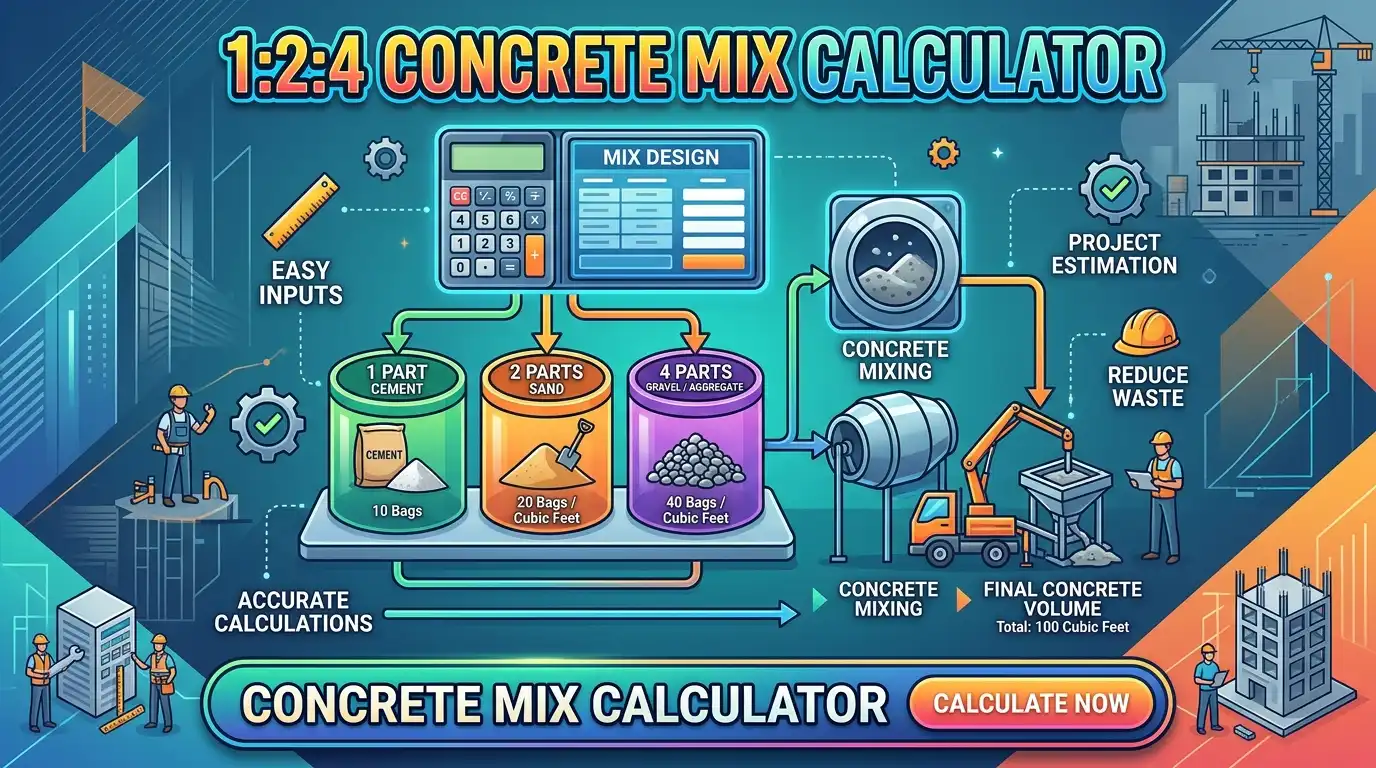
1:2:4 Concrete Mix Calculator: Free Cement, Sand & Crush Estimator
This 1:2:4 concrete mix calculator tells you how many cement bags, sand and crush you need for a slab. It works in cubic feet (cft) and square feet.
It is made for builders, contractors and homeowners. Accurate quantities stop costly over-ordering and mid-pour shortages.
How This 1:2:4 Concrete Mix Calculator Works
The calculator converts wet volume into dry volume. Dry materials shrink once water fills the gaps.
Wet volume = Length × Width × Thickness (ft)
Dry volume = Wet volume × 1.54
Material = Dry volume × (Part ÷ Sum of ratio parts)
Cement bags = Cement cft ÷ 1.25 (one 50 kg bag ≈ 1.25 cft)
For 1:2:4, the sum of parts is 7. Cement takes 1/7, sand 2/7 and crush 4/7 of the dry volume.
Step-by-Step Example for a Slab
Take a 20 ft × 15 ft slab that is 5 inches thick.
Wet volume is 20 × 15 × (5 ÷ 12) = 125 cft. Dry volume is 125 × 1.54 = 192.5 cft.
Cement is 192.5 ÷ 7 = 27.5 cft, or 22 bags. Sand is 55 cft and crush is 110 cft.
Add 5% wastage and you should order about 24 bags. This is how a 1:2:4 concrete mix calculator for slab work should be used.
What Affects Your Concrete Mix Quantities
1:2:4 Concrete Mix Calculator in CFT
Pakistani and Indian sites buy sand and crush by the cft. That is why this tool shows every material in cubic feet first.
Tip: one cubic metre equals 35.31 cft. Use it to convert supplier quotes quickly.
1:2:4 Concrete Mix Calculator in Square Feet
Slab area in square feet only becomes volume after you add thickness. A 300 sq ft slab at 4 in needs 100 cft, but at 6 in it needs 150 cft.
Always confirm thickness before ordering. A 1 inch error changes cement by about 20%.
1 2 4 Concrete Mix Calculator in Pakistan
Local cement bags are 50 kg and sold in Rs. Prices shift by city and season, so edit the rates in the tool.
Avoid pouring in peak summer heat above 40°C. Fast drying cracks slabs, so cure for at least 7 days.
1:2:3 Concrete Mix Calculator
A 1:2:3 mix uses more cement per cft. Choose it for beams, columns and roofs that carry heavier loads.
1:4:8 Concrete Mix Calculator
The 1:4:8 mix is lean concrete. It suits foundation beds, leveling courses and plain cement concrete (PCC) bases.
Hot Mix Asphalt Calculator Basics
Asphalt is estimated by weight, not by mix ratio. Tons = Area (sq ft) × Thickness (in) ÷ 12 × 145 lb ÷ 2,000.
For paved areas, see our asphalt driveway cost calculator.
Common Mistakes to Avoid
Do not skip the 1.54 dry factor. Also measure sand moisture, as wet sand can bulk by 25%.
Follow the Portland Cement Association guidance on curing and water-cement ratio.
Cement, Sand and Crush per 100 cft of Concrete
| Mix Ratio | Cement Bags | Sand (cft) | Crush (cft) | Best Use |
|---|---|---|---|---|
| 1:1.5:3 | 22.4 | 42 | 84 | Columns, beams |
| 1:2:3 | 20.5 | 51 | 77 | Roof slabs |
| 1:2:4 | 17.6 | 44 | 88 | Floors, slabs |
| 1:3:6 | 12.3 | 46 | 92 | Light duty bases |
| 1:4:8 | 9.5 | 47 | 95 | PCC, leveling |
Values are per 100 cft of wet concrete, before wastage.
1:2:4 Concrete Mix Calculator FAQs
What does 1:2:4 mean in concrete?
It means 1 part cement, 2 parts sand and 4 parts crushed aggregate by volume. This standard mix gives roughly 3,000 psi strength for slabs and floors.
How many cement bags are in 100 cft of 1:2:4 concrete?
About 17.6 bags of 50 kg. Multiply wet volume by 1.54, divide by 7, then divide by 1.25. Add wastage for a safe order.
Is there a 1:2:4 concrete mix calculator app or PDF?
This web tool works like a free app on any phone. Use the Print / Save as PDF button to keep your 1 2 4 concrete mix calculator results offline.
Why multiply by 1.54?
Dry materials contain air gaps that fill with water and cement paste. The 1.54 factor compensates, so your wet slab volume is achieved after mixing.
Can I use 1:2:4 for a slab?
Yes. It is the most common ratio for residential slabs, floors and driveways. For roofs or columns, choose 1:1.5:3 or 1:2:3 for extra strength.
How much wastage should I add?
Use 3–5% for flat slabs and 7–10% for uneven ground, footings or hand mixing. Spillage and over-excavation consume more material than most people expect.
How is a 1:4:8 mix different?
The 1:4:8 mix has far less cement. It is only for non-structural bases like PCC under footings, not for finished slabs or load-bearing members.
Related Calculators

Asrar Ahmad
Founder of CalculatorSuiteHub.com and Rankify SEO & AI Agency. Specializes in SEO, technical content writing, WordPress development, and AI-powered digital solutions. Builds accurate calculators and helps businesses grow online.