Water Softener Size Calculator: Find the Right Grain Capacity
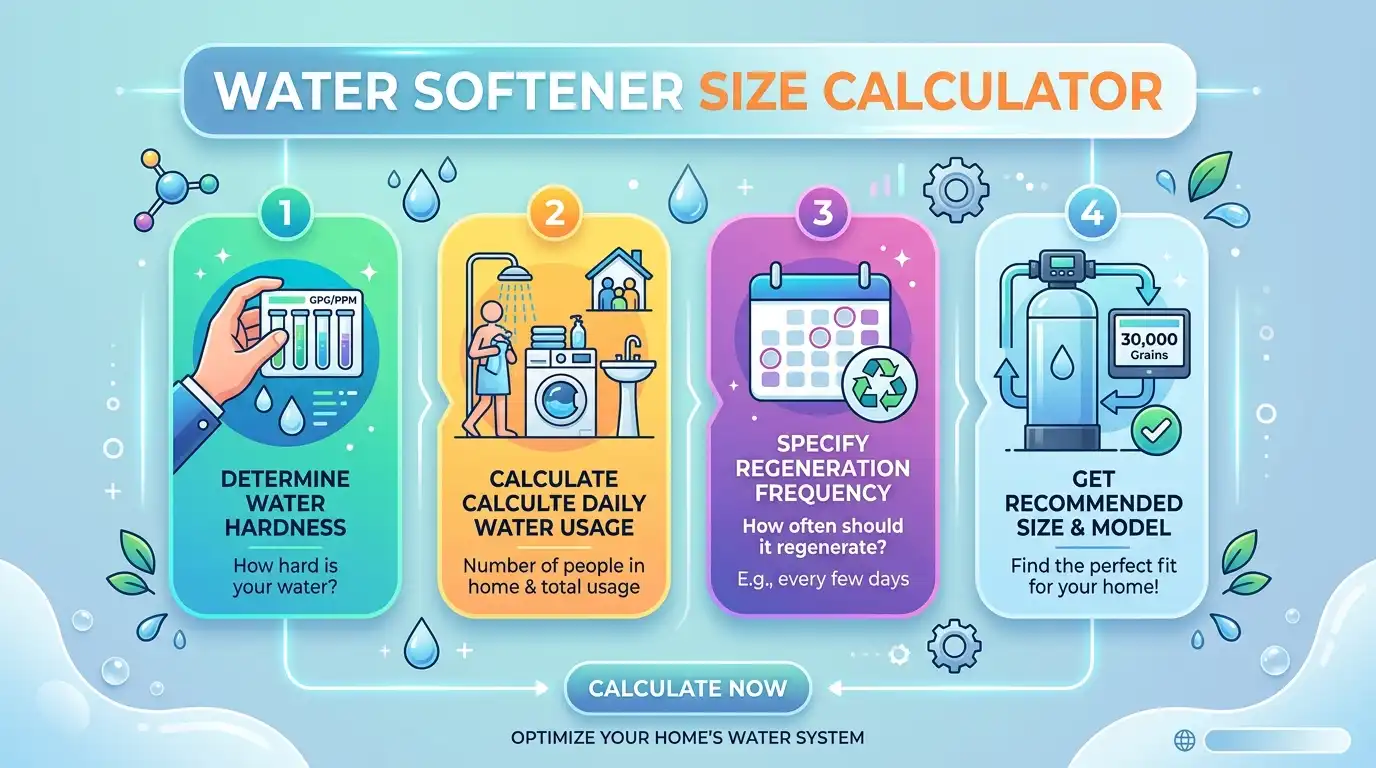
Choosing a softener by tank size alone can lead to frequent regeneration, wasted salt, or inadequate softening. This water softener size calculator estimates the grain capacity needed from household demand, water hardness, iron, and the desired regeneration interval.
The calculation is useful for homeowners, well-water users, plumbers, and people comparing 40,000-grain and 48,000-grain water softeners. It also gives you the math behind the recommendation so you can compare the result with the manufacturer’s actual capacity and salt-setting data.
Water Softener Size Calculator
Enter your water test and household demand to estimate the required grain capacity.
How This Calculator Works: Water Softener Formula
A water softener is sized by the amount of hardness it must remove between regeneration cycles. Penn State Extension gives a practical residential example using 75 gallons per person per day, hardness in grains per gallon, and a household population figure. :contentReference[oaicite:0]{index=0}
The calculator first converts hardness to grains per gallon when the test result is supplied in ppm. It then accounts for clear-water iron, calculates daily grain demand, adds the selected reserve, and rounds the result up to a common nominal softener capacity.
        Hardness (gpg) = ppm ÷ 17.1

        Compensated hardness = hardness + (5 × clear-water iron in mg/L)

        Daily gallons = people × gallons per person per day

        Daily grain load = daily gallons × compensated hardness

        Cycle demand = daily grain load × target regeneration days

        Planning capacity = cycle demand × (1 + reserve)
The 5-grain-per-mg/L iron adjustment is consistent with published softener guidance for ferrous iron. Pentair’s manual, for example, instructs users to adjust hardness by 5 grains for each 1 ppm of iron. :contentReference[oaicite:1]{index=1}
Step-by-Step Example Calculation
Suppose four people live in a home using 75 gallons per person per day. The water test reports 15 gpg hardness and 0.5 mg/L of clear-water iron.
Daily water use is 4 × 75 = 300 gallons. The compensated hardness is 15 + (0.5 × 5) = 17.5 gpg.
Daily grain demand is 300 × 17.5 = 5,250 grains. For a seven-day target, the cycle demand is 5,250 × 7 = 36,750 grains.
With a 20% planning reserve, the estimate becomes 36,750 × 1.20 = 44,100 grains. The next common nominal capacity is 48,000 grains.
That does not mean a 48,000-grain label automatically provides 48,000 usable grains at every salt setting. The final choice should be checked against the specific valve and resin manufacturer’s capacity table.
What Affects Your Water Softener Size?
Water Hardness and the Water Softener Formula
Hardness is usually reported as grains per gallon or ppm as calcium carbonate. Penn State Extension notes that one gpg is approximately 17 ppm and classifies water above 10.5 gpg as very hard. :contentReference[oaicite:2]{index=2}
A small change in hardness can have a large effect on grain demand. For that reason, use a current laboratory result or reliable water-supplier report instead of guessing.
What Size Water Softener for a Family of 2?
A two-person household can often need substantially less capacity than a large family. For example, at 75 gallons per person per day and 10 gpg hardness, daily demand is 1,500 grains.
Over seven days, that is 10,500 grains before reserve. The actual product size still depends on the manufacturer’s usable capacity and the chosen salt setting.
40,000 Grain Water Softener vs. 48,000 Grain Water Softener
A 40,000-grain unit and a 48,000-grain unit should not be compared only by the number printed on the cabinet. Look at the capacity available at the salt dose you intend to use.
If the calculated requirement is close to 40,000 grains, a 48,000-grain model may provide more nominal headroom. However, an oversized unit can also operate differently from a smaller system at an efficient salt setting.
Iron Can Change the Required Size
Dissolved ferrous iron consumes softening capacity and is therefore commonly converted into an equivalent hardness load. This calculator uses 5 grains per gallon of added hardness for each mg/L of ferrous iron.
Iron type matters. Ferric or oxidized iron and iron bacteria should not simply be treated as ordinary hardness. Penn State recommends addressing oxidized iron with appropriate filtration rather than relying on the softener resin. :contentReference[oaicite:3]{index=3}
Household Water Use
The 75-gallon-per-person assumption is useful for planning, but actual use varies. Long showers, frequent laundry, large soaking tubs, guests, and high-flow fixtures can increase demand.
For commercial applications, measured daily water use is more useful than multiplying occupancy by a residential allowance. The calculator therefore accepts an optional measured gallons-per-day value.
Commercial Water Softener Sizing Calculator Considerations
Commercial sizing needs more than a household population estimate. Peak flow, daily treated volume, hardness, iron, regeneration schedule, resin characteristics, and backwash requirements all matter.
A commercial system can therefore require hydraulic sizing in addition to grain-capacity sizing. The online estimate here is a preliminary capacity calculation, not a stamped engineering design.
Resin Capacity Calculation and Salt Efficiency
Resin capacity depends on the resin volume, regeneration salt dose, water chemistry, and manufacturer’s operating data. A nameplate such as 48,000 grains should not be treated as a universal usable capacity.
For a detailed resin capacity calculation, use the actual resin manufacturer’s capacity-versus-salt-dose curve. This is especially important for commercial systems, high-hardness water, and installations with unusual flow requirements.
Water Softener Design Calculation PDF or Worksheet
A useful design worksheet should record water hardness, iron, daily water volume, peak flow, regeneration interval, reserve, resin volume, salt dose, and the manufacturer’s rated capacity.
The calculator above provides the core residential sizing math that can be transferred into a spreadsheet. If you build a water softener calculator Excel worksheet, keep the input units and conversion factors visible so another person can audit the calculation.
Water Softener Size Comparison Table
| Nominal Size | Example Household | Typical Use Case | What to Verify |
|---|---|---|---|
| 24,000 grains | Small household / lower hardness | Lower daily grain demand | Actual usable capacity |
| 32,000 grains | Small to medium household | Moderate demand | Salt-dose capacity curve |
| 40,000 grains | Medium household | Moderate to higher hardness | Capacity at efficient salt setting |
| 48,000 grains | Medium to larger household | Higher daily grain demand | Usable grains and service flow |
| 64,000 grains | Larger household | High hardness or water demand | Resin volume and valve flow |
| 80,000+ grains | Large or demanding application | High load or commercial planning | Engineering and manufacturer data |
These are common nominal capacity labels rather than guaranteed usable capacities. The final system should be selected from the manufacturer’s performance data at the intended salt dose.
Frequently Asked Questions
How do I calculate what size water softener I need?
Multiply daily gallons by compensated hardness to get daily grain demand. Then multiply by the desired days between regeneration and add a reasonable planning reserve. Round up to a standard nominal size and verify the manufacturer’s usable capacity.
What size water softener do I need for a family of 2?
Start with the two-person daily water demand and your measured hardness. At 75 gallons per person and 10 gpg, the household uses about 1,500 hardness grains per day. Multiply that load by your regeneration interval and compare it with the manufacturer’s usable capacity.
Is a 40,000 grain water softener enough?
It can be for some households, but the label alone does not answer the question. Your water hardness, daily use, iron, regeneration target, and the unit’s actual capacity at its salt setting determine whether 40,000 grains is adequate.
Is a 48,000 grain water softener better for a large family?
A 48,000-grain nominal unit provides more labeled capacity than a 40,000-grain unit, but usable capacity varies by salt dose and resin volume. Calculate the actual grain load first, then compare both systems using their manufacturer capacity tables.
How much iron should I add to my water softener calculation?
For clear-water ferrous iron, this calculator adds 5 gpg of equivalent hardness per 1 mg/L of iron. Iron type matters, however. Oxidized iron and iron bacteria may require filtration instead of simply increasing the softener’s hardness setting.
How do I convert water hardness from ppm to gpg?
Divide hardness in ppm or mg/L as calcium carbonate by approximately 17.1. For example, 171 ppm is about 10 gpg. Using the correct unit is important because entering ppm as though it were gpg can dramatically oversize the calculated softener.
Can I use this as a commercial water softener sizing calculator?
Yes, as a preliminary grain-capacity estimate when you enter measured daily gallons. Commercial systems also require peak-flow, resin, valve, backwash, salt-dose, and water-quality checks, so the final design should be verified against equipment specifications.
Can I copy this formula into a water softener calculator Excel sheet?
Yes. Keep separate cells for hardness, hardness units, iron, daily gallons, regeneration days, and reserve. Convert ppm to gpg first, calculate compensated hardness, calculate daily grains, and then multiply by the regeneration interval.
Related Calculators
Use these related CalculatorSuiteHub tools when planning water use, plumbing flow, drainage, or other home-system projects.
Water Softener Sizing Source
For the underlying residential water-use example, hardness units, water-softening process, and regeneration discussion, see the Penn State Extension water softening guidance. It explains the 75-gallon-per-person example and shows how daily grain use can be estimated from household size and hardness.
CalculatorSuiteHub.com provides planning calculators for educational and estimating purposes. Water treatment equipment should be selected using current water-test results and the manufacturer’s specifications.

Asrar Ahmad
Founder of CalculatorSuiteHub.com and Rankify SEO & AI Agency. Specializes in SEO, technical content writing, WordPress development, and AI-powered digital solutions. Builds accurate calculators and helps businesses grow online.