Commercial Cleaning Cost Calculator: Get an Instant 2026 Estimate by Square Footage
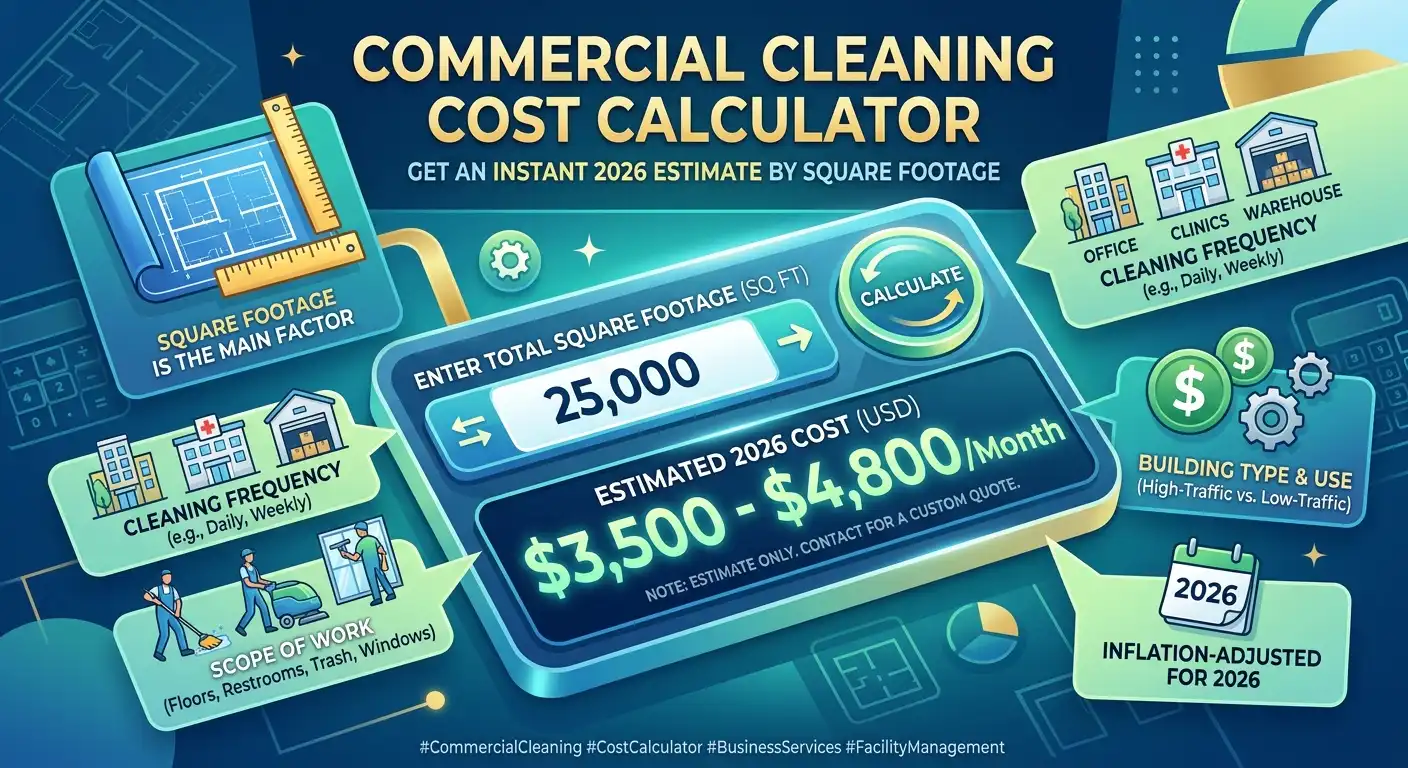
Commercial cleaning typically costs about $0.07–$0.30 per square foot for recurring service, depending on the facility type, cleaning frequency, labor market, restroom count, and services included. Use this free Commercial Cleaning Cost Calculator to estimate your expected cost by square footage and service needs.
Enter your building size, facility type, cleaning frequency, restrooms, and optional services below. The calculator provides estimated per-visit, monthly, and annual costs and shows how your estimate compares with a practical market range.
Estimate recurring commercial cleaning costs using square footage, facility type, frequency, restrooms, and add-on services.
Your estimated recurring rate falls within a typical market range.
How Much Does Commercial Cleaning Cost? (Quick Answer)
Commercial cleaning costs vary substantially by building type and service requirements. A small professional office may have a relatively straightforward recurring cleaning program, while a medical facility, restaurant, school, or industrial building can require additional labor, equipment, procedures, and documentation.
A practical planning range for recurring commercial cleaning is roughly $0.07 to $0.30 per square foot, although the actual price can fall outside this range for unusual buildings or specialized services.
For example, a 10,000-square-foot office may have a very different monthly price from a 10,000-square-foot medical facility because the second building can require more restroom attention, disinfecting, compliance procedures, and detailed cleaning specifications.
Industry pricing guides also emphasize that cleaning rates are influenced by facility type, frequency, soil level, labor, equipment, supplies, and the exact scope of work. A site walkthrough and written scope of work can therefore produce a more accurate number than square footage alone.
Commercial Cleaning Rates by Facility Type (2026)
There is no single commercial cleaning rate that works for every property. The cleaning requirements of an office are usually different from those of a medical clinic, restaurant, gym, warehouse, or school.
The following planning ranges are based on commonly published commercial cleaning benchmarks and should be treated as starting points rather than guaranteed quotes.
| Facility Type | Low Rate | Typical Rate | High Rate | Main Pricing Considerations |
|---|---|---|---|---|
| Office | $0.09/sq ft | $0.13/sq ft | $0.17/sq ft | Desk areas, kitchens, restrooms, floors and frequency |
| Medical / Dental | $0.14/sq ft | $0.21/sq ft | $0.29/sq ft | Disinfection, compliance, patient areas and higher cleaning standards |
| Retail | $0.07/sq ft | $0.11/sq ft | $0.15/sq ft | Customer traffic, glass, floors and operating hours |
| Warehouse / Industrial | $0.08/sq ft | $0.14/sq ft | $0.20/sq ft | Soil, floor area, machinery zones and safety requirements |
| School / Childcare | $0.07/sq ft | $0.105/sq ft | $0.14/sq ft | Classrooms, restrooms, high-touch areas and occupancy |
| Gym / Fitness | $0.10/sq ft | $0.16/sq ft | $0.24/sq ft | High traffic, showers, locker rooms and sanitation |
| Restaurant | $0.12/sq ft | $0.20/sq ft | $0.30/sq ft | Grease, kitchens, dining areas, restrooms and frequent service |
| Government | $0.09/sq ft | $0.15/sq ft | $0.25/sq ft | Security, documentation, specifications and facility requirements |
ISSA’s commercial cleaning pricing guidance gives published ranges for several facility categories, including offices, healthcare, industrial facilities, retail, and schools. Actual contracts can differ depending on the scope and market.
Labor is another major part of the equation. The U.S. Bureau of Labor Statistics reported a May 2025 median hourly wage of $17.71 for janitors and building cleaners, illustrating why local labor conditions can have a significant impact on commercial cleaning bids.
What Drives Your Commercial Cleaning Price?
1. Square Footage and Cleanable Area
Square footage is one of the easiest inputs to measure, but total building size does not always equal cleanable area. Mechanical rooms, storage areas, restricted spaces, production zones, and unused areas may have different cleaning requirements.
A detailed cleaning bid should identify the areas that are actually included in the scope. Two buildings with identical square footage can therefore have different prices.
2. Facility Type and Compliance Requirements
Facility type can dramatically affect labor and cleaning procedures. Healthcare environments may require more detailed disinfection procedures, while restaurants can involve grease, food-service areas, kitchens, and sanitation requirements.
Schools, gyms, and childcare facilities can also require frequent attention because of high occupancy and high-touch surfaces.
3. Cleaning Frequency
Cleaning once per week is very different from cleaning five or seven days per week. More frequent service can keep a facility in better condition, but it also increases the number of labor hours scheduled each month.
Frequency should be selected according to traffic, occupancy, building use, cleanliness expectations, and budget rather than simply choosing the cheapest schedule.
4. Restroom Count
Restrooms can require significant recurring labor because they involve fixtures, floors, mirrors, dispensers, touchpoints, waste removal, and replenishment.
A building with four restrooms may require considerably more labor than a similarly sized facility with one small restroom area.
5. Region and Local Labor Market
Cleaning prices vary by location because wages, insurance, transportation, business expenses, competition, and commercial rents differ between markets.
A quote that is reasonable in one city may be unusually low or high in another. Local proposals should therefore be compared against other quotes in the same market.
How to Calculate Your Commercial Cleaning Cost
A simple planning formula begins with the cleanable square footage and an appropriate facility rate. You can then adjust the estimate for frequency, restrooms, and additional services.
Estimated Monthly Cost = Cleanable Square Feet × Facility Rate × Frequency Adjustment + Additional Services
Suppose a 10,000-square-foot office uses a planning rate of $0.13 per square foot and requires three recurring visits per week. The annualized number of weekly visits is approximately 156 visits.
A cleaner may instead build the contract around expected monthly labor hours, supplies, overhead, and profit. This is why square-foot pricing should be viewed as a benchmark rather than a universal billing formula.
Worked Example
Imagine a 10,000-square-foot office with four restrooms, three visits per week, and no specialized add-ons. A planning estimate might place the recurring monthly service in the low-thousands depending on the local market and exact scope.
If the building also needs carpet extraction, interior windows, or floor restoration, those services should normally be priced separately or clearly identified as periodic services in the contract.
The most useful purpose of a commercial cleaning cost calculator is therefore to establish a realistic starting range before requesting actual proposals.
Pricing Models Explained: Per Sq Ft vs Hourly vs Flat Monthly vs Per Room
Commercial cleaners can price services in several ways. Understanding the pricing model helps you compare proposals that appear different on the surface.
| Pricing Model | How It Works | Best For | Potential Issue |
|---|---|---|---|
| Per Square Foot | Price is based on cleanable area. | Large recurring facilities | Can overlook unusual cleaning requirements |
| Hourly | You pay based on labor hours. | Variable or difficult-to-scope jobs | Final cost may vary with productivity |
| Flat Monthly | A fixed recurring contract price. | Stable recurring programs | Scope must be clearly defined |
| Per Room | Pricing is tied to rooms or areas. | Small specialized facilities | Large open areas can complicate comparison |
A flat monthly contract can be especially convenient when the cleaning scope is stable. However, the contract should explain exactly what is included, how often it is performed, and what happens when additional work is requested.
What’s Included in Standard Commercial Cleaning — and What Costs Extra?
Standard recurring commercial cleaning often includes routine tasks such as vacuuming, sweeping, mopping, dusting, restroom cleaning, trash removal, and cleaning common touchpoints.
Deep-cleaning and specialized services are often handled separately. These can include carpet extraction, floor restoration, window cleaning, high dusting, construction cleanup, and enhanced disinfection.
| Add-On Service | Typical Planning Range | Why It Costs Extra |
|---|---|---|
| Carpet Extraction | $0.08–$0.25/sq ft | Specialized equipment, labor and drying requirements |
| Floor Stripping / Refinishing | $0.30–$0.60/sq ft | Multiple labor-intensive restoration steps |
| Floor Scrub / Recoat | $0.20–$0.40/sq ft | Machine work and floor-care materials |
| Electrostatic Disinfection | $0.10–$0.30/sq ft | Specialized equipment and disinfecting process |
ISSA’s published commercial cleaning guidance lists these specialized-service ranges as examples and notes that actual prices depend on the building and service scope.
Commercial Cleaning Cost by US Region
Regional pricing is influenced heavily by labor costs and the local operating environment. Major metropolitan areas can have higher wages and business expenses than smaller markets, while competition can push prices in either direction.
| US Market Type | General Cost Level | Typical Pricing Pressure |
|---|---|---|
| New York / Northeast Major Metro | Higher | Higher labor, insurance and operating costs |
| California Major Metro | Higher | Labor and business operating costs |
| Seattle / Pacific Northwest Metro | Higher | Labor market and operating expenses |
| Chicago / Midwest Major Metro | Moderate–Higher | Labor, building size and commercial competition |
| Texas Major Metro | Moderate | Large commercial inventory and local competition |
| Southeast Metro Areas | Moderate | Local labor availability and building demand |
| Smaller / Rural Markets | Variable | Travel distance and limited provider availability |
These regional categories are directional rather than fixed price indexes. Your local quotes should always be compared with other providers serving the same building and geographic market.
In-House Cleaning Staff vs Outsourcing
Businesses sometimes consider hiring their own cleaning employees instead of contracting with a commercial cleaning company. The correct choice depends on building size, staffing requirements, management resources, and the desired level of control.
| Factor | In-House | Outsourced |
|---|---|---|
| Hiring | Managed internally | Handled by provider |
| Training | Employer responsibility | Usually provider responsibility |
| Supplies & Equipment | Purchased by business | Often included in contract |
| Scheduling | Internal management | Provider manages cleaners |
| Scalability | Can require additional hiring | Often easier to adjust |
| Management Time | Higher internal involvement | Lower day-to-day involvement |
BLS data illustrates that direct employee compensation is only one component of operating a cleaning program. Employers and contractors also have to account for supplies, equipment, supervision, insurance, administration, payroll-related costs, and other overhead.
How to Spot a Lowball or Unrealistic Commercial Cleaning Quote
The cheapest quote is not necessarily the best value. A quote that appears dramatically lower than competing proposals may have a smaller scope, fewer scheduled labor hours, fewer included services, or exclusions that are not obvious at first glance.
- Check whether the quoted square footage matches your actual cleanable area.
- Confirm the number of cleaning visits per week.
- Ask whether restrooms are fully included.
- Check whether supplies and consumables are included.
- Ask whether periodic floor and carpet services cost extra.
- Verify insurance and business credentials.
- Ask how quality control and inspections are handled.
- Compare the actual scope of work rather than comparing only the monthly price.
Contract Terms to Check Before You Sign
Commercial cleaning contracts should define the service in enough detail that both parties understand what is being purchased. A low monthly price is less useful if the contract allows frequent extra charges for ordinary tasks.
Scope of Work
Review every room and service category included in the scope. Look for specific language covering offices, hallways, kitchens, restrooms, entrances, trash, floors, touchpoints, and other common areas.
Cleaning Frequency
Make sure the contract clearly identifies which services occur daily, weekly, monthly, quarterly, or annually. Periodic tasks should not be left ambiguous.
Supplies and Equipment
Determine whether cleaning chemicals, liners, paper products, machines, vacuums, floor equipment, and other supplies are included. Some contracts include equipment but exclude consumables.
Price Adjustments
Check whether the company can increase the price because of labor costs, minimum wage changes, supply costs, fuel, or changes to the building. The contract should explain when and how price changes can occur.
Cancellation and Renewal
Understand the initial term, renewal process, notice period, cancellation fees, and procedures for ending the contract.
How to Get an Accurate Commercial Cleaning Quote
A calculator is useful for budgeting, but an actual quote should be based on the building and its cleaning requirements. Give each cleaning company the same information so that proposals can be compared fairly.
- Measure or confirm the cleanable square footage.
- List every room and major building area.
- Count restrooms and identify high-use facilities.
- Describe flooring types such as carpet, tile, vinyl, concrete, or hardwood.
- Specify how often routine cleaning is required.
- Identify periodic and specialized services.
- Explain building access and preferred cleaning hours.
- Request a written scope of work.
- Compare multiple local proposals.
Before selecting a provider, it can also help to check pricing for other exterior and facility services you may need. Our Pressure Washing Estimate Calculator can help you budget for exterior surface cleaning as part of your overall facility maintenance plan.
ISSA also recommends detailed scopes of work, site walkthroughs, and comparing proposals when developing a commercial cleaning program.
Related Cost Calculators
Commercial cleaning is only one part of property maintenance. These related calculators can help you estimate other cleaning and service costs.
Frequently Asked Questions
How much does commercial cleaning cost per square foot?
Commercial cleaning can commonly fall around $0.07–$0.30 per square foot for recurring service, but the appropriate rate depends on facility type, frequency, local labor costs, building condition, restrooms, and included services.
How much does it cost to clean a 10,000 square foot office?
A 10,000-square-foot office can cost from several hundred to several thousand dollars per month depending on the cleaning frequency, local market, restroom count, service scope, and whether specialized services are included. Use the calculator above for a planning estimate.
Is commercial cleaning priced hourly or by square foot?
Both models are used. Large recurring facilities are often priced using square-foot or flat monthly contracts, while hourly pricing can be useful for variable or difficult-to-scope work.
What is the cheapest commercial cleaning frequency?
Once-weekly service generally requires fewer scheduled visits than daily cleaning, so it can produce a lower monthly bill. However, the cheapest schedule is not always appropriate for high-traffic facilities.
Does square footage determine the entire cleaning price?
No. Square footage is important, but facility type, layout, soil level, restrooms, flooring, frequency, labor market, accessibility, and specialized services can all affect the final price.
Are carpet cleaning and floor waxing included in commercial cleaning?
They may be included in some contracts, but they are often treated as periodic or additional services. Always ask for these services to be listed clearly in the scope of work.
How can I compare two commercial cleaning quotes?
Compare the same square footage, cleaning frequency, rooms, restrooms, supplies, labor coverage, periodic services, insurance, quality controls, and contract terms. Comparing monthly prices alone can be misleading.
Can I use this calculator for a cleaning company bid?
Yes. Select the cleaning-company pricing option and use the result as a planning benchmark. A professional bid should still account for labor hours, payroll costs, supplies, equipment, overhead, insurance, supervision, profit, and the specific scope of work.
Get an Accurate Quote for Your Building
Use the calculator above to establish a realistic starting budget, then request written proposals from qualified commercial cleaning companies in your area.
The strongest comparison is not simply the lowest monthly price. Look for a clearly defined scope, realistic labor coverage, appropriate cleaning frequency, transparent add-on pricing, insurance, quality control, and dependable service.

Asrar Ahmad
Founder of CalculatorSuiteHub.com and Rankify SEO & AI Agency. Specializes in SEO, technical content writing, WordPress development, and AI-powered digital solutions. Builds accurate calculators and helps businesses grow online.

One Comment