Post Construction Cleaning Calculator – Free Online Calculator 2026
Post Construction Cleaning Calculator: Free 2026 Estimate
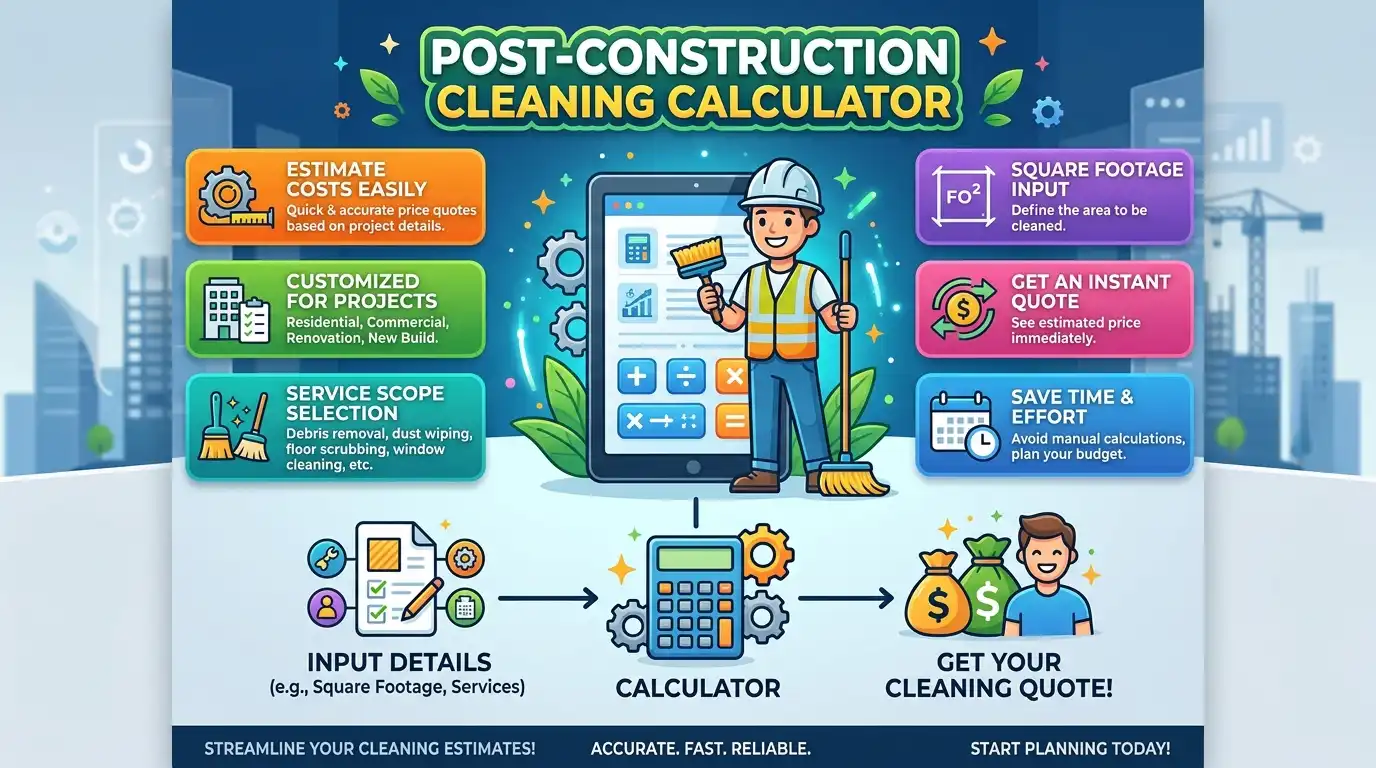
A post construction cleaning calculator helps homeowners, builders, general contractors, property managers, and cleaning companies estimate the labor and operating cost of cleaning a newly built or renovated space.
Construction cleanup differs from routine house cleaning because drywall dust, paint residue, adhesive, grout, sawdust, stickers, fine debris, and trade-generated dirt can require several passes.
Enter the cleanable square footage, cleaning phase, debris level, production rate, labor cost, and optional specialty work below to create a practical planning estimate.
The tool separates labor, supplies, overhead, profit, and add-on work so the result can be checked instead of treated as a black-box number.
Free Post Construction Cleaning Calculator
Estimate labor hours, project cost, cost per square foot, and a realistic low-to-high planning range.
How This Calculator Works
The calculator uses a labor-based estimating method rather than blindly multiplying square footage by a single published price.
That distinction matters because two 2,500-square-foot projects can require very different amounts of labor.
A lightly dusty finished space may move quickly, while a renovation with drywall residue, adhesive, high ceilings, glass, stickers, and heavy floor residue can take substantially longer.
The underlying approach is straightforward: estimate labor-hours from the cleanable area and production rate.
Then adjust those hours for the project type, cleaning phase, debris, and access conditions.
Finally, add direct operating costs and the desired profit margin.
The result can also be expressed as a cost per square foot, which is useful when preparing a contractor-facing bid.
Base Labor Hours = Cleanable Area ÷ Production Rate
Adjusted Labor Hours:
Base Labor Hours × Project Type Factor × Debris Factor × Access Factor
Labor Cost:
Adjusted Labor Hours × Loaded Labor Cost Per Worker / Hour
Operating Cost:
Labor Cost + Supplies/Equipment + Overhead + Disposal + Add-On Services
Final Selling Price:
Operating Cost ÷ (1 − Target Profit Margin)
Production rate is intentionally editable because it is one of the most important variables in a cleaning bid.
The calculator’s default values are planning examples, not a universal industry production standard.
A professional cleaning company should replace the default labor rate, production rate, supply percentage, overhead, and add-on pricing with its own historical job data.
Step-by-Step Example Calculation
Consider a 2,500-square-foot residential renovation requiring a final/detail clean.
Assume a moderate debris level, standard ceiling height, a two-person crew, and a $25 loaded labor cost per worker-hour.
Also assume a 1,000-square-foot-per-labor-hour base production rate, 10% supplies and equipment, and 20% overhead.
The example also uses a 20% target profit margin and $150 of disposal.
- Base labor hours: 2,500 ÷ 1,000 = 2.50 labor-hours.
- Difficulty adjustment: Moderate debris and selected project conditions increase required labor time.
- Labor cost: Adjusted labor-hours × $25 loaded labor rate.
- Supplies: 10% of labor cost.
- Overhead: 20% of labor cost.
- Disposal: $150 is added as a direct project expense.
- Profit: The target margin is applied to the final selling price rather than simply adding 20% to cost.
This is why the tool asks for production rate and business costs instead of pretending that one national per-square-foot number fits every project.
If your crew historically completes similar final cleans much faster or slower, changing that production rate makes the estimate more representative of your actual operation.
What Affects Your Post Construction Cleaning Cost?
Post Construction Cleaning Calculator App Inputs That Matter
A useful post construction cleaning calculator app should capture more than square footage.
Area is important, but it does not tell you whether workers are removing loose construction debris, performing a detailed final clean, scraping adhesive from floors, or removing window stickers.
It also does not show whether workers are cleaning cabinet interiors or using lifts.
Those details can directly affect labor.
The most important inputs are cleanable square footage, cleaning phase, debris level, access conditions, production rate, loaded labor cost, crew size, disposal, supplies, overhead, and specialty services.
For a cleaning company, these inputs can be updated using actual historical production data.
For a homeowner or general contractor, they provide a better framework for comparing quotes.
Cleaning Phase: Rough, Final, or Touch-Up
Rough cleaning is usually focused on removing larger debris, construction dust, packaging, and obvious site residue so other trades can continue.
Final or detail cleaning is more presentation-focused.
Surfaces, floors, fixtures, glass, cabinets, tracks, and other visible areas may need detailed attention.
Touch-up cleaning happens after remaining punch-list work and walkthrough traffic create another layer of dust and fingerprints.
If a project needs all three phases, estimating each phase separately is preferable to multiplying the entire building by one rate.
The work changes from phase to phase, and the production rate that makes sense for rough cleanup may not make sense for a final detail clean.
Debris, Dust, and Construction Residue
Debris level is one of the easiest factors to underestimate.
Fine drywall dust can settle on horizontal surfaces and inside cabinets.
Paint splatter, grout haze, adhesive, silicone, labels, and protective films may require slower detail work.
Heavy residue can also increase equipment usage and the number of passes required.
The calculator increases estimated labor when the debris setting moves from light to moderate, heavy, or very heavy.
This is a planning adjustment, not a promise that every heavy site takes exactly the same percentage longer.
A site walkthrough remains the best way to identify unusual conditions.
High Ceilings, Stairs, and Difficult Access
Accessibility changes productivity.
Workers may need ladders, extension poles, lifts, additional setup time, or extra movement between floors.
High ceilings also make dusting and fixture cleaning slower than equivalent work performed at normal residential ceiling height.
Multiple floors can create another hidden cost.
Workers spend time moving equipment, supplies, bags, vacuums, and waste between levels.
If elevator access is unavailable or the site has long travel paths, the real labor requirement can exceed what a simple square-foot calculation suggests.
Windows, Glass, Stickers, and Adhesive Removal
Windows often deserve separate attention because sticker removal, paint overspray, construction labels, tracks, frames, and exterior glass can require detail tools and additional labor.
A building with ordinary interior cleaning needs can become much more labor-intensive when every window needs residue removal.
The calculator treats window and glass detailing as an add-on rather than hiding it inside the base square-foot rate.
That makes the estimate easier to explain to a builder or property owner.
It also reduces the chance of forgetting a labor-intensive task during bidding.
Floor Residue and Specialty Floor Work
Newly completed floors may contain grout haze, adhesive, paint, drywall compound, protective-film residue, or other construction material.
Basic vacuuming and mopping should not automatically be treated as floor restoration, stripping, waxing, or specialized surface treatment.
If the scope includes actual floor restoration, chemical treatment, machine scrubbing, sealing, or refinishing, obtain a specialist price.
Do not assume that ordinary post-construction cleaning covers that work.
The calculator’s floor-detail add-on is intended only as a budgeting allowance.
For projects involving wood floors, you can also review the Hardwood Floor Refinishing Cost Calculator for a separate cost-planning reference.
Labor Rate and Local Market Conditions
Labor is normally one of the largest components of a professional cleaning quote.
A company’s true labor cost can include wages, payroll taxes, workers’ compensation, benefits, paid nonproductive time, supervision, and other burden.
For that reason, the calculator asks for a loaded hourly labor cost instead of assuming that the worker’s wage equals the company’s cost.
Local market conditions also matter.
Urban areas with higher operating costs, difficult parking, travel time, or specialized commercial requirements can produce higher bids than a similar building in a lower-cost market.
Seasonal demand, project deadlines, and after-hours access can also influence the final quote.
Post Construction Cleaning Rates Per Square Foot
Per-square-foot pricing is useful because builders and property owners can compare bids quickly.
However, it should normally be the output of an underlying labor estimate rather than the only input.
A rate that looks attractive may be unprofitable if it ignores high-detail areas, debris removal, access problems, specialty cleaning, or the number of required passes.
A better workflow is to calculate expected labor-hours first, price direct costs, add overhead, and then apply the desired margin.
Once that number is known, divide the selling price by the cleanable square footage to obtain the implied price per square foot.
Post Construction Cleaning Cost Range Table
| Cleaning Phase | Typical Scope | Planning Rate Range* | Best Used For |
|---|---|---|---|
| Rough Clean | Large debris, sweeping, initial dust removal | $0.10–$0.30/sq. ft. | Between construction trades |
| Final / Detail Clean | Detailed dusting, floors, fixtures, glass, cabinets | $0.30–$0.75/sq. ft. | Pre-handover or move-in |
| Touch-Up | Post-punch-list dust, fingerprints and spot cleaning | $0.10–$0.20/sq. ft. | Final walkthrough preparation |
| Multiple Phases | Rough + final + touch-up | $0.45–$1.10+/sq. ft. | Projects requiring staged cleaning |
*These are broad planning benchmarks, not guaranteed local prices.
Actual bids should be derived from the project’s scope, labor productivity, local labor cost, disposal requirements, access, specialty work, and required finish level.
Medical, industrial, high-rise, occupied, or unusually contaminated environments may require specialized pricing and procedures.
How to Get a More Accurate Post Construction Cleaning Estimate
- Measure the actual cleanable area rather than using the entire construction project’s gross square footage.
- Identify whether the project requires rough cleaning, final cleaning, touch-up cleaning, or multiple phases.
- Walk the site after major trades are substantially complete so the dust and debris condition is visible.
- Count or estimate windows, glass, cabinets, fixtures, bathrooms, stairs, and other labor-intensive areas.
- Determine whether construction debris removal is included or handled by the general contractor.
- Use your company’s historical production rate for comparable jobs whenever possible.
- Calculate labor, supplies, equipment, overhead, disposal, and profit separately.
- Write exclusions clearly so specialty restoration, hazardous materials, damage repair, and unrelated contractor work do not become accidental cleaning obligations.
Common Post Construction Cleaning Pricing Mistakes
The biggest mistake is using a single square-foot rate without checking the scope.
A 3,000-square-foot empty new build and a 3,000-square-foot occupied renovation can have completely different labor requirements.
Another common error is forgetting the time needed for setup, equipment movement, waste handling, inspection, and a second pass after dust settles.
Cleaning companies should also avoid confusing markup with margin.
Adding 20% to cost does not create a 20% profit margin on the final selling price.
The calculator uses the margin formula selling price = operating cost ÷ (1 − margin).
This keeps the requested margin mathematically consistent.
Finally, do not include hazardous-material remediation in an ordinary cleaning estimate.
If a site presents a potential hazardous-material issue, stop and follow the appropriate professional, regulatory, and site-safety requirements before proceeding.
Frequently Asked Questions
How much does post construction cleaning cost per square foot?
Post construction cleaning can vary widely by phase and site conditions.
Broad planning ranges are often around $0.10–$0.30 per square foot for rough cleaning, $0.30–$0.75 for final/detail cleaning, and $0.10–$0.20 for touch-ups.
High ceilings, heavy dust, extensive glass, residue removal, rush schedules, and specialty work can push the effective rate higher.
How does a post construction cleaning calculator estimate labor?
The calculator starts with cleanable square footage divided by a production rate to estimate base labor-hours.
It then adjusts those hours for project type, debris level, and access conditions.
Labor cost is calculated from the adjusted hours and loaded labor rate, after which supplies, overhead, disposal, specialty services, and the target profit margin are included.
What should be included in a post construction cleaning quote?
A professional quote should identify the cleaning phase, cleanable area, surfaces included, number of passes, windows, cabinets, fixtures, floors, debris handling, equipment, labor, and any specialty services.
It should also state exclusions such as hazardous-material remediation, damage repair, major debris hauling, restoration, or work outside the agreed cleaning scope.
Is a free post construction cleaning calculator accurate enough for a contractor bid?
A free post construction cleaning calculator is useful for preliminary budgeting and bid preparation.
However, it should not replace a site walkthrough.
Accuracy improves significantly when you use your actual production rate, loaded labor cost, local disposal charges, access conditions, and historical productivity from similar projects.
What is the difference between rough cleaning and final cleaning?
Rough cleaning focuses on larger debris and initial construction dust so the site can continue progressing.
Final cleaning is more detailed and is usually performed close to handover or occupancy.
It can include detailed dust removal, floors, glass, fixtures, cabinets, tracks, and visible residue.
Touch-up cleaning is performed later after punch-list work or walkthrough traffic creates additional dirt.
Can I use this post construction cleaning calculator app for commercial buildings?
Yes. The calculator can be used for residential renovations, offices, retail spaces, restaurants, and other commercial projects.
Commercial jobs should be adjusted for access, occupied areas, after-hours scheduling, high ceilings, glass, elevators, security requirements, and the project’s required finish level.
Larger facilities may also need separate phase-by-phase production estimates.
Should construction debris removal be included in cleaning costs?
It depends on the contract.
Some builders provide dumpsters and expect cleaners to move only small cleaning-related waste, while other projects require the cleaning company to handle hauling.
Disposal should be priced as a separate line item whenever possible because dumpster access, weight, local disposal fees, and haul distance can change the cost substantially.
Why is my post construction cleaning estimate higher than a normal house cleaning?
Construction cleaning requires specialized labor because workers may be removing fine dust, paint splatter, adhesive, grout residue, protective film, construction debris, and material residue from many surfaces.
It can also involve multiple passes, ladders, HEPA equipment, detailed glass work, floor residue removal, and tight contractor deadlines.
Those requirements make it fundamentally different from routine maintenance cleaning.
Related Calculators
Those historical numbers can become more useful than generic national pricing when you calibrate your own cleaning calculator.

Asrar Ahmad
Founder of CalculatorSuiteHub.com and Rankify SEO & AI Agency. Specializes in SEO, technical content writing, WordPress development, and AI-powered digital solutions. Builds accurate calculators and helps businesses grow online.