Spray Foam Insulation Cost Calculator: 2026 Estimate
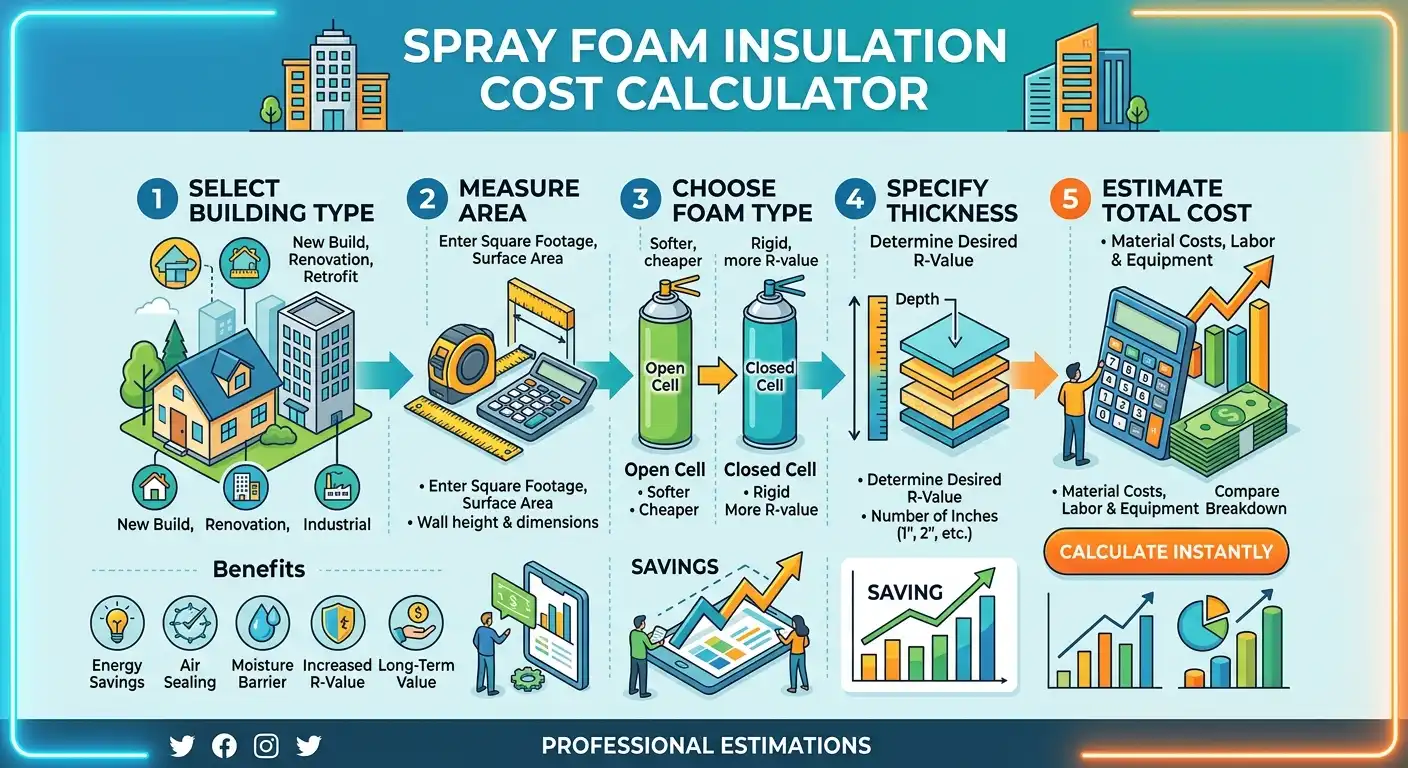
Spray Foam Insulation Cost Calculator
Estimate your spray foam project using area, foam type, thickness, application, existing insulation, access, regional labor conditions, and realistic installation allowances. The calculator converts surface area and foam depth into board feet, then builds a low, typical, and high planning estimate.
Calculate Your Spray Foam Insulation Cost
Enter your project details below. The calculator uses board-foot pricing because spray foam quantity depends on both surface area and installed thickness.
A spray foam insulation cost calculator helps homeowners, builders, remodelers, and property investors turn an insulation area and foam thickness into a practical project budget. Instead of looking only at dollars per square foot, this calculator uses the industry concept of a board foot: one square foot of coverage at one inch of thickness. That distinction matters because doubling the foam depth doubles the foam volume required. The calculator also accounts for foam type, preparation, access, existing insulation, waste, and regional labor conditions so the estimate is more useful than a simple square-foot multiplier.
How This Spray Foam Insulation Cost Calculator Works
The calculation begins with the physical quantity of foam required. Spray foam is commonly estimated in board feet rather than treating every square foot as the same job. A 1,000-square-foot surface sprayed to 1 inch requires approximately 1,000 board feet, while the same surface sprayed to 5 inches requires about 5,000 board feet before accounting for waste and application losses.
Foam Material Cost = Board Feet × Material Price per Board Foot
Labor Cost = Board Feet × Labor Price per Board Foot
Total Estimate = Material + Labor + Preparation + Removal + Ventilation/Cleanup
The calculator uses planning ranges rather than pretending there is one universal contractor price. Open-cell and closed-cell foam have different densities, expansion characteristics, R-values, and typical pricing. The calculator therefore changes the underlying allowance when you switch foam type.
For thermal performance, the model uses approximately R-3.6 per inch for open-cell foam and approximately R-6.5 to R-7 per inch for closed-cell foam as practical planning values. Actual products vary, so the product’s technical data sheet should control the final R-value specification.
The U.S. Department of Energy explains that open-cell spray polyurethane foam has a lower R-value per inch and is more vapor permeable, while closed-cell foam has higher R-value per inch and greater resistance to vapor and liquid water. Those properties can affect where each foam type is appropriate. U.S. Department of Energy insulation guidance
Step-by-Step Example Calculation
Suppose a homeowner has a 1,500-square-foot attic roof deck and wants 5.5 inches of open-cell spray foam. Assume a 10% application allowance for overspray and yield variation.
- Base board feet = 1,500 × 5.5 = 8,250 board feet.
- Waste-adjusted board feet = 8,250 × 1.10 = 9,075 board feet.
- The calculator applies an open-cell material allowance to those board feet.
- Installation labor is estimated separately rather than hidden inside one rate.
- Preparation, masking, ventilation/cleanup, and any selected removal allowance are then added.
- The final result is presented as low, most likely, and high planning values.
This approach is particularly useful when comparing contractor quotes. If one quote appears much higher, you can ask whether the difference comes from foam thickness, product type, removal, difficult access, fire protection, roof preparation, or a different labor market instead of assuming the contractor simply has a higher markup.
What Affects Your Spray Foam Insulation Cost?
Spray Foam Calculator Inputs That Matter Most
The most important inputs are surface area and foam thickness. A quote for 1,000 square feet at 2 inches is not comparable with a quote for 1,000 square feet at 5.5 inches. The physical volume of foam changes dramatically as depth increases. Measure the actual surface receiving foam rather than using the home’s conditioned floor area unless the two measurements are genuinely the same.
Open-Cell vs. Closed-Cell Foam
Open-cell foam generally costs less per board foot and provides good air sealing when installed at the required thickness. Its lower density also means a lower R-value per inch. Closed-cell foam costs more but provides substantially more R-value per inch and is much less vapor permeable. It can be valuable where space is limited or moisture control is an important part of the assembly.
Choosing based only on price can therefore be misleading. A thinner layer of closed-cell foam may achieve a similar thermal target to a much thicker layer of open-cell foam. However, the correct choice depends on the wall or roof assembly, climate, vapor-control requirements, building code, and the specific product.
Spray Foam Cost Calculator and Board-Foot Pricing
Board-foot pricing is one of the biggest concepts homeowners miss when comparing spray foam estimates. One board foot equals one square foot at one inch thick. Therefore, 2,000 square feet at 3 inches equals 6,000 board feet before waste. A contractor quoting $1.50 per board foot is therefore not charging $1.50 for the entire square foot; the thickness has to be included in the calculation.
Spray Foam Roofing Calculator Considerations
A spray foam roofing calculator needs additional caution because roof work is not identical to interior insulation. Roof area, slope, penetrations, existing roof condition, drainage, substrate repairs, foam thickness, and protective topcoat requirements can all affect the installed price. Spray polyurethane roofing commonly includes a protective elastomeric coating over the foam, and that coating should be priced separately when a contractor’s proposal does so.
For roofing projects, do not use the calculator’s insulation estimate as a complete roof replacement quotation. Water damage, deck repairs, flashing, drains, penetrations, primers, walkway pads, coating thickness, warranty requirements, and mobilization can materially change the final project.
Existing Insulation Removal
Removing fiberglass, cellulose, damaged foam, or contaminated insulation can turn a straightforward installation into a larger renovation. Disposal costs, labor, containment, cleaning, and repairs may be added before new foam is installed. If the existing insulation can safely remain and the assembly allows it, keeping it may reduce project cost, but the contractor must verify the assembly first.
Access, Masking, and Preparation
A large open attic is usually easier to spray than a cramped crawlspace or a finished room that needs extensive protection. Cabinets, HVAC equipment, wiring, windows, stored belongings, recessed fixtures, and mechanical systems can increase masking and preparation time. High ceilings can also require additional equipment and slower application.
Regional Labor and Seasonal Factors
Labor rates differ considerably between regions. High-cost metropolitan areas may have significantly higher contractor rates than smaller markets. Scheduling can also influence a quote when crews are busy or when weather limits exterior work. For roof applications, temperature, humidity, substrate moisture, and weather conditions can affect whether spraying can proceed safely and correctly.
Spray Foam Insulation Cost Range by Type and Application
| Project / Foam Type | Typical Planning Range | Main Cost Drivers |
|---|---|---|
| Open-cell insulation | About $0.50–$1.50 per board foot installed | Thickness, labor, access, preparation |
| Closed-cell insulation | About $1.50–$3.50 per board foot installed | Density, thickness, substrate, labor |
| Attic spray foam | Often several dollars per sq ft installed | Roofline vs. attic floor, depth, masking, ventilation |
| Wall cavities | Varies with cavity depth and access | Framing depth, existing finishes, drilling/removal |
| Spray foam roofing | Often about $3.50–$7+ per sq ft for complete systems | Foam, topcoat, roof condition, penetrations, repairs |
These are broad U.S. planning ranges rather than guaranteed market prices. Published 2026 cost references show considerable variation because different sources include different levels of labor, preparation, coating, removal, and contractor overhead. Use the calculator to establish a reasonable budget, then compare at least two or three detailed written proposals.
Common Spray Foam Insulation Cost Mistakes
- Using floor area instead of actual spray area: attic roof decks, sloped ceilings, and wall surfaces may have substantially different areas.
- Ignoring thickness: board feet increase directly with foam depth.
- Comparing open-cell and closed-cell by square-foot price alone: their R-values and moisture properties are different.
- Forgetting preparation: masking, cleaning, substrate repairs, removal, and ventilation can add meaningful labor.
- Assuming the calculator is a bid: a contractor must evaluate actual site conditions and product specifications.
- Ignoring minimum charges: small projects can have a much higher effective price per square foot because a spray crew still has mobilization and setup costs.
Frequently Asked Questions About Spray Foam Insulation Cost
How much does spray foam insulation cost per square foot?
Installed pricing varies primarily with foam type and thickness. Open-cell foam is generally less expensive than closed-cell foam. Published 2026 estimates often place complete installed spray foam projects in a broad range of roughly $2.50 to $8 or more per square foot, while specific applications such as attic and roofing systems can fall outside that range.
How do you calculate spray foam board feet?
Multiply the spray area in square feet by the foam thickness in inches. For example, 1,000 square feet sprayed at 3 inches requires 3,000 board feet before waste. Add a reasonable allowance for overspray and application losses when creating a purchasing or budgeting estimate.
Is open-cell or closed-cell spray foam cheaper?
Open-cell spray foam is normally cheaper per board foot. Closed-cell foam costs more because it is denser and provides higher R-value per inch. The cheaper material is not automatically the lower-cost solution for the whole assembly, because the required thickness and moisture-control requirements may differ.
How accurate is a spray foam cost calculator?
A calculator is useful for budgeting but cannot replace an on-site quote. Actual costs depend on local labor, product yield, access, substrate condition, removal, preparation, code requirements, minimum charges, and contractor workload. For a major project, compare two or three written proposals using the same scope.
Does thicker spray foam always cost more?
Generally yes, because board feet increase as thickness increases. A 2-inch application uses twice as much foam volume as a 1-inch application over the same area. However, the final price per square foot can change because contractors may price labor, mobilization, setup, and larger projects differently.
Can I use this as a spray foam roofing calculator?
You can use the tool for an initial roofing insulation budget, especially when estimating roof area, foam depth, and project complexity. A complete spray foam roofing proposal needs additional items such as roof preparation, substrate repairs, primers, protective topcoat, penetrations, drainage work, walk pads, warranties, and manufacturer requirements.
Does removing old insulation increase spray foam costs?
Yes. Removal can add labor, disposal, containment, cleaning, and sometimes substrate repair. The increase depends on the existing material, its condition, accessibility, and local disposal rates. Select the removal option in the calculator when you are replacing old insulation rather than spraying onto a clean, prepared surface.
What R-value does spray foam provide per inch?
A practical planning figure for open-cell foam is around R-3.6 per inch, while closed-cell foam commonly provides roughly R-6 to R-7 per inch depending on the specific product. Always use the manufacturer’s tested aged R-value when a project has a code or performance specification.
Related Calculators

Asrar Ahmad
Founder of CalculatorSuiteHub.com and Rankify SEO & AI Agency. Specializes in SEO, technical content writing, WordPress development, and AI-powered digital solutions. Builds accurate calculators and helps businesses grow online.
Similar Posts
Post Construction Cleaning Calculator – Free Online Calculator 2026
Post Construction Cleaning Calculator: Free 2026 Estimate By Asrar Ahmad · CalculatorSuiteHub.com A post construction cleaning calculator helps homeowners, builders, general contractors, property managers, and cleaning companies estimate the labor and operating cost of cleaning a newly built or renovated space. Construction cleanup differs from routine house cleaning because drywall dust, paint residue, adhesive, grout,…
Residential Construction Cost Per Square Foot by Zip Code Calculator
Home Improvement & Construction Cost Residential Construction Cost Per Square Foot by ZIP Code Calculator Planning a new home build starts with a realistic construction budget. This residential construction cost per square foot by zip code calculator helps homeowners, builders and property investors estimate construction costs. It uses ZIP code, finished square footage, quality level…
Mini Split Sizing Calculator – Free Online Calculator 2026
Mini Split Sizing Calculator: Find the Right BTU Size Choosing a ductless heat pump that is too small can leave a room struggling on extreme days. An oversized system can also reduce humidity control and efficiency. This mini split sizing calculator gives homeowners, landlords and installers a practical starting estimate. Enter the room area, ceiling…
The Ultimate Age Difference Calculator 2026: Exact Gap in Years, Months & Days
CalculatorSuiteHub → Math & Science → Age Difference Calculator Math & Science · Free Calculator Age Difference Calculator: Find the Exact Age Gap Calculate the precise difference between two birth dates in years, months, days, total days and weeks, and instantly see who is older. Age Difference Calculator Enter two dates of birth for an…
Hydrant Flow Test Calculator – Free Online Calculator 2026
“`html Fire Protection & Water Supply Hydrant Flow Test Calculator: Fast Fire Flow Estimate A hydrant flow test calculator helps fire protection professionals, water-system planners, inspectors, engineers, and facility managers estimate water flow from field pressure readings. Enter static pressure, residual pressure, pitot pressure, outlet diameter, and discharge coefficient to calculate flow in gallons per…
Pipe Friction Loss Calculator: Free 2026 Tool + Fire Hose
Pipe Friction Loss Calculator: Water Pipe & Fire Hose By Asrar Ahmad · CalculatorSuiteHub.com This pipe friction loss calculator helps estimate pressure loss when water moves through a pressurized pipe or fire hose. It is useful for plumbing, irrigation, water distribution, pump sizing, hydraulic checks, and fireground hose calculations. The tool calculates straight-pipe friction, velocity,…






One Comment