Septic Tank Size Calculator: Find the Right Tank Capacity
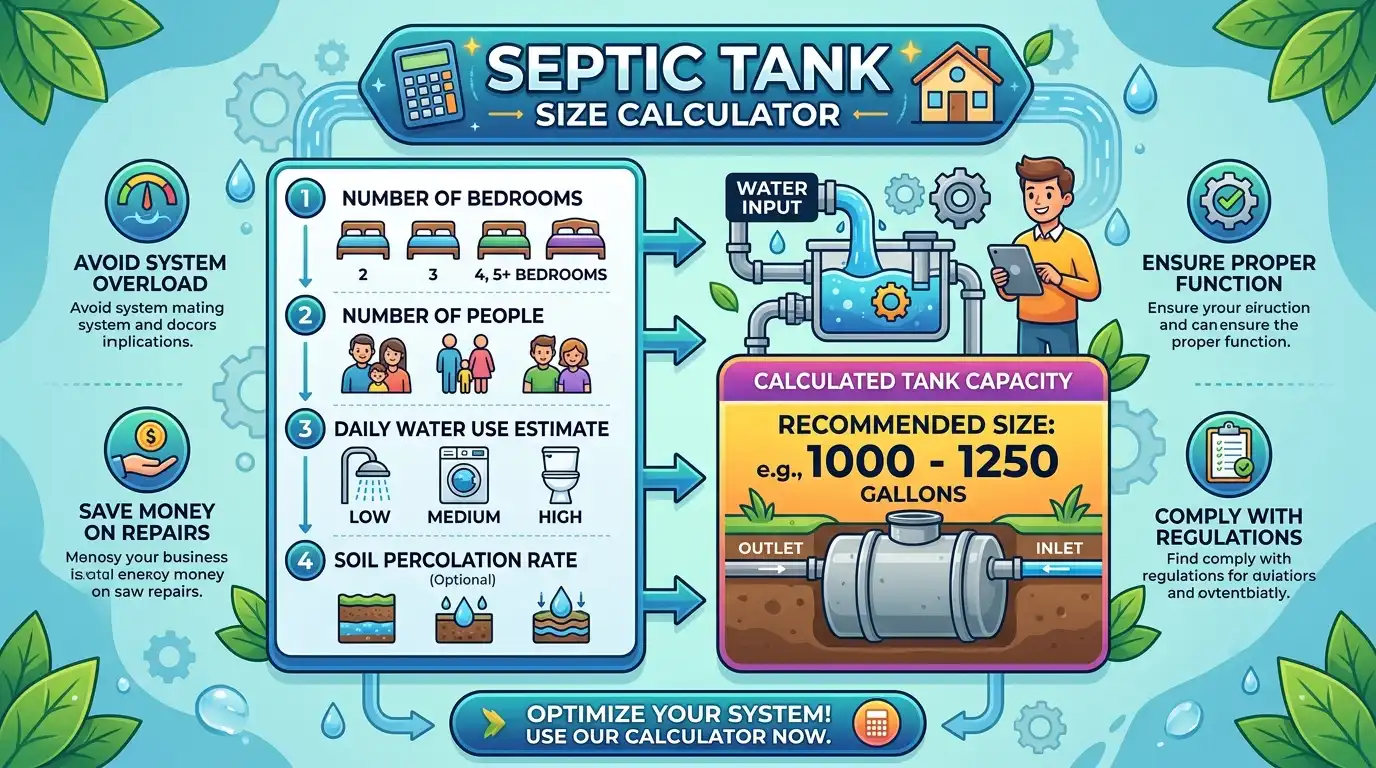
A septic tank size calculator helps homeowners estimate the liquid capacity needed for a residential septic system before buying a tank or planning an installation. The estimate can be useful when you know the number of bedrooms, household occupants, expected wastewater flow, and local minimum tank requirement.
Septic sizing is not simply a matter of choosing the largest tank available. Bedroom count, design flow, retention time, local regulations, garbage disposals, and site conditions can all affect the final design. Published requirements also vary by jurisdiction, so a calculator should be treated as a planning tool rather than a permit decision.
This calculator gives results in US gallons and liters. It also checks the bedroom-based capacity against a flow-and-retention calculation, then rounds the result to a practical standard tank size.
gal
Table of Contents
ToggleHow This Septic Tank Size Calculator Works
The calculator uses two main sizing checks. First, it applies a bedroom-based planning capacity. Second, it calculates a flow-based volume from expected daily wastewater and the selected retention period.
The governing value is the largest of the applicable bedroom basis, local minimum, and flow-based requirement. A garbage disposal adjustment is then applied when selected because higher solids loading can require additional capacity under some local rules.
Formula for Tank Capacity
Daily wastewater flow = occupants × wastewater per person per day.
Flow-based tank volume = daily wastewater flow × retention hours ÷ 24.
Planning capacity = maximum of bedroom basis, local minimum, and flow-based volume.
The calculator then rounds the result upward to a common nominal tank size. This is useful because manufacturers normally sell tanks in standard capacities rather than every possible gallon value.
Technical reference: EPA technical guidance shows that septic tank capacity has historically been related to bedroom count and daily sewage flow, while state requirements can differ substantially. EPA’s current homeowner guidance also stresses regular inspection, pumping, and local requirements.
Step-by-Step Example Calculation
Consider a three-bedroom house with four occupants. Assume the planning wastewater rate is 75 gallons per person per day.
Daily flow is 4 × 75, which equals 300 gallons per day. With a 48-hour retention target, the flow-based volume is 300 × 48 ÷ 24, or 600 gallons.
Now compare that result with a 1,000-gallon local minimum and a 1,000-gallon bedroom planning basis. The governing planning capacity becomes 1,000 gallons.
That result is also approximately 3,785 liters. A 1,000-gallon tank is therefore a sensible starting point for this example, subject to the actual local code and approved system design.
What Affects Your Septic Tank Size?
Septic Tank Capacity Per Person
Household population matters because more occupants generally produce more wastewater. A simple planning calculation is occupants multiplied by daily wastewater generation per person.
However, tank capacity is not normally determined only by today’s occupants. Bedroom count is often used because a septic system is expected to serve the home’s potential occupancy over its service life.
Septic Tank Size Calculator in Feet
Tank capacity in gallons does not uniquely determine its physical dimensions. Two tanks can have the same liquid capacity while using different length, width, and liquid-depth combinations.
For a rectangular tank, the basic volume relationship is length × width × liquid depth. Convert cubic feet to US gallons using approximately 7.48052 gallons per cubic foot.
Do not use excavation depth as liquid depth. Freeboard, tank walls, inlet and outlet structures, and compartment arrangements affect the usable liquid volume.
Septic Tank Size Calculator in Liters
One US gallon equals approximately 3.78541 liters. Therefore, a 1,000-gallon septic tank has a nominal volume of about 3,785 liters.
A 1,500-gallon septic tank is approximately 5,678 liters. Metric capacity is useful when comparing imported tanks, international specifications, or engineering drawings that use liters and cubic meters.
Standard Septic Tank Size for 3 Bedroom House
A three-bedroom home is commonly associated with a 900- to 1,500-gallon range in published requirements and historical technical references. A 1,000-gallon tank is a common planning figure in many residential applications.
The exact requirement is not universal. Some jurisdictions require 1,050, 1,200, 1,250, 1,500 gallons, or another capacity depending on local rules and system conditions.
Standard Septic Tank Size for 4 Bedroom House
Four-bedroom homes often move beyond the basic 1,000-gallon planning level. Published standards have included 1,000 to 2,000 gallons across different jurisdictions, with 1,200, 1,250, and 1,500 gallons appearing in various sizing approaches.
If your local requirement is 1,250 gallons, choosing a 1,000-gallon tank would not satisfy that rule even if the household’s actual daily water use is low. Always enter the local minimum in the calculator when you know it.
1000 Gallon Septic Tank
A 1,000-gallon septic tank is a common residential capacity. It can be suitable for some three-bedroom homes and smaller systems, but the correct size depends on the applicable code and design conditions.
The important figure is the rated liquid capacity, not the tank’s outside dimensions. Manufacturer drawings should be checked before assuming that a particular length, width, and depth combination equals 1,000 gallons.
1500 Gallon Septic Tank
A 1,500-gallon septic tank provides substantially more nominal liquid capacity than a 1,000-gallon tank. It may be specified for larger homes, higher design flows, or jurisdictions with more conservative minimums.
A bigger tank does not automatically solve an undersized drainfield. The soil, percolation characteristics, groundwater conditions, and hydraulic loading of the absorption area must be evaluated separately.
Standard Size of Septic Tank for Residential Properties
There is no single nationwide residential septic tank size. EPA technical material documents different historical minimums and state ranges, while current state codes can impose their own bedroom and flow requirements.
For example, Washington’s current rule specifies 1,000 gallons for a single-family residence with up to four bedrooms, while Virginia uses a different bedroom-based table. These differences show why local verification is essential.
Bedrooms vs. Occupants
Bedrooms and occupants answer different sizing questions. Bedrooms help establish potential residential demand, while occupants are useful for estimating actual wastewater flow.
A four-bedroom house with two residents can have lower current flow than a four-bedroom house with six residents. The system still needs to satisfy the applicable design standard for the property.
Garbage Disposals and High Solids Loading
Garbage disposals can increase the amount of solids entering the septic tank. Some jurisdictions specifically require additional capacity or other design measures when a disposal is installed.
If your property has a disposal, select “Yes” in the calculator and then verify the adjustment against your local septic rules. Do not assume the calculator’s planning adjustment replaces a permit requirement.
Retention Time
Retention time describes how long wastewater is intended to remain in the tank before leaving for further treatment. Longer retention can increase the calculated flow-based volume.
Local rules may use 24 hours, 48 hours, or another design basis. This calculator lets you change the value so you can match the preliminary calculation to the requirement provided by your designer or permitting authority.
Drainfield and Soil Conditions
Tank size is only one part of an onsite wastewater system. The drainfield must be able to accept the design wastewater load without excessive hydraulic stress.
Soil texture, permeability, seasonal groundwater, available land area, slope, and setbacks can affect the final system. A larger septic tank cannot compensate for an unsuitable or undersized absorption field.
Septic Tank Size Comparison Table
| Home Size | Common Planning Capacity | Approx. Liters | Important Check |
|---|---|---|---|
| 1–2 bedrooms | 750–1,000 gal | 2,839–3,785 L | Local minimum |
| 3 bedrooms | 1,000–1,250 gal | 3,785–4,732 L | State/county rule |
| 4 bedrooms | 1,200–1,500 gal | 4,542–5,678 L | Design flow and local code |
| 5 bedrooms | 1,500–2,000 gal | 5,678–7,571 L | Flow and bedroom requirement |
| 6+ bedrooms | 1,750–2,500+ gal | 6,624–9,464+ L | Site-specific design |
These ranges are planning references, not a universal code table. The EPA has documented historical ranges from state requirements, and current jurisdictions can use different minimums. Use the local requirement field in the calculator whenever an official value is available.
Frequently Asked Questions
What size septic tank do I need for a 3 bedroom house?
A 1,000-gallon tank is a common planning figure for a three-bedroom home, but local requirements vary. Published standards have used capacities from about 900 gallons upward for three bedrooms. Enter your local minimum in the calculator for a more accurate preliminary result.
What size septic tank do I need for a 4 bedroom house?
A four-bedroom home may require around 1,200, 1,250, 1,500 gallons, or another locally specified capacity. The correct value depends on the jurisdiction, design flow, system type, and other site factors. Do not assume that a 1,000-gallon tank is sufficient.
Is a 1000 gallon septic tank enough for a family?
A 1,000-gallon tank can be appropriate for some residential systems, especially smaller homes. It is not determined by family size alone. Bedroom count, local minimum capacity, wastewater flow, and site-specific design requirements should all be checked before selecting the tank.
When would I need a 1500 gallon septic tank?
A 1,500-gallon septic tank may be required for a larger home, higher design flow, or a jurisdiction with a higher minimum capacity. It can also be selected when the approved design calls for additional liquid volume. Your local permitting authority or septic designer should confirm the final capacity.
How do I calculate septic tank capacity in liters?
Multiply the nominal US gallon capacity by 3.78541. For example, 1,000 gallons is about 3,785 liters, while 1,500 gallons is about 5,678 liters. For physical dimensions, use the internal liquid dimensions rather than the outside tank measurements.
Can I calculate septic tank size from the number of people?
Occupants can be used to estimate daily wastewater flow, but they should not automatically replace bedroom-based or local code requirements. A practical preliminary calculation is occupants × gallons per person per day, followed by the applicable retention or capacity rule.
Does a bigger septic tank mean a bigger drainfield?
Not necessarily. Tank capacity and drainfield area are related parts of the same wastewater system, but they are not interchangeable. Drainfield sizing depends heavily on design flow, soil characteristics, hydraulic loading, groundwater, and local regulations.
How often should a residential septic tank be pumped?
The EPA says household septic tanks are typically pumped every three to five years, although actual timing depends on tank size, household size, wastewater generation, solids accumulation, and system type. Regular inspections can identify sludge and scum levels before they create problems.
Related Calculators
CalculatorSuiteHub.com provides planning estimates for informational purposes. Final septic system design should be based on the requirements of the applicable permitting authority and qualified wastewater professional.

Asrar Ahmad
Founder of CalculatorSuiteHub.com and Rankify SEO & AI Agency. Specializes in SEO, technical content writing, WordPress development, and AI-powered digital solutions. Builds accurate calculators and helps businesses grow online.