The Ultimate AP Physics 2 Score: Calculator 2026 Free
AP Physics 2 Score Calculator
Estimate your AP Physics 2 result from your multiple-choice and free-response performance.
The 2026 exam has 40 multiple-choice questions worth 50% and four free-response questions worth 50%.
The calculator produces a 0–100 composite estimate and an estimated AP score from 1 to 5.
Calculate Your AP Physics 2 Score
2026 FormatEnter the number of multiple-choice questions you got correct and your estimated points on each FRQ.
The calculator scales both sections to 50 points and combines them into a 100-point composite.
How This AP Physics 2 Score Calculator Works
The current AP Physics 2: Algebra-Based exam has two equally weighted sections.
Section I contains 40 multiple-choice questions and accounts for 50% of the exam score.
Section II contains four free-response questions and also accounts for 50%.
The four FRQs have maximum scores of 10, 12, 10, and 8 points, for 40 raw points.
Because both sections contribute half of the exam, this calculator converts each section to 50 points.
The scaled values are added to create a 0–100 composite.
The composite is then mapped to an estimated AP score from 1 through 5 using a planning conversion.
FRQ scaled score = (FRQ points ÷ 40) × 50
Composite score = MCQ scaled score + FRQ scaled score
For example, 28 of 40 correct MCQs gives 35 composite points.
If you earn 28 of 40 FRQ points, the free-response section adds another 35 points.
Your estimated composite is therefore 70/100.
This calculation reflects the official section weighting.
The final translation to the AP 1–5 scale is different.
College Board uses evidence-based standard setting rather than one permanent raw-score curve for every year.
What each input means
- Multiple-choice correct: Enter the number of questions answered correctly out of 40. Incorrect answers do not subtract points from your raw MCQ score.
- FRQ 1: Mathematical routines, maximum 10 points.
- FRQ 2: Translation between representations, maximum 12 points.
- FRQ 3: Experimental design and analysis, maximum 10 points.
- FRQ 4: Qualitative/quantitative translation, maximum 8 points.
The calculator accepts individual FRQ scores instead of only one total.
This shows where your composite points come from and helps identify a weak free-response skill.
For official exam structure and current administration information, see College Board’s AP Physics 2 exam information. For the official explanation of AP score setting, see AP Physics C Grade Calculator.
Step-by-Step Example Calculation
Suppose you answered 28 of 40 multiple-choice questions correctly. Your estimated FRQ scores are 7/10, 8/12, 7/10, and 6/8.
Step 1: Calculate the MCQ contribution
Your multiple-choice performance therefore contributes 35 points to the 100-point composite.
Step 2: Add the FRQ points
Step 3: Scale the FRQ section
Step 4: Calculate the composite
A 70 composite falls into the calculator’s estimated 5 band. However, 70 is not an official College Board cutoff.
Use this estimate as a practical practice-test benchmark.
The individual breakdown is also useful.
In this example, the student is earning 35/50 from multiple choice and 35/50 from free response, so neither section is disproportionately dragging down the composite.
What Affects Your AP Physics 2 Score
AP Physics 2 Calculator Inputs and the MCQ Section
The multiple-choice portion represents half of the exam.
With 40 questions, each correct answer becomes 1.25 composite points after scaling to 50.
Moving from 24 to 28 correct answers therefore adds 5 composite points.
An additional correct answer does not guarantee a one-step increase in the final AP score.
The AP 1–5 result comes from the complete scoring process, not a fixed percentage-to-grade conversion.
Use the calculator to compare practice-test performances rather than treating one prediction as guaranteed.
AP Physics 2 Calculator and Free-Response Performance
Free-response performance deserves separate attention because points come from specific response elements.
Depending on the question, diagrams, equations, reasoning, experimental design, representations, and explanations can all contribute points.
The four current FRQ types test different skills. Mathematical routines emphasize quantitative pathways.
Translation between representations connects mathematical, graphical, diagrammatic, or verbal descriptions.
Experimental design and analysis focuses on investigations.
Qualitative/quantitative translation connects physical reasoning with quantitative relationships.
Physics 2 Score Calculator: Thermodynamics
Thermodynamics is one of the seven current AP Physics 2 units.
Practice should include thermal energy transfer, ideal gases, the first law of thermodynamics, kinetic theory, and entropy.
Weak explanations can cost FRQ points.
AP Physics 2 Calculator: Electric Force, Field, and Potential
Electric force, electric fields, electric potential, capacitors, charging processes, and electric potential energy are major course topics.
When reviewing mistakes, separate algebra errors from conceptual errors. Confusing electric potential with electric field requires conceptual review.
AP Physics 2 Calculator: Electric Circuits
Circuits connect current, resistance, voltage, power, and conservation rules.
Practice should include simple and compound DC circuits plus RC behavior.
For FRQs, focus on explaining the physical relationship rather than only presenting a number.
AP Physics 2 Calculator: Magnetism, Optics, Waves, and Modern Physics
Magnetism and electromagnetism, geometric optics, waves and sound, physical optics, and modern physics make up the remaining units.
Diagrams and representations can be especially important. If results vary, track performance by topic instead of only by total score.
Why the Year Matters
AP exam structures can change. The 2026 AP Physics 2 exam uses 40 multiple-choice questions in 80 minutes.
It also has four free-response questions in 100 minutes.
College Board has announced further changes beginning with May 2027, so always use information for your exam year.
The official AP Physics 2 course page currently lists seven course units.
They are Thermodynamics; Electric Force, Field, and Potential; Electric Circuits; Magnetism and Electromagnetism; Geometric Optics; Waves, Sound, and Physical Optics; and Modern Physics.
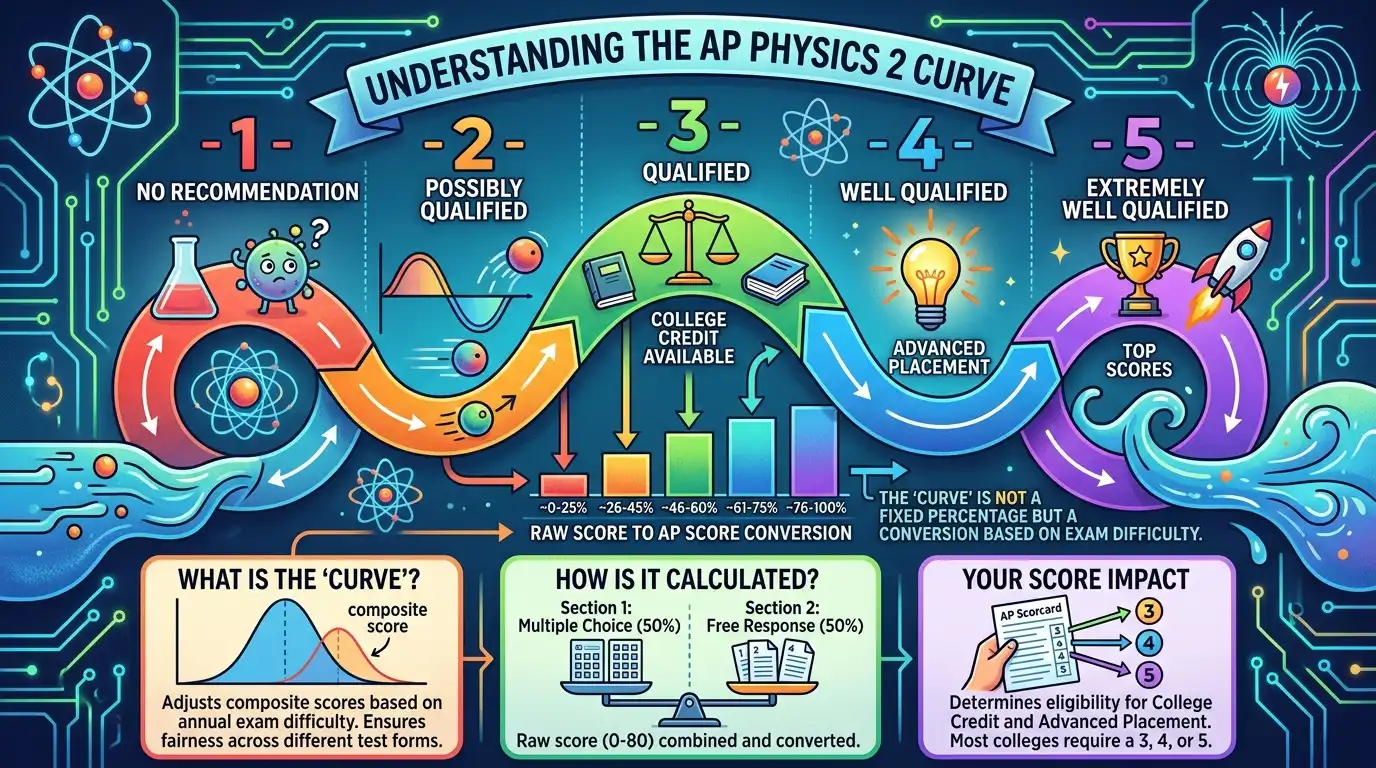
AP Physics 2 Score Range Table
The following table is a planning scale used by this calculator, not an official College Board raw-score conversion table. It helps interpret practice-test results, but AP score standards can change by administration.
| Estimated AP Score | Composite Range | Interpretation |
|---|---|---|
| 5 | 70–100 | Strong estimated performance |
| 4 | 54–69 | Very strong estimated performance |
| 3 | 40–53 | Estimated qualified range |
| 2 | 25–39 | Estimated below-qualified range |
| 1 | 0–24 | Estimated lowest performance band |
College Board’s published 2026 AP Physics 2 distribution shows 20% earning a 5, 29% a 4, 23% a 3, 21% a 2, and 7% a 1.
This provides context but is not the raw-score conversion used by this calculator.
You can review the to compare your eventual result with recent student performance.
Frequently Asked Questions
How is AP Physics 2 scored?
The current 2026 exam has 40 multiple-choice questions worth 50% and four free-response questions worth 50%.
The FRQs total 40 possible points.
This calculator scales both sections to 50 points each, producing a 0–100 composite before estimating the AP score from 1 to 5.
How many questions are on AP Physics 2?
For the 2026 AP Physics 2 exam, Section I contains 40 multiple-choice questions.
Section II contains four free-response questions.
The MCQ section is 80 minutes and the FRQ section is 100 minutes, for three hours of total testing time.
What is the AP Physics 2 calculator formula?
The calculator converts your MCQ result using correct answers divided by 40, multiplied by 50.
It converts your FRQ total using points divided by 40, multiplied by 50. Adding both values gives the 0–100 composite.
The 1–5 result is then an estimated planning conversion.
Can I use a calculator on AP Physics 2?
Yes. College Board permits calculators on AP Physics 2.
Students also receive the applicable reference information.
Always follow the current College Board calculator policy for your specific exam administration.
Is a 3 a good AP Physics 2 score?
A 3 is classified by College Board as “qualified,” but college credit depends on the institution and program.
Some colleges award credit for a 3, while others require a 4 or 5 or do not award AP Physics 2 credit. Check the college’s current AP credit policy.
Does AP Physics 2 still have 50 multiple-choice questions?
No. Older AP Physics 2 score calculators may use outdated exam structures.
The 2026 exam has 40 multiple-choice questions in 80 minutes.
Further format changes begin with the May 2027 administration, so calculators should be updated by exam year.
What are the four AP Physics 2 FRQ types?
The current exam includes Mathematical Routines, Translation Between Representations, Experimental Design and Analysis, and Qualitative/Quantitative Translation.
Their maximum raw scores are 10, 12, 10, and 8 points respectively, for 40 total FRQ points.
How accurate is an AP Physics 2 score calculator?
The section-weighting calculation follows the stated 50/50 exam structure when your estimated raw scores are correct.
The AP 1–5 prediction is less certain because College Board does not publish one permanent raw-score cutoff for every future exam.
Use the result as a practice benchmark rather than a guaranteed official score.
Related Calculators

Asrar Ahmad
Founder of CalculatorSuiteHub.com and Rankify SEO & AI Agency. Specializes in SEO, technical content writing, WordPress development, and AI-powered digital solutions. Builds accurate calculators and helps businesses grow online.