AP Chemistry Score Calculator | Free AP Chem Predictor 2026
AP Chemistry Score Calculator
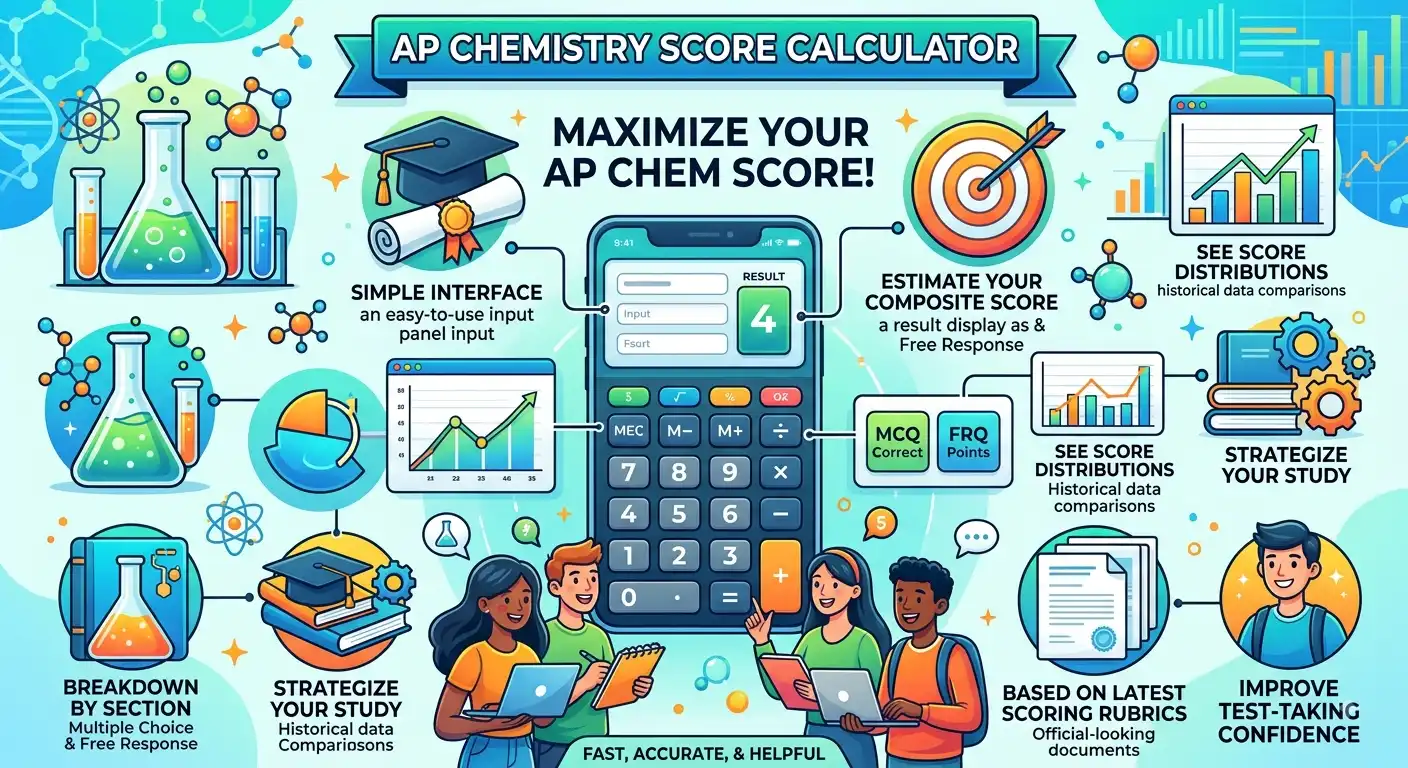
If you just finished a timed AP Chem practice test and want more than a vague “you’ll probably get a 4,” this AP Chemistry Score Calculator converts your raw multiple-choice and free-response points into a projected 1–5 AP score using the College Board’s real 100-point composite structure. Most tools billed as an ap chem test calculator only ask for one lump FRQ total — this ap chemistry exam calculator instead lets you enter all three long FRQs and all four short FRQs separately, so you can see exactly which question type on the real AP Chem exam calculator format is costing you the most points before test day.
Formula source: College Board AP Chemistry Course & Exam Description and released 2022–2025 student score distributions.
How This AP Chem Score Calculator Works — Formula & Explanation
Unlike AP Calculus, AP Chemistry doesn’t use a flat point-per-question multiplier — both sections are scaled to a common 50-point maximum before being added together. Here’s the exact ap chem exam scoring weights logic this ap chemistry calculator applies:
Step 1 — Scale the MCQ section: Section I has 60 multiple-choice questions with no guessing penalty. Your raw correct count out of 60 is scaled to a 50-point maximum: MCQ scaled = (correct ÷ 60) × 50.
Step 2 — Scale the FRQ section: Section II has 7 free-response questions — 3 “long” questions worth 10 points each (30 points) and 4 “short” questions worth 4 points each (16 points), for 46 raw points total. That raw total is also scaled to 50 points: FRQ scaled = (raw FRQ points ÷ 46) × 50.
Step 3 — Add for the composite: Composite Score = MCQ scaled + FRQ scaled, for a maximum of 100 points — this is the number most ap chem score calc tools display before mapping it to a final grade.
Step 4 — Map to a 1–5 score: The composite is compared against that year’s cutoffs. Because exact cutoffs are never published in advance, this and every other ap chemistry exam score calculator relies on historical ranges — we show a Low–Most Likely–High spread rather than pretending to certainty.
Step-by-Step Example Calculation
Priya takes a full-length AP Chemistry practice exam. She answers 42 of 60 MCQs correctly and scores 8, 7, and 6 on her three long FRQs, plus 3, 3, 2, and 3 on her four short FRQs.
MCQ scaled: (42 ÷ 60) × 50 = 35.0 points.
FRQ raw total: 8 + 7 + 6 + 3 + 3 + 2 + 3 = 32 points out of 46.
FRQ scaled: (32 ÷ 46) × 50 = 34.8 points.
Composite score: 35.0 + 34.8 = 69.8, rounded to 70 out of 100.
Using the table below, a composite of 70 falls in the 58–71 range, predicting a 4. Priya’s
third long FRQ (equilibrium calculations) and her third short FRQ (particulate diagrams) were her weakest —
exactly the topics worth another focused practice session before the real AP Chem exam.
What Affects Your AP Chemistry Score
Long FRQs vs. Short FRQs: Where the Points Really Are
Because each long FRQ is worth 10 raw points versus 4 for a short FRQ, the three long questions alone control nearly two-thirds of the FRQ section (30 of 46 points). Any ap chem test score calculator that only asks for one combined FRQ number hides this — a student who nails the four short questions but blanks on long FRQ 3 (commonly equilibrium or thermodynamics) loses far more ground than the raw “1 question missed” suggests.
Is There a Wrong-Answer Penalty?
No. Like every current AP exam, AP Chemistry MCQs are scored purely on correct answers — wrong and blank responses both earn zero points, so there’s no strategic reason to leave a question blank. This trips up students used to older SAT-style negative-marking rules.
Calculator Use and Data-Table Questions
A scientific or graphing calculator is permitted on the entire AP Chemistry exam (both sections), along with a periodic table, equation sheet, and constants table — unlike AP Calculus, which restricts calculator use to only part of each section. Many MCQs and FRQs are built around experimental data tables or titration curves, so practicing data interpretation matters as much as memorizing formulas when you use any ap chem calc tool to predict your range.
Common FRQ Mistakes That Cost Points
Graders consistently deduct for missing units on numerical answers, skipping significant-figure rules, and failing to justify particulate-level diagrams with a written explanation. On equilibrium and acid-base FRQs, forgetting to show the ICE table setup even when the final number is correct routinely costs 1–2 points per question — fixable in a single focused review session.
Why AP Chem 2023 Score Calculator Estimates Differ From This Year’s
Students searching for an “ap chem 2023 score calculator” or “ap chem score calculator 2023” are often trying to compare an older curve to the current one — but composite cutoffs shift by roughly 2–4 points most years as the College Board re-equates difficulty, so a 2023-specific tool can be a few points off for this year’s exam. This calculator uses the most recent multi-year averaged ranges instead of freezing on a single past year.
AP Chemistry Composite Score Cutoff Table
| AP Score | Composite Range (/100) | Approx. % Needed | Meaning |
|---|---|---|---|
| 5 | 72 – 100 | ~72% | Extremely well qualified |
| 4 | 58 – 71 | ~58–71% | Well qualified |
| 3 | 42 – 57 | ~42–57% | Qualified (typical passing score) |
| 2 | 25 – 41 | ~25–41% | Possibly qualified |
| 1 | 0 – 24 | below 25% | No recommendation |
Ranges are estimates averaged from 2022–2025 released College Board score distributions; the College Board does not pre-publish official cutoffs.
Frequently Asked Questions
What is a good AP Chemistry score?
A 3 or higher is considered passing and earns credit at many colleges, though selective schools often want a 4 or 5. About 78% of students scored a 3 or higher in 2025, with roughly 17% earning the top score of 5, according to College Board data.
How does this AP chem score calc work?
It scales your MCQ correct count (out of 60) and FRQ raw points (out of 46) each to 50 points, adds them for a composite out of 100, then compares that composite to historical cutoff ranges to predict your 1–5 AP Chemistry score.
Is there a wrong-answer penalty on AP Chemistry MCQs?
No. Wrong and blank MCQ answers both score zero — there is no deduction for guessing, so it’s always in your interest to answer every question on this or any ap chemistry exam calculator scenario you’re testing.
Are long FRQs worth more than short FRQs?
Yes. Each of the three long free-response questions is worth up to 10 raw points, while each of the four short questions is worth up to 4 points. The three long FRQs alone make up 30 of the 46 total raw FRQ points, so they carry the most individual weight in Section II.
What composite score do I need for a 5?
Roughly 72 or higher out of 100 typically predicts a 5, which usually means around 45–50 correct MCQs (75–83%) combined with 32–38 FRQ points (70–83%). You generally need strong performance in both sections — one section can’t fully compensate for a weak other.
Can I use a calculator on the AP Chemistry exam?
Yes — a scientific or graphing calculator is allowed throughout the entire exam, along with a provided periodic table, equation sheet, and constants table. This differs from AP Calculus, which limits calculator use to specific sections only.
Why do ap chem score calculator 2023 results differ from this year?
Composite cutoffs typically shift 2–4 points year to year as the College Board re-equates exam difficulty, so a calculator frozen on 2023 data can be noticeably off. This tool uses multi-year averaged ranges instead of a single past year’s cutoffs.
Does this ap chemistry score calculator give my official score?
No calculator can — only the College Board issues official AP scores, released each July through your College Board account. This tool is meant to help you interpret practice exam results and prioritize study time before test day.
Related Calculators
Further reading: College Board — AP Chemistry Course Details · AP Central — AP Chemistry Exam Format & Rubrics · AP Central — How AP Exams Are Scored

Asrar Ahmad
Founder of CalculatorSuiteHub.com and Rankify SEO & AI Agency. Specializes in SEO, technical content writing, WordPress development, and AI-powered digital solutions. Builds accurate calculators and helps businesses grow online.