AP Calculus General Score Calculator | Free AB & BC Tool
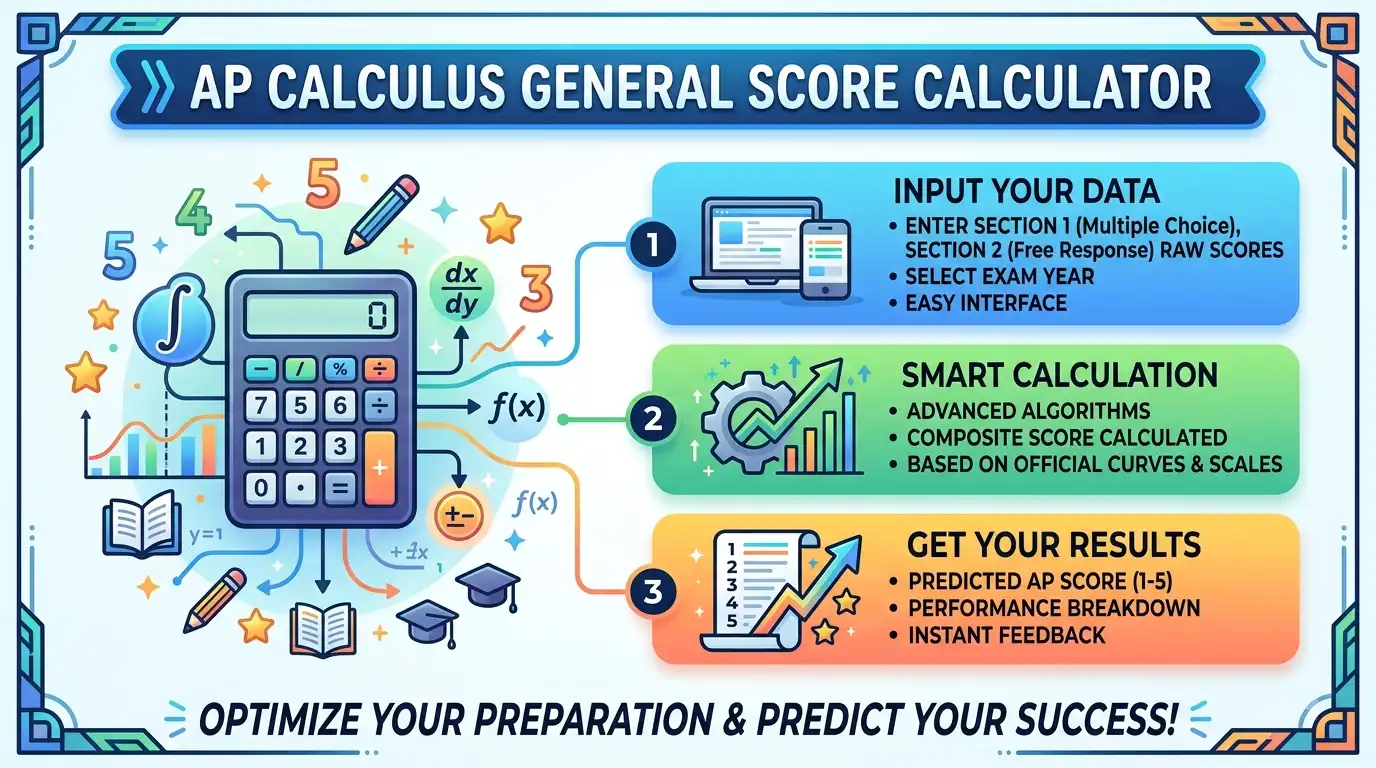
AP Calculus General Score Calculator
If you just finished an AP Calculus AB or BC practice exam and want a realistic prediction instead of a guess, this AP Calculus General Score Calculator converts your raw multiple-choice and free-response points into a projected 1–5 AP score using the same 108-point composite structure the College Board uses on the real exam. Unlike most ap calc score calculator tools that only ask for an MCQ total and one average FRQ number, this one lets you enter each of your six free-response scores individually — because a 6/9 on the Related Rates FRQ and a 6/9 on the Series FRQ (BC) tell very different stories about where you’re losing points.
Formula source: College Board AP Calculus AB/BC Course & Exam Description and released 2022–2025 student score distributions.
How This AP Calculus Score Calculator Works — Formula & Explanation
Both AP Calculus AB and BC use the identical two-section, 108-point composite structure, then apply a different score curve because the BC student population skews stronger. The math behind this ap calc score calculator breaks down like this:
Step 1 — Scale the MCQ section: Section I has 45 multiple-choice questions with no penalty for guessing. Each correct answer is worth 1.2 scaled points, so the section maxes out at 45 × 1.2 = 54 points — exactly half of the 108-point composite.
Step 2 — Total the FRQ section: Section II has 6 free-response questions, each hand-graded on a 0–9 point rubric that rewards correct setup, process, and final answers (partial credit counts heavily). The six raw scores are simply added together for a maximum of 54 points — the other half of the composite.
Step 3 — Build the composite: Composite Score = (MCQ Correct × 1.2) + Sum of 6 FRQ Scores, for a maximum possible composite of 108.
Step 4 — Map to a 1–5 score: The College Board converts the composite to a final AP score using cutoffs it sets fresh each year. Because AB and BC test different populations, the same composite lands on a different final score depending on which exam you took — this calculator applies each exam’s own curve.
Step-by-Step Example Calculation
Marcus takes a full AP Calculus AB practice exam. He answers 34 of 45 MCQs correctly and scores 7, 6, 6, 5, 4, and 5 on his six FRQs.
MCQ scaled score: 34 × 1.2 = 40.8 points.
FRQ total: 7 + 6 + 6 + 5 + 4 + 5 = 33 points.
Composite score: 40.8 + 33 = 73.8, rounded to 74 out of 108.
Using the AB score table below, a composite of 74 falls in the 59–76 range, predicting a 4.
Marcus’s FRQ 5 and FRQ 6 (his no-calculator integration questions) are his weakest scores, so that’s where an
extra 90 minutes of focused practice would move the needle most before the real exam.
What Affects Your AP Calculus Score
AB vs. BC: Why the Cutoffs Are So Different
Students consistently ask why a 60/108 composite predicts a 3 on AP Calculus AB but a 4 on AP Calculus BC. The exams share the same point structure, but BC’s cutoffs sit lower because BC self-selects for students who have already succeeded in a faster-paced, more advanced course. The College Board’s annual standard-setting process accounts for this population difference rather than grading BC “easier” — the content is harder, the curve is simply calibrated to a stronger cohort.
The AB Subscore on the BC Exam
Every BC test-taker also receives a separate AB subscore, generated from performance on the AB-aligned portion of the same exam. Colleges that don’t grant BC credit will sometimes still accept the AB subscore for one semester of calculus placement, so it’s worth checking your target school’s policy even if your overall BC score comes in lower than you hoped.
Calculator vs. No-Calculator Sections
Both the MCQ and FRQ sections split into calculator-allowed and no-calculator parts. FRQs 1–2 permit a graphing calculator (numerical/analytical problems like rates and accumulation); FRQs 3–6 do not, and instead test symbolic manipulation — derivatives, antiderivatives, and justification writing. Students who lean on a calculator for the whole course often lose the most points here, since no-calculator FRQs are graded on exact, hand-worked reasoning.
Common Free-Response Mistakes That Cost Points
Graders consistently dock points for three habits: skipping units on a final numerical answer, failing to justify a maximum/minimum with a first- or second-derivative test, and rounding intermediate steps too early (the rubric expects three decimal places minimum until the final answer). Fixing just these three habits typically recovers 3–5 raw FRQ points across a full exam.
Why AP Calc Score Calculator Estimates Vary by Year
No composite-to-score table is official or fixed — the College Board resets cutoffs annually based on that year’s exam difficulty so a 5 means the same thing across different test dates. Any ap calc score calculator, including this one, is working from historical ranges, which is why we show a Low–Most Likely–High spread instead of a single guaranteed number.
AP Calculus Composite Score Cutoff Table (AB vs. BC)
| AP Score | AB Composite Range | BC Composite Range | Meaning |
|---|---|---|---|
| 5 | 77 – 108 | 61 – 108 | Extremely well qualified |
| 4 | 59 – 76 | 46 – 60 | Well qualified |
| 3 | 43 – 58 | 33 – 45 | Qualified (typical passing score) |
| 2 | 27 – 42 | 20 – 32 | Possibly qualified |
| 1 | 0 – 26 | 0 – 19 | No recommendation |
Ranges are estimates averaged from 2022–2025 released College Board score distributions; the College Board does not pre-publish official cutoffs.
Frequently Asked Questions
What is a good AP Calculus score?
A 3 or higher is considered passing and is what most colleges require for credit or placement. A 4 or 5 signals strong mastery and is preferred by more selective schools. Roughly 64% of AB students and over 80% of BC students score a 3 or above in recent years, according to College Board score distribution reports.
How is the AP Calculus composite score calculated?
Composite Score = (MCQ correct × 1.2) + total FRQ points. MCQ contributes up to 54 points and FRQ contributes up to 54 points, for a 108-point maximum. This AP Calculus General Score Calculator applies that exact formula before mapping your composite to a 1–5 score.
Do wrong answers hurt my AP Calculus MCQ score?
No. There is no guessing penalty on either the AB or BC exam — wrong and blank answers both score zero, so every question is worth answering. This is different from older SAT-style exams that once deducted points for incorrect guesses.
What’s the difference between AB and BC score cutoffs?
BC cutoffs sit noticeably lower on the same 108-point scale — roughly 61 points earns a 5 on BC versus about 77 on AB — because the BC test-taking population is more self-selected and academically stronger, not because the BC exam covers easier material.
What is the AB subscore on the BC exam?
Every AP Calculus BC student automatically receives a second 1–5 score based only on AB-level topics (limits, derivatives, basic integrals) covered within the BC exam. Some colleges use this subscore to grant Calculus I credit even when the full BC score falls short of their cutoff.
How many FRQ points do I need for a 5?
There’s no fixed number since cutoffs shift yearly, but historically averaging roughly 6–7 out of 9 on each of the six FRQs, combined with a strong MCQ score (33+/45), lands comfortably in 5 territory on AB; BC students can score a 5 with a somewhat lower FRQ average due to the more generous curve.
Are AP Calculus score cutoffs the same every year?
No. The College Board runs a standard-setting process after each exam administration and adjusts composite cutoffs based on that year’s overall difficulty, so a 74 composite might predict a 4 one year and sit closer to the 5 boundary another year. Use this calculator’s range as a planning guide, not a guarantee.
Does this calculator give my official AP score?
No calculator can, including this one — only the College Board issues official scores, released each July through your College Board account. This tool exists to help you interpret practice exam results and prioritize study time before the real test.
Related Calculators
Further reading: College Board — AP Calculus AB Course Details · College Board — AP Calculus BC Course Details · AP Central — How AP Exams Are Scored

Asrar Ahmad
Founder of CalculatorSuiteHub.com and Rankify SEO & AI Agency. Specializes in SEO, technical content writing, WordPress development, and AI-powered digital solutions. Builds accurate calculators and helps businesses grow online.