AP Calculus AB Score Calculator (2026) | Free & Instant
AP Calculus AB Score Calculator
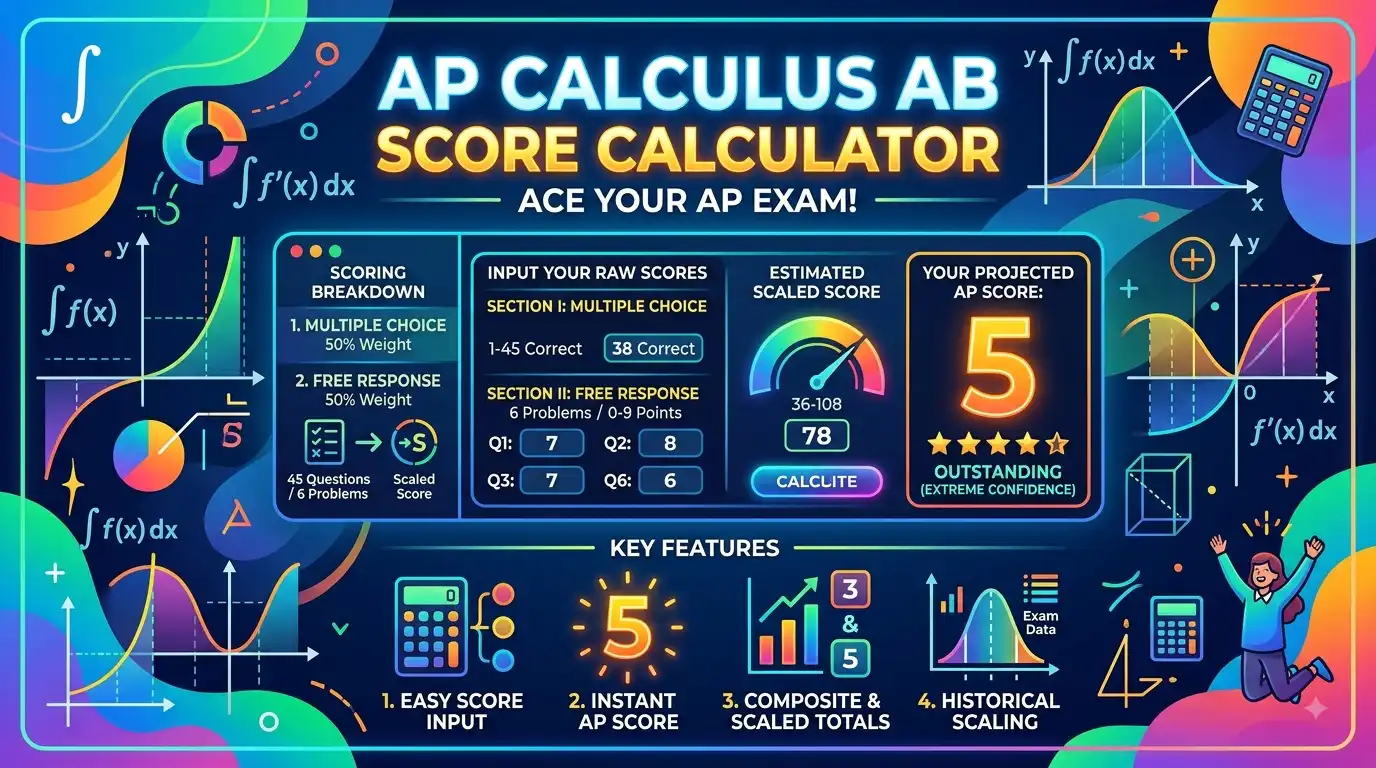
If you just finished a practice exam or the real thing, the AP Calculus AB Score Calculator below turns your raw multiple-choice and free-response points into a predicted 1–5 AP score in seconds. Because College Board blends two very differently-scaled sections into one composite, doing this by hand is easy to get wrong — a single mis-added FRQ point can shift your predicted score by a full band. Enter your numbers and get an instant, weighted breakdown instead of guessing.
Enter Your Raw Scores
Works for both AP Calculus AB and AP Calculus BC — select your exam below.
How This Calculator Works — The Real AP Calculus Scoring Formula
Every AP Calculus AB score calculator (this one included) is built on the same three-step process College Board itself uses before applying its annual curve:
- Scale the multiple-choice section. Your raw MCQ score (correct out of 45) is multiplied
by 1.2, converting it to a 54-point scale:
MCQ Scaled = Correct × 1.2. - Total the free-response section. Each of the 6 FRQs is worth up to 9 rubric points, so
your raw FRQ total already sits on a 54-point scale — no multiplier needed:
FRQ Total = Q1+Q2+Q3+Q4+Q5+Q6. - Add both sections for your composite.
Composite = MCQ Scaled + FRQ Total, producing a score out of 108, weighted exactly 50/50 between the two sections.
Your composite is then mapped to the familiar 1–5 AP score using cutoffs that move slightly every year. College Board doesn’t release a single permanent table — instead it uses a process called Evidence-Based Standard Setting (EBSS), comparing your composite against historical performance data so a “5” represents the same skill level whether you tested this May or three years ago. Based on released 2022–2025 data, the approximate bands are:
| Composite Score (0–108) | AP Score | Meaning |
|---|---|---|
| 68–108 | 5 | Extremely well qualified |
| 54–67 | 4 | Well qualified |
| 42–53 | 3 | Qualified (most colleges accept for credit) |
| 30–41 | 2 | Possibly qualified |
| 0–29 | 1 | No recommendation |
Step-by-Step Example Calculation
MCQ Scaled = 34 × 1.2 = 40.8
FRQ Total = 7+6+8+5+7+6 = 39
Composite = 40.8 + 39 = 79.8 → 80
A composite of 80 falls in the 68–108 band, so this student is projected to earn a 5 — comfortably above the roughly 68-point threshold, meaning several missed MCQs or a couple of weak FRQ parts still wouldn’t have dropped them to a 4.
What Affects Your AP Calc AB Score Calculator Result
Because the AB exam blends a machine-scored section with a human-graded one, small habits move your composite more than most students expect.
AP Calc Exam Score Calculator: Why MCQ Guessing Never Hurts
There is no wrong-answer penalty on the multiple-choice section, so an unanswered question and an incorrect one cost you the same 1.2 scaled points. Any AP calc exam score calculator that models a penalty is using outdated logic — fill in every bubble, even on questions you skip entirely.
Calc AB Score Calculator: Partial Credit on FRQs Adds Up Fast
Unlike MCQs, free-response points are earned piece by piece against a published rubric — a correct derivative setup can earn 2–3 points even if your final numeric answer is wrong. Students who “show work” on every part of every FRQ routinely gain 6–10 composite points over students who leave blanks after getting stuck, which is often the gap between a 3 and a 4.
Calc Ab Score Calc: Calculator-Active vs. No-Calculator Parts
Both sections split into calculator-permitted and no-calculator portions. Students who practice
exclusively with a graphing calculator often lose easy points on the no-calculator MCQ Part B and FRQ
Part B, where the exam expects exact values (like π/3) instead of decimal approximations —
a decimal answer where an exact form is required can cost you the point even if the number is technically correct.
Ap Calc Ab Calculator: Free-Response Time Management
Section II gives 90 minutes for 6 FRQs — roughly 15 minutes each, but Part A (calculator-active, 2 questions) genuinely needs a bit more time than Part B (no calculator, 4 questions) for most students. Running out of time on Question 6 after over-spending on Question 2 is one of the most common ways a composite lands 5–8 points lower than a student’s true ability.
Ap Calc Bc Score Calculator and Ap Calc Bc Calculator Differences
The AP Calculus BC exam uses the identical 108-point structure (45 MCQs × 1.2, plus 54 FRQ points) but covers more content — parametric/polar functions, series, and Euler’s method — and is graded on a more generous curve, since BC students are typically stronger overall. A calc bc score calculator also reports a separate AB Subscore, calculated only from the AB-aligned questions embedded in the BC exam, so a student can earn AB credit even with a modest full BC score. Toggle “AP Calculus BC” above to see BC-specific cutoffs.
Ap Calculus Bc Score Calculator: The AB Subscore Explained
Roughly 60% of BC exam questions are AB-level material. College Board scores these separately to produce the AB Subscore (also 1–5), reported alongside your main BC score on your official score report — useful if your target college accepts AB credit but you’re unsure about full BC readiness.
AP Calculus AB Score Ranges by Percentile (2025 National Data)
| AP Score | % of Students (2025) | Composite Range |
|---|---|---|
| 5 | ~22.5% | 68–108 |
| 4 | ~26.7% | 54–67 |
| 3 | ~15.0% | 42–53 |
| 2 | ~17.8% | 30–41 |
| 1 | ~18.0% | 0–29 |
In 2025, roughly 64% of AP Calculus AB students scored a 3 or higher — the threshold most colleges use for credit consideration, though highly selective schools frequently require a 4 or 5.
Frequently Asked Questions
What is a good AP Calculus AB score?
A 4 or 5 is considered strong and is accepted for college credit or placement at most universities. A 3 is “qualified” and still earns credit at many state schools, but selective private colleges often require a 4+. A 1 or 2 typically earns no credit anywhere.
Does an AP Calc AB score calculator match my real score exactly?
Not exactly — College Board recalibrates cutoffs annually through equating, so any calc ab score calculator (including this one) uses historical 2022–2025 ranges as an estimate. Expect your prediction to be accurate within about ±1 AP score point.
Is there a guessing penalty on AP Calculus multiple choice?
No. AP Calc AB and BC use rights-only scoring — you earn points only for correct answers, with zero deduction for wrong ones. Always fill in every MCQ bubble, even as a guess.
How many FRQ points do I need for a 5?
There’s no fixed FRQ-only threshold since MCQ and FRQ combine into one composite, but scoring around 40+ of 54 FRQ points while getting roughly 34+/45 MCQs correct typically lands a composite above 68 — a 5.
What’s the difference between the calc ab score calc and a calc bc score calculator?
Both use the same 108-point, 50/50 MCQ-FRQ structure, but BC content is more advanced and its score distribution skews higher — in 2025, 44% of BC test-takers earned a 5 versus about 22.5% on AB.
Can I get college credit with an AP Calculus AB score of 3?
Often yes. Many public universities award credit or placement starting at a 3, but competitive programs (engineering, pre-med tracks) and Ivy-League-tier schools frequently set the bar at 4 or 5 — always confirm against your specific college’s AP credit policy page.
Why did my ap calc ab score calculator prediction change between practice tests?
Composite-to-score cutoffs shift a few points year to year based on national difficulty. A composite of 66 might predict a 4 using one year’s curve and sit right at the 5 threshold using another — treat predictions near a boundary as “on the edge” rather than certain.
Does skipping a free-response question hurt more than a wrong MCQ?
Yes, proportionally. A blank FRQ forfeits up to 9 raw points (worth roughly the same as 7–8 missed MCQs), while showing partial work — even an unfinished derivative or integral setup — can still bank 1–3 points per question.
Related Calculators
Sources: College Board — How AP Scores Are Calculated, AP Calculus AB/BC Course & Exam Description (AP Central), National Center for Education Statistics.

Asrar Ahmad
Founder of CalculatorSuiteHub.com and Rankify SEO & AI Agency. Specializes in SEO, technical content writing, WordPress development, and AI-powered digital solutions. Builds accurate calculators and helps businesses grow online.