AP Chemistry Exam Score Calculator 2026
AP Chemistry Exam Score Calculator
This AP Chemistry exam score calculator converts your raw multiple-choice and free-response points into a predicted 1–5 AP score — and, unlike most ap chem score calculator tools online, it also shows exactly how many composite points you’re earning (and losing) in each individual section, so you know where to focus your remaining study time before test day.
Calculate My AP Chemistry Score
How This AP Chemistry Exam Score Calculator Works — Formula & Explanation
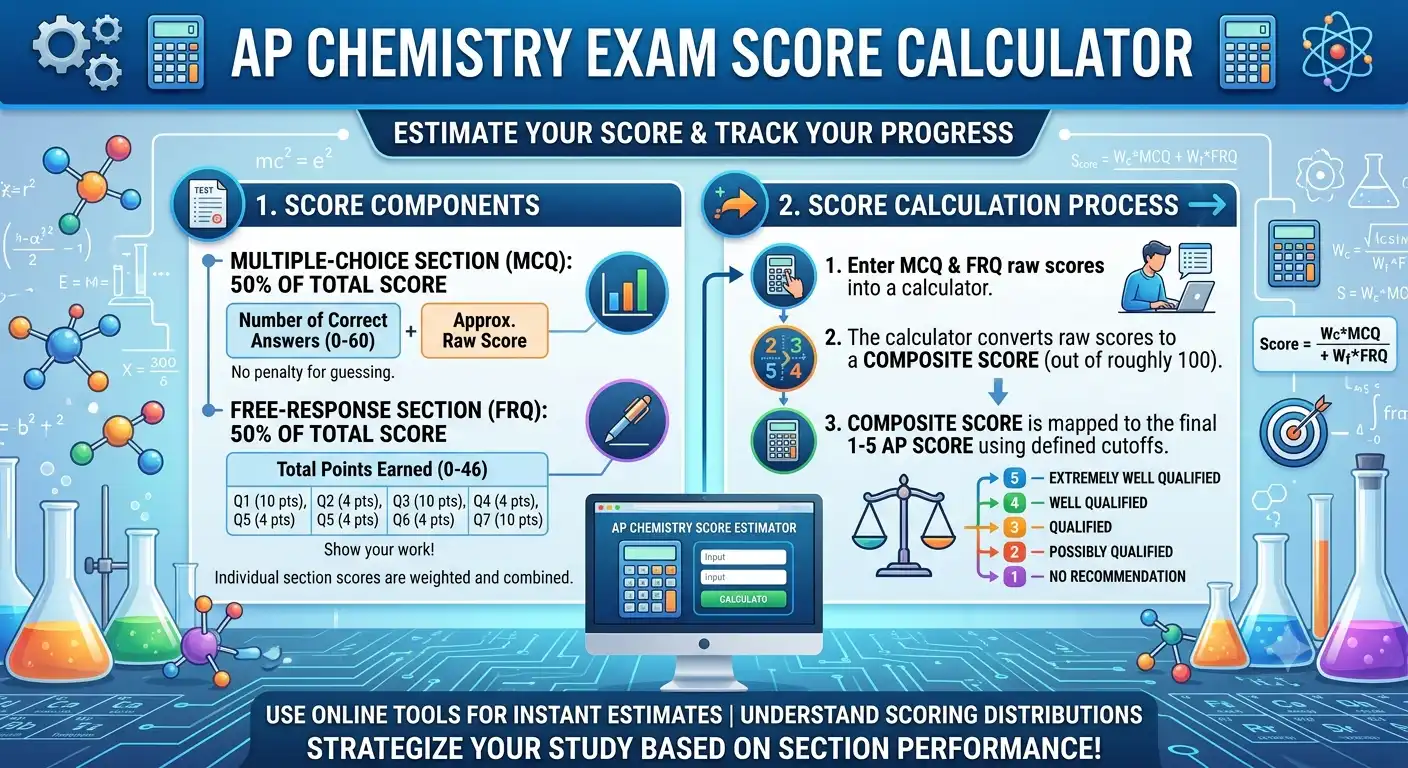
The AP Chemistry exam score comes from two equally weighted sections that combine into a composite score out of 100, which is then mapped onto the familiar 1–5 AP scale:
Composite = (MCQ Correct ÷ 60 × 50) + (Total FRQ Points ÷ 46 × 50)
MCQ Correct = number right out of 60 (no penalty for guessing). Total FRQ Points = the sum of all 7 free-response questions, out of a maximum of 46 raw points (3 long questions worth 10 each = 30, plus 4 short questions worth 4 each = 16).
Each section is scaled independently to 50 composite points, then added together for a composite out of 100. That composite is compared against approximate historical score cutoffs to estimate your final AP Chemistry score.
Step-by-Step Example Calculation
Scenario: A student gets 42 of 60 MCQ correct, and scores 7, 6, and 8 on the three long FRQs plus 3, 3, 2, and 3 on the four short FRQs.
- MCQ scaled: (42 ÷ 60) × 50 = 35.00 composite points.
- FRQ raw total: (7+6+8) + (3+3+2+3) = 21 + 11 = 32 out of 46.
- FRQ scaled: (32 ÷ 46) × 50 = 34.78 composite points.
- Composite: 35.00 + 34.78 = 69.78 / 100 — solidly in AP Score 4 territory (typical cutoff ≈ 58–71).
That’s exactly what the calculator above returns with its default values — swap in your own practice-exam numbers to get your specific predicted score.
What Affects Your AP Chemistry Exam Score
Why the MCQ Section Matters More Than It Feels Like
With 60 questions and zero penalty for wrong answers, the multiple-choice section is worth exactly 50% of your composite no matter how you split the two sections’ difficulty in your head — every correct MCQ answer is worth roughly 0.83 composite points (50 ÷ 60), which is why guessing on unanswered MCQs is always better than leaving them blank.
Long FRQ vs. Short FRQ — Where the Points Really Live
The three long free-response questions carry up to 30 of the 46 raw FRQ points combined — nearly two-thirds of the section — so a strong performance on Q1–Q3 (especially the quantitative, calculation-heavy questions) moves your composite more than any single short FRQ. This ap chem test score calculator’s breakdown chart separates long and short FRQ contributions specifically so you can see this imbalance.
Why “AP Chem Score Calc” Predictions Vary by a Point
Because the College Board adjusts the exact composite-to-score cutoffs every year based on that year’s exam difficulty, any ap chemistry score calculator — including this one — is an estimate, typically accurate within about one AP score point. The three-curve range shown above (lenient, typical, strict) reflects that real year-to-year variation instead of pretending there’s one fixed cutoff.
Calculator Policy During the Real Exam
Calculators are not permitted during Section I (multiple choice) but are allowed and recommended during Section II (free response) — a rule many students misremember, and one worth practicing under during timed mock exams.
What a Passing AP Chem Score 2026 Actually Means
A 3 or higher is generally considered “passing” for AP credit purposes, though many selective colleges only award credit or placement for a 4 or 5 — check your target school’s specific AP credit policy before deciding how hard to push for that extra composite point.
AP Chemistry Score Cutoff Ranges (Approximate, Recent Years)
| AP Score | Meaning | Typical Composite Range (out of 100) | Approx. % of Students |
|---|---|---|---|
| 5 | Extremely well qualified | 72 – 100 | ~10% |
| 4 | Well qualified | 58 – 71 | ~20% |
| 3 | Qualified | 42 – 57 | ~28% |
| 2 | Possibly qualified | 25 – 41 | ~24% |
| 1 | No recommendation | 0 – 24 | ~18% |
Frequently Asked Questions
How does this AP Chemistry exam score calculator work?
It scales your multiple-choice raw score (out of 60) and your free-response raw score (out of 46) to 50 composite points each, adds them for a composite out of 100, then compares that composite against approximate historical AP score cutoffs to predict your final 1–5 score.
What composite score do I need for a 5 on the AP Chem exam?
Under a typical recent curve, roughly 72 out of 100 composite points earns a 5. Because cutoffs shift slightly year to year, this ap chem calc shows a lenient-to-strict range so you can see how close you are under different possible curves.
Is a 50% raw score enough to pass AP Chemistry?
Not necessarily — a raw 50% doesn’t map directly to a 50-composite score once MCQ and FRQ are separately scaled, but a composite in the low-to-mid 40s is usually enough for a 3 (passing), depending on that year’s specific curve.
How many points is each free-response question worth?
Long FRQ 1–3 are worth up to 10 raw points each (30 total), and Short FRQ 4–7 are worth up to 4 raw points each (16 total), for 46 raw FRQ points overall — scaled to 50 composite points regardless of raw total.
Are calculators allowed on the AP Chemistry exam?
No calculators are allowed during Section I (multiple choice). A scientific or graphing calculator is allowed — and recommended — during Section II (free response), where most quantitative FRQ work happens.
Does guessing on multiple-choice questions hurt my score?
No. There is no penalty for incorrect MCQ answers, so leaving a question blank only costs you the chance of a lucky guess — always fill in every MCQ bubble even if you have to guess.
How accurate is an ap chem score calculator 2026 prediction?
Most predictors, including this one, are accurate within about one AP score point of your actual result, since the College Board doesn’t release the year’s exact cutoffs until after scores are published. Use it for study planning, not as a guarantee.
What’s the difference between raw score and composite score?
Raw score is the unweighted total of correct MCQ answers plus FRQ rubric points. Composite score is the weighted combination — each section separately scaled to 50 points — used to determine your final 1–5 AP score.
Related Calculators
Coming soon on CalculatorSuiteHub — links will activate once each page is published and verified.
Reference: AP Central — AP Chemistry Exam (College Board) · AP Chemistry Scoring Guidelines (College Board)

Asrar Ahmad
Founder of CalculatorSuiteHub.com and Rankify SEO & AI Agency. Specializes in SEO, technical content writing, WordPress development, and AI-powered digital solutions. Builds accurate calculators and helps businesses grow online.