The Ultimate AP U.S. Government & Politics Score Calculator: Free 1–5 Tool
AP US Government & Politics Score Calculator
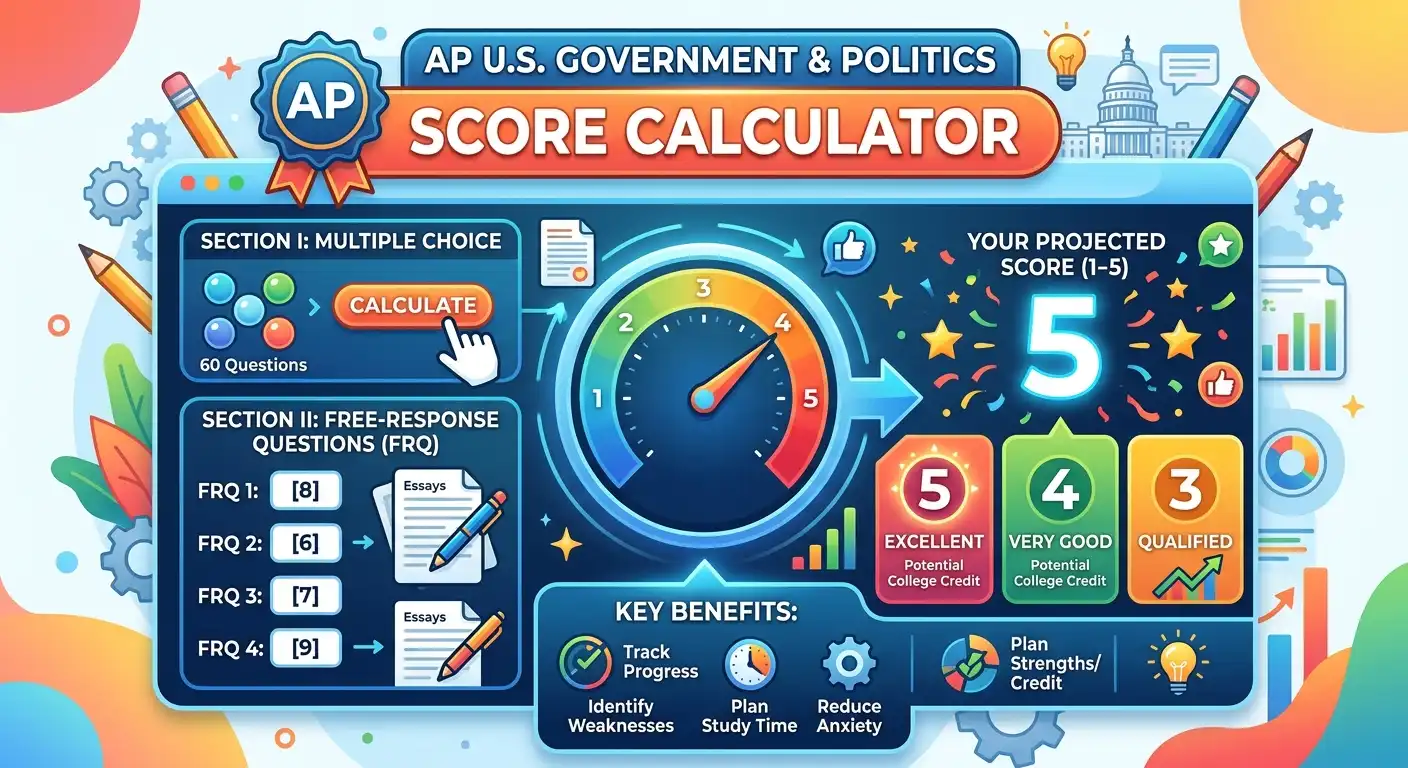
Estimate your AP Gov score from your multiple-choice performance and all four free-response questions. See your weighted composite, predicted 1–5 score, section accuracy, and exactly where your points are coming from.
AP Gov Score Calculator
Enter the number of correct MCQs and your raw FRQ points. The calculator uses the current 55-question, four-FRQ structure and the College Board’s 50% / 50% section weighting.
How AP US Government & Politics Score Calculator Works: Formula & Explanation
The current AP US Government and Politics exam has two equally weighted sections: 55 multiple-choice questions in Section I and four free-response questions in Section II. Each section contributes 50% of the final AP exam score.
The four FRQs have different raw-point maximums: Concept Application is worth 3 points, Quantitative Analysis is worth 4, SCOTUS Comparison is worth 4, and the Argument Essay is worth 6, for 17 raw FRQ points.
Because the College Board creates a composite score before converting it to the reported 1–5 AP score, this calculator first scales each section to a maximum of 60 points.
That produces a transparent 0–120 composite rather than pretending that a simple addition of raw MCQ and FRQ points represents the actual weighting.
            Weighted MCQ = (MCQ correct ÷ 55) × 60

            Weighted FRQ = (FRQ total ÷ 17) × 60

            Composite = Weighted MCQ + Weighted FRQ

            Predicted AP score = historical composite-band estimate from 1–5
The 60-point scaling is simply a way to express the published 50% / 50% structure on a 120-point composite. It does not mean the College Board publicly publishes one permanent 0–120 cutoff chart for every administration.
The final AP score is established using score boundaries for that exam, and those boundaries can change.
For the free-response section, the calculator preserves the real relative value of each question. A six-point Argument Essay therefore contributes more to the FRQ half than a three-point Concept Application question.
This is an important difference from simplified AP Gov calculators that incorrectly treat four FRQs as if every question were worth the same number of points.
The official exam description confirms the current 55-question multiple-choice and four-question free-response structure, with each section worth 50% of the exam.
College Board also states that multiple-choice scoring is based on the number of correct answers, with no deduction for incorrect or unanswered questions.
For the latest official exam format, scoring information, and released questions, consult the College Board’s AP US Government and Politics exam resources and scoring guidelines.
Step-by-Step Example Calculation
Example student: 40 of 55 multiple-choice questions correct, 2/3 on Concept Application, 3/4 on Quantitative Analysis, 3/4 on SCOTUS Comparison, and 4/6 on the Argument Essay.
Step 1 — Multiple choice:
(40 ÷ 55) × 60 = 43.64 weighted points.
Step 2 — Free response:
2 + 3 + 3 + 4 = 12 of 17 raw FRQ points.
(12 ÷ 17) × 60 = 42.35 weighted FRQ points.
Step 3 — Composite:
43.64 + 42.35 = 85.99, or about 86/120.
Step 4 — Score estimate:
An 86 composite falls in the historical reference area used by this calculator for an
estimated AP score of 4. Because the College Board establishes score
boundaries for each administration, a result close to a boundary should always be treated
as uncertain rather than guaranteed.
What Affects Your AP Gov Score Result?
AP Gov Score Calculator Inputs: Multiple Choice Accuracy
Your multiple-choice accuracy is important because Section I accounts for half of the exam. With 55 questions, each additional correct answer changes the weighted MCQ result by about 1.09 points on the 60-point section scale.
Moving from 35 correct to 40 correct, for example, adds roughly 5.45 weighted points before considering any FRQ changes. That makes targeted MCQ practice valuable, especially when you are already close to a score boundary.
AP GOPO Score Calculator: Concept Application
The first FRQ asks you to apply a political concept, institution, behavior, or process to a scenario. It is worth 3 raw points. Students often lose points by naming a concept without explaining how it operates in the specific scenario.
When estimating your score, use the actual points earned under the rubric rather than giving yourself partial credit simply because an answer sounds generally relevant.
AP Gov Calculator: Quantitative Analysis
Quantitative Analysis is worth 4 points and requires more than reading a graph.
Strong responses identify relevant information, describe a pattern or difference, draw an appropriate conclusion, and connect the evidence to a political principle, process, policy, or behavior.
A student who correctly spots a trend but does not explain its political significance may not receive every available point.
AP US Government & Politics Score Calculator: SCOTUS Comparison
The SCOTUS Comparison FRQ is another 4-point component. Your estimate should reflect the points you can actually justify from the scoring rubric, including identification, explanation of constitutional principles or holdings, and comparison.
Memorizing case names alone is not enough. You need to explain why a required Supreme Court case is relevant to the comparison the question asks you to make.
AP U.S. Government Score Calculator: Argument Essay
The Argument Essay is worth 6 raw points, making it the largest individual FRQ. Its scoring includes a defensible claim or thesis and rewards evidence-based reasoning.
Because the question carries more raw points than any other FRQ, improving argument structure can have a noticeable effect on the FRQ half of your composite.
A common mistake is to treat the essay as a generic opinion response rather than a political argument supported by required course concepts and evidence.
Why the AP Score Conversion Can Change
A predicted 1–5 score is never the same thing as a raw percentage. College Board explains that AP scores are created after raw performance is converted into a composite and then score boundaries are established for the exam.
The organization uses statistical equating and other standard-setting methods rather than simply declaring that a fixed percentage always equals a particular AP score.
That is why two AP Gov score calculators can show different predicted scores for the same raw inputs.
Recent official results illustrate why caution matters. In 2025, 71.7% of AP U.S. Government and Politics students earned a 3 or higher, compared with 73.0% in 2024. The 2025 mean score was 3.34.
These are useful context points, but they are score distributions—not official composite cutoffs for individual students.
Exam Version, Rubric Performance, and Scoring Accuracy
Your estimate is only as good as the raw points you enter. For a practice exam, use your actual number correct rather than your percentage. For FRQs, score each response against the appropriate College Board rubric whenever possible.
Self-scoring can be optimistic, especially on argumentation and evidence points. For the most reliable estimate, have a teacher or experienced AP reader review borderline FRQ responses.
AP U.S. Government Score Ranges & Reference Table
The table below is a planning reference for the calculator’s 0–120 composite scale. It should not be interpreted as an official permanent AP score cutoff table.
College Board establishes the boundaries used to turn a composite into a reported 1–5 score, and those boundaries can vary by exam administration.
| Predicted AP Score | Historical Composite Reference | College Board Meaning | Planning Interpretation |
|---|---|---|---|
| 5 | 91–120 | Extremely well qualified | Very strong performance across both sections |
| 4 | 79–90 | Well qualified | Strong overall performance |
| 3 | 62–78 | Qualified | Solid qualifying performance |
| 2 | 42–61 | Possibly qualified | Below the typical qualifying range |
| 1 | 0–41 | No recommendation | Substantial improvement recommended |
These composite bands are historical planning references, not guaranteed current-year cutoffs. The College Board does not publish one fixed AP Gov conversion threshold that can be assumed for every future exam.
Frequently Asked Questions About AP Gov Scoring
How many questions are on the AP U.S. Government and Politics exam?
The current exam has 55 multiple-choice questions in Section I and four free-response questions in Section II. Multiple choice accounts for 50% of the exam and free response accounts for the other 50%.
The FRQs are Concept Application, Quantitative Analysis, SCOTUS Comparison, and an Argument Essay.
Is there a penalty for wrong answers on AP Gov multiple choice?
No. College Board states that multiple-choice scoring is based on the number of questions answered correctly, with no points deducted for incorrect or unanswered questions. Therefore, your raw MCQ score is simply the number correct out of 55.
There is no reason to leave a multiple-choice question blank.
How are the four AP Government FRQs weighted?
The four FRQs are not equal in raw-point value. Concept Application is worth 3 points, Quantitative Analysis is worth 4, SCOTUS Comparison is worth 4, and the Argument Essay is worth 6.
Together they total 17 raw points and make up 50% of the complete AP exam.
How does an AP Gov score calculator convert raw points?
This calculator scales your 55-question MCQ result to a 60-point section and your 17-point FRQ result to another 60-point section. Those two weighted values create a 0–120 composite.
The composite is then compared with historical score references to estimate a reported AP score from 1 to 5.
What composite score do I need for a 5 on AP U.S. Government?
There is no permanent public composite cutoff that guarantees a 5 on every AP Gov exam. Historical released conversion references have placed the 5 range around the upper end of the 0–120 composite scale.
Use this calculator to test different MCQ and FRQ combinations, but treat any boundary result as an estimate.
What is a good AP U.S. Government score?
A 3 is classified by College Board as qualified, a 4 as well qualified, and a 5 as extremely well qualified. Whether a 3, 4, or 5 earns college credit depends on the institution.
Colleges set their own AP credit and placement policies, so check the policy for every school where you may use the score.
Why do different AP Gov score calculators give different answers?
Most differences come from the score-conversion step. The exam’s 50% MCQ and 50% FRQ weighting is clear, but third-party calculators may use different composite scales, historical conversion references, or estimated score bands.
The College Board sets score boundaries for each exam, so no unofficial calculator can guarantee your final 1–5 score.
Can this AP U.S. Government and Politics score calculator predict my official score?
It can estimate your likely score, but it cannot reproduce the official scoring process. Your final AP score depends on the actual exam’s scoring standards and established score boundaries.
Use the calculator for practice-test planning, target setting, and identifying whether improving MCQs or FRQs is likely to have the largest effect on your composite.
Related Calculators
Official AP Government Scoring Resources
For authoritative information, use College Board’s official AP U.S. Government and Politics exam materials, including current exam structure, released free-response questions, scoring guidelines, and score distributions.
The official materials are the best source for checking a rubric or understanding how a particular FRQ was scored.
College Board’s current exam information confirms the 55-question multiple-choice section, four free-response questions, 50% weighting for each section, and the current digital testing format.
Released scoring guidelines also show the point structure for individual FRQs, including the six-point Argument Essay.
The official 2025 score distribution reported 23.7% of students earning a 5, 24.8% earning a 4, and 23.2% earning a 3, with 71.7% earning a 3 or higher. Those figures are useful for context, but they should not be confused with fixed score cutoffs.

Asrar Ahmad
Founder of CalculatorSuiteHub.com and Rankify SEO & AI Agency. Specializes in SEO, technical content writing, WordPress development, and AI-powered digital solutions. Builds accurate calculators and helps businesses grow online.