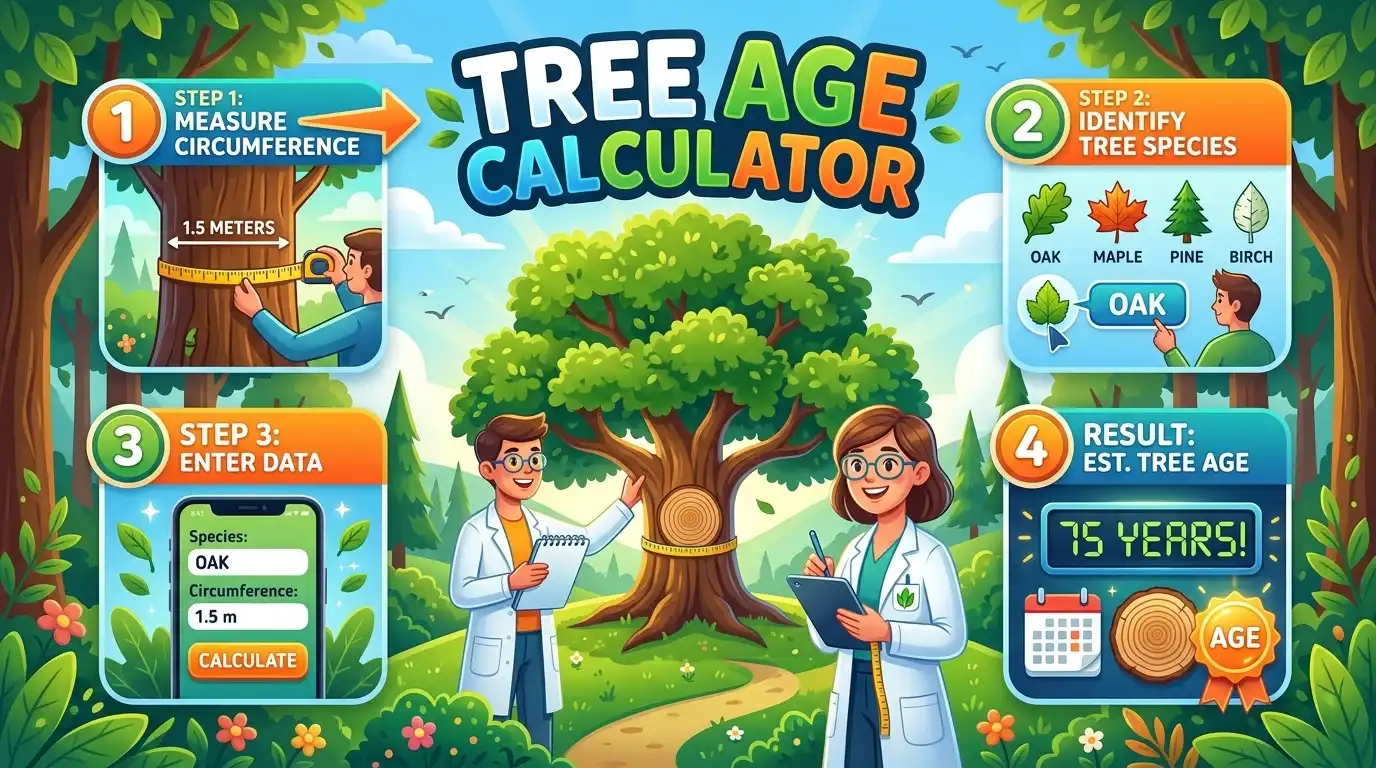
Tree Age Calculator: Estimate Tree Age in 3 Steps
Tree Age Calculator: Estimate Tree Age from Trunk Size
A tree can look older than it really is, or younger. This tree age calculator gives a quick, non-destructive estimate using trunk diameter (DBH) or circumference and a species-specific growth factor. Treat the result as a helpful estimate, not an exact birth date.
Tree Age Calculator
Measure the trunk at breast height, choose the species, and calculate instantly.
Estimated age = DBH × growth factor = 20.0 × 5.0 ≈ 100 years.
How This Tree Age Calculator Works
“`The calculator uses a diameter-based growth-factor equation common in forestry. DBH (diameter at breast height) is measured about 4.5 feet above ground, following U.S. Forest Service standards.
DBH is the trunk diameter in inches. Growth factor is the average years per inch of diameter for a species — lower means faster growth, higher means slower growth.
The method is deliberately simple: it turns an easy field measurement into an age estimate. Real growth still varies with weather, site quality, competition, and tree health.
“`How to Measure a Tree for an Age Estimate
“`1. Find the breast-height point
Measure about 4.5 feet (1.37 m) above ground on the uphill side of the tree. This standard point keeps DBH measurements comparable between trees.
2. Measure circumference or diameter
Use a flexible tape around the trunk for circumference — the calculator divides it by π to get diameter. If you already have a diameter reading, select the DBH option instead.
3. Select the closest species
Species matters because two trees with the same diameter can have very different ages. If the exact species is unknown, a documented local growth factor works better than guessing.
4. Check the site before trusting the number
Trees near roads, buildings, or compacted soil may grow differently from woodland trees. Drought, competition, pruning, and disease can all change the result.
“`Step-by-Step Example Calculation
“`Example: A mature white oak has a trunk circumference of 62.8 inches at breast height.
Step 1 — Convert circumference to diameter:
DBH = 62.8 ÷ 3.14159 ≈ 20.0 inches.
Step 2 — Select the species factor:
White oak has a growth factor of 5.0 years per inch of DBH.
Step 3 — Estimate age:
Age ≈ 20.0 × 5.0 = 100 years.
Step 4 — Interpret the result:
A planning range of roughly 80–120 years is more honest than treating 100 as exact, since the factor is an average.
The same 20-inch DBH on a silver maple (factor 3.0) would estimate about 60 years — proof that species selection changes the outcome directly.
“`What Affects Your Tree Age Result?
“`Tree Species and Growth Factor
Growth factor is the most important variable after diameter. Fast-growing species reach a large DBH quickly, while slower species need much more time for the same size.
Trunk Diameter and Circumference
Measurement error gets amplified by the formula. Keep the tape snug and level, and avoid measuring over a swollen or unusual section of trunk.
Forest-Grown vs. Open-Grown Trees
Forest trees compete for light and water, while yard trees may face compacted soil or pavement heat instead. A generic factor can miss these real differences.
Climate, Water, and Soil
Rainfall, drought, temperature, and soil quality all affect yearly growth. A tree that suffered repeated droughts likely grew slower than the reference average.
Tree Health and Competition
Disease, insect damage, shading, and root injury can slow trunk growth. A large diameter doesn’t automatically mean an exceptionally old tree.
Measurement Height and Unusual Trunks
Measuring near the base instead of breast height can overstate DBH, since trunks often flare near the ground. Leaning or multi-stem trees need extra care.
Tree Rings and Core Sampling
When precise age matters, growth rings are far more reliable than a growth factor. An increment borer can extract a thin core from a living tree for ring counting, ideally by a trained professional.
“`Common Tree Growth Factors and Estimated Age Ranges
“`These values are commonly used in educational tree-age guidance. They are useful reference points, not fixed biological constants.
| Tree Species | Growth Factor | Age at 20-inch DBH | Typical Growth Group |
|---|---|---|---|
| Cottonwood | 2.0 | 40 years | Fast |
| Silver Maple | 3.0 | 60 years | Fast |
| Pin Oak | 3.0 | 60 years | Moderate-fast |
| River Birch | 3.5 | 70 years | Moderate |
| Red Oak | 4.0 | 80 years | Moderate |
| Red Maple | 4.5 | 90 years | Moderate |
| Black Walnut | 4.5 | 90 years | Moderate |
| White Oak | 5.0 | 100 years | Slower |
| Sugar Maple | 5.0 | 100 years | Slower |
| Shagbark Hickory | 7.5 | 150 years | Slow |
A 20-inch trunk isn’t “100 years old” by itself — it’s about 100 years under a 5.0 growth factor. The species label changes the math, not just the name.
“`Tree Age Calculator FAQs
“`How do I calculate the age of a tree without cutting it down?
Measure the trunk circumference at breast height, divide by π to get DBH, then multiply DBH by the species growth factor for an approximate age.
What is the formula for tree age from circumference?
Age ≈ (Circumference ÷ π) × Growth Factor. Measure consistently and match the factor to the correct species.
What is DBH in tree age calculations?
DBH is diameter at breast height, measured about 4.5 feet above ground — a standard, comparable trunk-size reading.
How accurate is a tree age estimate from diameter?
It’s a rough estimate, not an exact age. Soil, drought, competition, and health can all shift real growth away from the average factor.
Can the same tree diameter produce different ages?
Yes. A 20-inch tree could be 60 years old at a 3.0 factor or 100 years old at a 5.0 factor, depending on species.
Where should I measure a tree’s circumference?
At breast height, about 4.5 feet above ground, keeping the tape level and away from swelling or branches.
What is the most accurate way to determine a living tree’s age?
Counting annual growth rings, often via a thin core sample, gives far stronger evidence than any growth-factor formula.
Should I use a custom growth factor for my local tree?
Yes, if you have credible local data for the same species and site conditions — just don’t invent a number to match an expected age.
Related Calculators
“` “`Important Note About Tree Age Estimates
Treat the result as a range of plausible history, not a precise birthday. It’s useful for education, property research, or a quick check — less so under unusual growing conditions.
If the result affects a heritage designation, legal matter, or valuation, don’t rely on this calculator alone — have the tree assessed by a qualified professional using ring analysis.

Asrar Ahmad
Founder of CalculatorSuiteHub.com and Rankify SEO & AI Agency. Specializes in SEO, technical content writing, WordPress development, and AI-powered digital solutions. Builds accurate calculators and helps businesses grow online.