Surface Area of a Triangular Prism Calculator
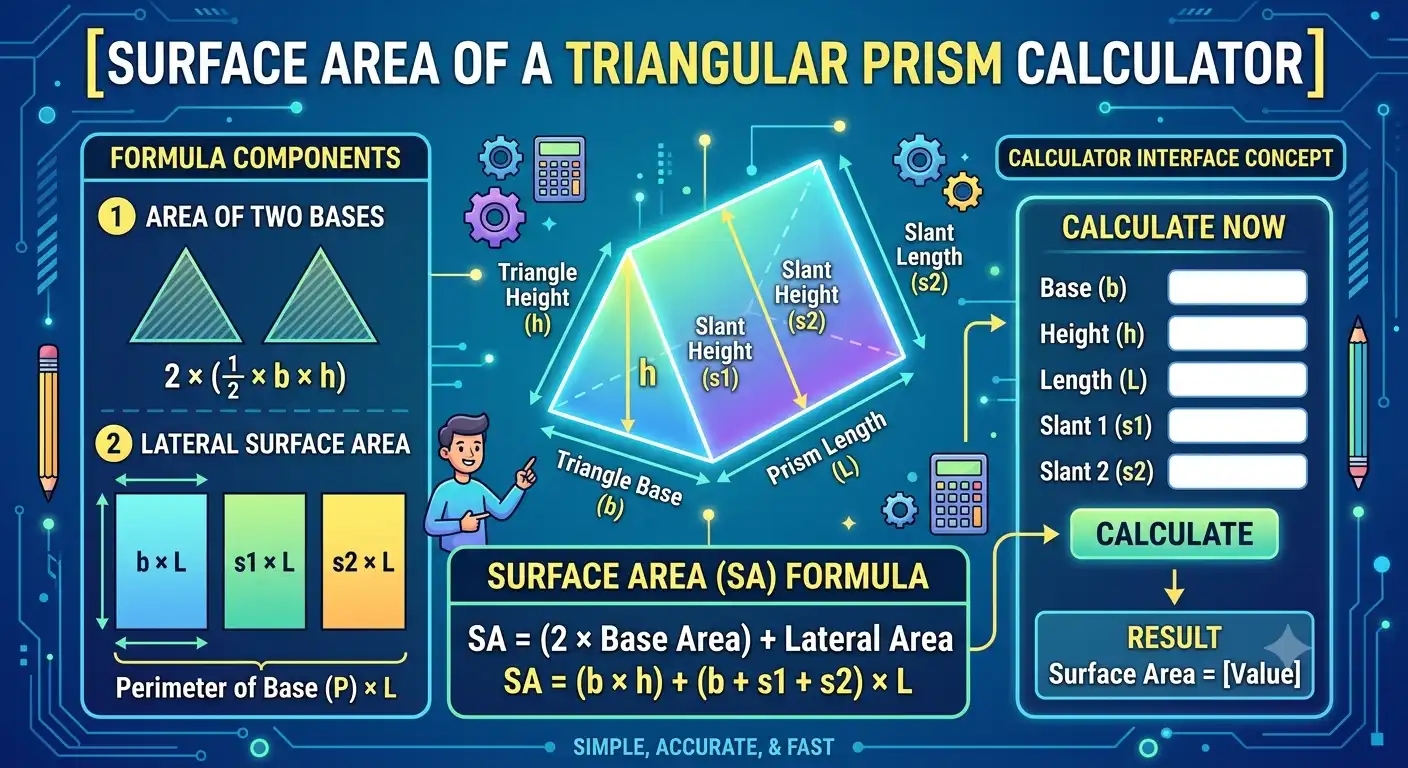
Surface Area of a Triangular Prism Calculator
Use this surface area of a triangular prism calculator to get an instant, verified answer plus a face-by-face material breakdown — something no other free triangular prism surface area calculator online currently shows you. Whether you’re checking homework, sizing a tent, or estimating sheet material for a roof truss or ramp, accuracy on each individual face matters as much as the total.
Calculate Surface Area Now
How Surface Area of a Triangular Prism Calculator Works — Formula & Explanation
A triangular prism has 5 faces: two identical triangular ends and three rectangular sides. The surface area of a triangular prism formula adds the area of both triangles to the combined area of the three rectangles:
Total Surface Area = 2 × (Triangle Area) + (Perimeter of Triangle × Prism Length)
A = 2B + PL, where B = area of one triangular base, P = perimeter of that triangle (a + b + c), and L = the prism’s length.
Finding B (the triangle’s area) depends on what you already know:
- All three sides known: use Heron’s formula — B = √[s(s−a)(s−b)(s−c)], where s = (a+b+c)/2 (the semi-perimeter). This calculator uses Heron’s formula automatically in “Three Sides” mode.
- It’s a right triangle (two legs known): B = ½ × leg1 × leg2, and the hypotenuse is found with the Pythagorean theorem, c = √(leg1² + leg2²). This is what the “Right Triangle Legs” mode does.
Step-by-Step Example Calculation of Surface Area of a Triangular Prism Calculator
Scenario: A right-triangular roof truss end has legs of 3 ft and 4 ft, and the truss runs 10 ft long.
- Find the hypotenuse: c = √(3² + 4²) = √25 = 5 ft.
- Find the triangle’s area: B = ½ × 3 × 4 = 6 ft².
- Find the perimeter: P = 3 + 4 + 5 = 12 ft.
- Find the lateral area: P × L = 12 × 10 = 120 ft².
- Find the total surface area: A = 2(6) + 120 = 132 ft².
That’s exactly what the calculator above returns with its default values — plug in your own numbers to get your specific total.
What Affects Your Surface Area of a Triangular Prism Calculator Result
Surface Area vs. Volume of a Triangular Prism
Surface area measures the material needed to wrap the outside of the shape (square units); volume measures the space it occupies inside (cubic units). If you also need volume, the formula is V = ½ × base × height of triangle × L — a related but separate calculation from what this page solves.
Surface Area of a Triangular Pyramid vs. a Prism
A prism has two triangular ends connected by rectangles; a pyramid has one triangular base and three (or four) triangular sides meeting at a single apex. If your shape comes to a point rather than running parallel like a tent or wedge, you need a surface area of a triangular pyramid calculator instead — the formula and face count are different.
Right Triangular Prism vs. Oblique (Slanted) Prism
This calculator — like almost every free tool online — assumes a right prism, where the rectangular faces meet the triangular ends at 90°. An oblique prism (leaning sideways) needs the true slant length of each face, not just the vertical prism length, or your total will read low.
Why Each Rectangular Face Is Different
Unless your triangle is equilateral or isosceles, the three rectangular faces are not the same size — each one is (side length × L). Most calculators only report a single lumped “lateral area” number, which hides this. That’s why the breakdown chart above shows all three rectangles separately: it tells you exactly how much material each individual panel needs, which matters for cutting sheet goods, fabric, or metal to size.
Units and Precision
Keep every input in the same unit before calculating — mixing feet and inches is the single most common error people make with a triangular pyramid surface area calculator or prism calculator alike. Use the unit selector above; the tool also converts your total into ft², m², and in² automatically so you don’t have to convert by hand.
Surface Area of a Triangular Prism Calculator Ranges by Common Use Case
| Use Case | Typical Triangle Size | Typical Prism Length | Approx. Surface Area Range |
|---|---|---|---|
| Classroom / textbook problem | 3–8 units per side | 5–15 units | 60 – 400 sq. units |
| Camping tent (A-frame) | 4–7 ft per side | 6–10 ft | 90 – 220 ft² |
| Roof truss end / gable | 8–20 ft per side | 20–40 ft | 700 – 3,000 ft² |
| Wedge ramp or door stop | 0.5–2 ft per side | 1–4 ft | 2 – 20 ft² |
| Industrial trough / hopper panel | 2–5 m per side | 3–8 m | 20 – 120 m² |
Frequently Asked Questions
What is the formula for the surface area of a triangular prism?
The formula is A = 2B + PL, where B is the area of one triangular end, P is that triangle’s perimeter, and L is the prism’s length. This accounts for both triangular ends plus all three rectangular sides.
How do I find the surface area of a triangular prism with only 3 sides given?
Use Heron’s formula to get the triangle’s area first: find the semi-perimeter s = (a+b+c)/2, then B = √[s(s−a)(s−b)(s−c)]. Add the perimeter × prism length for the lateral area, then apply A = 2B + PL. This calculator’s “Three Sides” mode does this automatically.
What’s the difference between total surface area and lateral surface area?
Lateral surface area is only the three rectangular side faces (P × L) — it excludes the two triangular ends. Total surface area adds those two triangular ends back in (2B), giving you the full outer surface of the solid.
Can I calculate surface area without knowing the triangle’s height?
Yes. If you know all three side lengths, Heron’s formula finds the area without needing a separate height measurement. Height is only required if you’re using the base-and-height method instead of the three-sides method.
Is the formula the same for a right triangular prism and a general (scalene) one?
The overall formula A = 2B + PL is the same for any triangular prism. What changes is how you find B: a right triangle uses B = ½ × leg1 × leg2, while a scalene or isosceles triangle needs Heron’s formula using all three sides.
How much material do I actually need to cover a triangular prism, like a tent or truss?
Add 5–10% to the calculated total surface area to cover seams, overlaps, and cutting waste. Also check each rectangular face separately in the breakdown above — real materials (plywood, canvas, sheet metal) are usually cut per panel, not as one combined lateral figure.
How is this different from a triangular pyramid surface area calculator?
A prism has two parallel triangular ends and three rectangular sides (5 faces total). A pyramid has one triangular base and triangular sides that meet at a single apex point, with no parallel rectangular faces at all — a completely different formula and face count.
What units should I use, and will mixing units break the calculation?
Enter every measurement in the same unit (all feet, all meters, etc.) before calculating — mixing units is the most common source of wrong answers. Use the unit dropdown above; the result panel then auto-converts your total into ft², m², and in² for reference.
Related Calculators
Coming soon on CalculatorSuiteHub — links will activate once each page is published and verified.
Formula reference: Math Is Fun — Prisms · NIST Weights & Measures (unit standards)

Asrar Ahmad
Founder of CalculatorSuiteHub.com and Rankify SEO & AI Agency. Specializes in SEO, technical content writing, WordPress development, and AI-powered digital solutions. Builds accurate calculators and helps businesses grow online.