The Ultimate AP Spanish Score Calculator 2026: Predict Your AP Score
AP Spanish Score Calculator
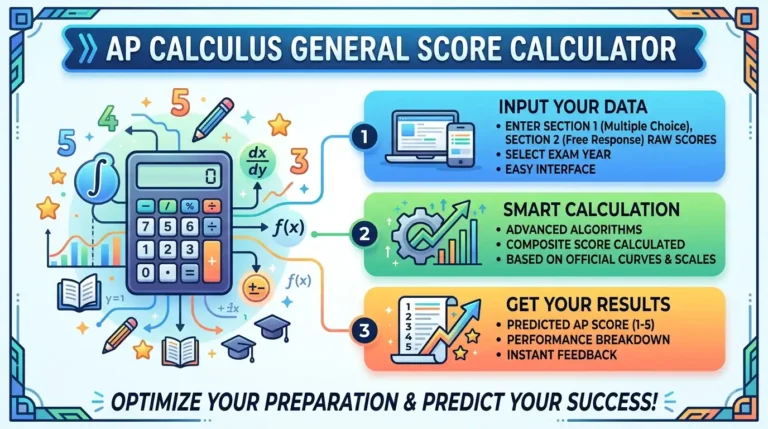
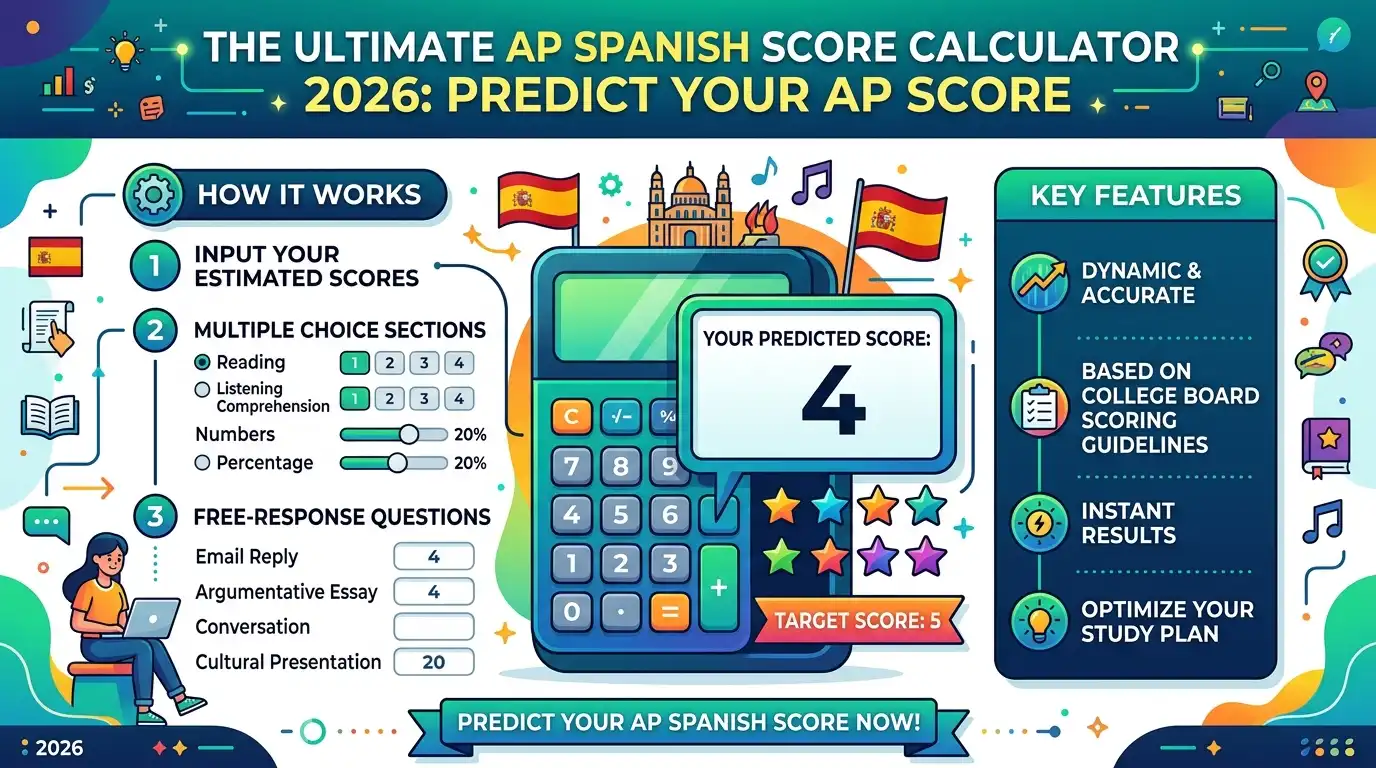
The AP Spanish Score Calculator helps AP Spanish Language and Culture students estimate a 1–5 AP score from multiple-choice and free-response performance. Enter your correct answers from both multiple-choice parts and your estimated 0–5 scores for the four free-response tasks. The calculator converts those results into an estimated composite score out of 150 and an unofficial AP score range. Use it to check a practice exam, set a target score, or identify where improvement may help most.
Enter Your AP Spanish Scores
Section I — Multiple Choice (50% of exam)
Section II — Free Response (50% of exam)
How This AP Spanish Score Calculator Works
The AP Spanish Language and Culture exam measures interpretive, interpersonal, and presentational communication. Section I has 65 multiple-choice questions, while Section II has four free-response tasks. College Board gives each section 50% of the final exam weight. Part A contains 30 questions and represents 23%, while Part B has 35 questions and represents 27%. Each FRQ contributes 12.5%.
Simply calculating the percentage of correct answers does not reproduce this weighted structure. This AP Spanish calculator keeps Part A, Part B, and each FRQ separate before combining them into a 150-point estimated composite.
AP Spanish Score Calculator Formula & Explanation
The calculator first converts each component into its official exam weight. The estimated composite formula is:
The result uses a 0–150 planning scale. Part A contributes up to 34.5 points, Part B up to 40.5 points, and each FRQ up to 18.75 points. These values reflect their percentage of the total exam.
The final 1–5 prediction is compared with approximate composite bands. These are not official College Board conversion tables. They are planning estimates that can change from year to year.
Step-by-Step Example Calculation
Suppose a student gets 21 out of 30 on Part A and 25 out of 35 on Part B. They estimate scores of 4, 3, 4, and 3 on the Email Reply, Argumentative Essay, Conversation, and Cultural Comparison tasks.
Part A contributes 21 ÷ 30 × 34.5 = 24.15 points. Part B contributes 25 ÷ 35 × 40.5 = 28.93 points. The four FRQs contribute 15.00 + 11.25 + 15.00 + 11.25 = 52.50 points.
The estimated composite is 24.15 + 28.93 + 52.50 = 105.58 out of 150, or about 70.4%. Under this calculator’s approximate bands, that falls in the estimated 4 range. Each FRQ is worth 12.5%, so improving one task can meaningfully affect the composite.
What Affects Your AP Spanish Score?
AP Spanish Curve
Students often search for the “AP Spanish curve” as though one permanent table determines every year’s score. That is misleading. College Board converts raw performance to the 1–5 AP scale, and the relationship can vary by exam administration. A calculator can estimate a score, but it cannot know future official cutoffs.
For planning, approximate thresholds such as 86 for a 3, 99 for a 4, and 118 for a 5 can be useful. However, they should not be treated as guaranteed official cutoffs because the conversion may change each year.
AP Spanish Calculator: Multiple Choice Performance
The 65 multiple-choice questions account for half of the exam. Part A has 30 questions based on print texts, while Part B has 35 questions involving print and audio combinations and audio texts. Because Part B carries 27% of the exam, its questions have a different contribution to the 150-point planning scale than Part A questions.
Track the two parts separately instead of using only a combined percentage. If reading is strong but listening is weak, the calculator makes that difference visible and can help you target practice.
AP Spanish Language Calculator: Free Response
The free-response section represents half of the exam and contains four equally weighted tasks: Email Reply, Argumentative Essay, Conversation, and Cultural Comparison. Each task receives a score from 0 to 5.
The four tasks test different communication skills. Because each task is worth 12.5%, a one-point improvement on one FRQ can materially change the estimated composite.
AP Spanish Writing Scores
Writing is not graded only for grammar. Scoring considers task fulfillment, development, vocabulary, language structures, register, and comprehensibility. The scoring guidelines distinguish performance levels using these factors.
When estimating an FRQ score, avoid counting every grammatical mistake. A response can still communicate effectively despite errors, while strong vocabulary alone does not guarantee a high score if the task is incomplete.
AP Spanish Speaking Scores
Speaking represents 25% of the total exam because Conversation and Cultural Comparison each carry 12.5%. Pronunciation, pacing, comprehensibility, task fulfillment, vocabulary, grammar, and communication all affect performance.
For practice tests, use your teacher’s rubric-based estimate instead of guessing from confidence alone. Writing and speaking performance can vary, so score each task separately.
Why Your Practice Score May Differ From the Official AP Score
A practice calculator cannot reproduce every part of College Board’s scoring process. FRQ scores may also be uncertain when responses are self-scored, and released exams can differ in difficulty and scoring context.
The best use of an AP Spanish score calculator is trend tracking. Run several practice exams, record the same categories, and watch whether your estimated composite is improving.
AP Spanish Score Ranges: Approximate Planning Guide
| Estimated AP Score | Approximate Composite Range | Planning Interpretation |
|---|---|---|
| 5 | 118–150 | Excellent overall performance |
| 4 | 99–117 | Strong overall performance |
| 3 | 86–98 | Generally passing-level performance |
| 2 | 71–85 | Developing performance |
| 1 | 0–70 | Limited demonstrated performance |
These are estimated planning bands, not an official permanent AP Spanish curve. Use College Board’s official materials as the authority for exam format, weighting, rubrics, and final scores.
How to Use Your AP Spanish Calculator Result
If your estimated score is close to the next boundary, focus on the component where improvement is most realistic. For example, if reading is strong but listening is weak, targeted audio practice may be more efficient than repeating complete reading sections.
Do not treat one practice score as your final outcome. Record Part A, Part B, each FRQ, and the composite after every full practice exam. The pattern across several tests is more useful than one unusually easy or difficult practice set.
Official AP Spanish Exam Resources
For authoritative information about the exam structure, weighting, course framework, and scoring, consult the College Board AP Spanish Language and Culture resources. The official course and exam description confirms the multiple-choice section, four free-response tasks, and section weighting.
The 2025 AP Spanish Language scoring guidelines explain how free-response answers are evaluated. College Board also publishes AP Spanish Language scoring statistics for official performance data.
Frequently Asked Questions About the AP Spanish Score Calculator
How does the AP Spanish Score Calculator estimate my score?
It converts your Part A, Part B, and four FRQ scores according to the exam weighting, producing an estimated composite out of 150. It then compares the composite with approximate 1–5 planning bands. The result is unofficial because the raw-to-score conversion can vary by exam year.
How many questions are on the AP Spanish Language exam?
The AP Spanish Language and Culture exam has 65 multiple-choice questions plus four free-response tasks. Part A has 30 questions and Part B has 35. The free-response section includes an Email Reply, Argumentative Essay, Conversation, and Cultural Comparison.
What percentage of AP Spanish is multiple choice?
Multiple choice represents 50% of the AP Spanish Language and Culture exam. Part A represents 23% and Part B represents 27%. The remaining 50% comes from the four equally weighted free-response tasks.
What score do I need for a 5 on AP Spanish?
There is no single permanent percentage that guarantees a 5 every year. For planning, this calculator uses an approximate composite threshold of 118 out of 150 for a 5. Treat 118 as an estimate rather than an official guaranteed cutoff.
Is the AP Spanish curve the same every year?
No. Students should not assume that the exact composite needed for a 3, 4, or 5 remains identical every year. Exam difficulty and the scoring process can affect the conversion.
How much are the AP Spanish FRQs worth?
The four free-response tasks together account for 50% of the exam. Because they are equally weighted, each contributes 12.5% of the total score. Each task receives a rubric score from 0 to 5.
Can I use this AP Spanish calculator for a practice test?
Yes. Enter the number of multiple-choice questions answered correctly and estimate each FRQ score using your teacher’s or practice rubric. Running the calculator after several tests can show whether your composite is moving toward a 3, 4, or 5.
Is this AP Spanish score calculator official?
No. CalculatorSuiteHub is not affiliated with or endorsed by College Board. The tool uses the published exam structure and weighting to create an educational estimate. Your official AP score is determined by College Board.
Related Calculators


Asrar Ahmad
Founder of CalculatorSuiteHub.com and Rankify SEO & AI Agency. Specializes in SEO, technical content writing, WordPress development, and AI-powered digital solutions. Builds accurate calculators and helps businesses grow online.