Ultimate Chronological Age Calculator: Exact Age in 3 Steps
Chronological Age Calculator
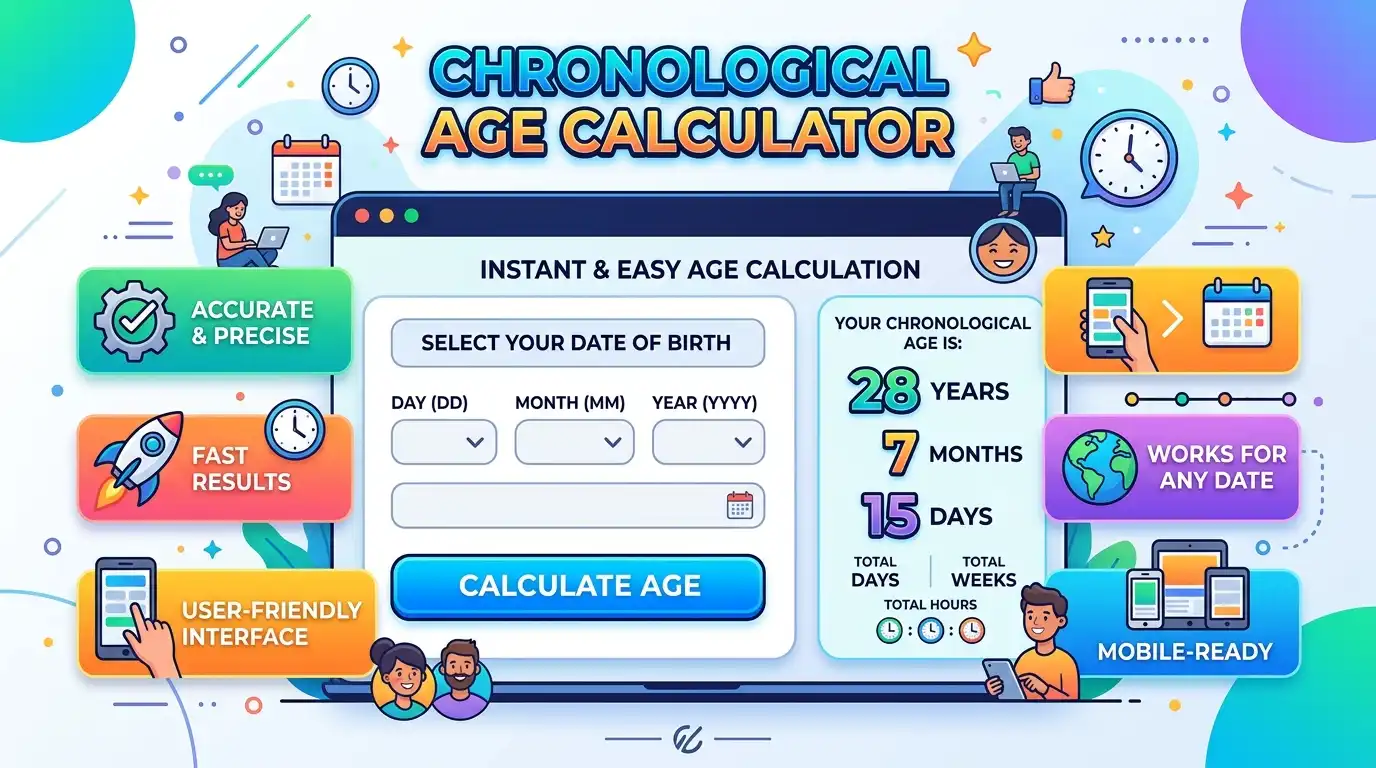
This chronological age calculator determines a person’s exact age between a birth date and an assessment date in years, months, and days. It is particularly useful for parents, teachers, speech-language professionals, psychologists, educators, and anyone completing a developmental or standardized assessment. Entering the exact assessment date matters because chronological age can affect which age band, developmental reference, or scoring rule applies. For children born prematurely, the tool can also calculate corrected age using gestational age at birth. An optional developmental-age field can calculate a developmental quotient (DQ), but DQ should be interpreted as an assessment measure rather than a diagnosis.
Calculate Chronological Age with Chronological Age Calculator
Use the actual birth date and the exact date on which the assessment, screening, or comparison is being made.
If you already have a developmental age from a standardized assessment, enter it in months. This calculator uses DQ = developmental age ÷ chronological age × 100.
Calculation Breakdown
How Chronological Age Calculator Works
Chronological age is the elapsed time between a person’s date of birth and a specified target date. For everyday use, people often think of age as a whole number of years. In assessments, however, the exact combination of years, months, and days can matter. A child who is 7 years and 2 months old is not in exactly the same age position as a child who is 7 years and 11 months old, even though both are described casually as seven-year-olds.
The calculator therefore uses calendar arithmetic rather than simply dividing the number of elapsed days by 365. It accounts for different month lengths and leap years. The same approach is useful when chronological age is required for developmental screening, speech and language assessment, educational records, psychology testing, or a specific test date.
Chronological Age Formula
The calculation first determines completed years. It then determines the number of complete calendar months after the last birthday and finally counts the remaining days. This prevents errors caused by assuming every month has 30 days or every year contains exactly 365 days.
The calculator also calculates total elapsed days directly from the two calendar dates. This value is useful when a record requires an exact day interval, but it should not be confused with the years-months-days representation used by many assessments.
Step-by-Step Example Calculation
Suppose a child was born on August 15, 1995 and an assessment took place on July 2, 2026.
- The child has completed 30 full years by July 2, 2026.
- The next birthday would be August 15, 2026, so the child has not yet completed 31 years.
- From August 15, 2025 to June 15, 2026 is 10 complete months.
- From June 15 to July 2 is another 17 days.
The chronological age is therefore 30 years, 10 months, and 17 days. The exact interval is 11,279 days. The important point is that the calculator does not estimate this as 30 × 365 days because leap years and actual calendar dates change the total.
What Affects Your Chronological Age Result?
Birth Date Accuracy
The birth date is the foundation of the entire calculation. A one-day difference in the date of birth can change the final days component, and a mistake around a birthday can change the completed-years component. For school, medical, legal, or assessment documentation, use the date recorded in the relevant official or clinical record rather than relying on memory.
Assessment or Target Date
A common mistake is automatically using today’s date when the actual requirement is the age on the date of testing. For standardized assessments, the test date may be the important reference point. If a child was assessed on March 10, enter March 10 rather than the date the report is written several weeks later.
Leap Years and Different Month Lengths
February can contain 28 or 29 days, while other months contain 30 or 31 days. This is why a simple formula such as age = total days ÷ 365 is not suitable when the required answer is exact years, months, and days. Calendar-based borrowing and anniversary calculations provide a more reliable result.
Chronological Age in Developmental Assessment
Chronological age is often the reference age against which developmental performance is interpreted. Depending on the assessment, a professional may need the child’s exact age in years and months, or sometimes years, months, and days. The correct format should always follow the manual for the specific assessment rather than assuming every test uses the same convention.
Corrected Age Calculator for Premature Babies
Corrected age, also called adjusted age, is different from chronological age. It is used for some developmental assessments of children born prematurely. The basic correction accounts for the time between the child’s actual gestational age at birth and a 40-week term reference.
Corrected Age = Chronological Age − Weeks Premature
A more calendar-friendly implementation is to calculate the estimated due date by adding the weeks and days of prematurity to the actual birth date, then calculate age from that due date to the assessment date. If the assessment date occurs before the estimated due date, the baby has not yet reached term and a clinician may instead report postmenstrual age.
The exact use of corrected age depends on the child and assessment context. The CDC advises using corrected age for certain milestone checklists when a child was born more than three weeks prematurely. :contentReference[oaicite:0]{index=0} NICE guidance also describes developmental assessment using corrected age during early follow-up of children born preterm. :contentReference[oaicite:1]{index=1}
Developmental Quotient Formula
A developmental quotient (DQ) compares a measured developmental age with chronological age. It is not the same thing as chronological age and should not be interpreted as an independent diagnosis.
For example, if a standardized assessment gives a developmental age of 30 months and the child’s chronological age is 36 months, the DQ is approximately 83.3. The underlying developmental-age estimate must come from an appropriate assessment; this calculator does not create a developmental age from milestone guesses.
Published developmental research uses the same basic relationship between developmental age and chronological age for DQ calculations. :contentReference[oaicite:2]{index=2} Clinical developmental references also emphasize that developmental assessment requires more than a single numerical quotient.
Why Corrected and Chronological Age Should Not Be Confused
A premature child can have a chronological age of 12 months while having a corrected age that is several weeks or months younger. Those two numbers are both valid; they answer different questions. Chronological age describes the time since birth. Corrected age adjusts the developmental reference for prematurity.
Research has found that using chronological rather than corrected age in some assessments of preterm infants can affect developmental scores and the classification of developmental delay. :contentReference[oaicite:3]{index=3} This is why the child’s clinician or the specific assessment manual should determine which age should be used for scoring.
Chronological Age Examples and Useful Ranges
| Situation | Age to Calculate | Important Point |
|---|---|---|
| General age check | Birth date → today | Useful for exact current age |
| Speech or developmental assessment | Birth date → test date | Use the actual assessment date |
| School or educational record | Birth date → required cutoff date | Follow the institution’s cutoff rule |
| Preterm developmental follow-up | Birth date + gestational correction | Corrected age may be required |
| Developmental quotient | Chronological age + developmental age | Developmental age must come from assessment data |
Common Mistakes When Calculating Chronological Age
The most common error is treating every year as 365 days and every month as 30 days. That shortcut can produce an answer that looks reasonable but is wrong when exact age matters. Another mistake is using today’s date instead of the actual test date. A third is subtracting prematurity from chronological age without checking whether the relevant clinical or assessment protocol actually calls for corrected age.
Parents should also avoid interpreting a calculated DQ by itself. Development is multidimensional, and formal developmental evaluation considers the assessment instrument, individual domains, clinical history, observations, and other relevant information. A calculator can perform the arithmetic accurately; it cannot replace professional interpretation.
FAQs About Chronological Age
What is chronological age?
Chronological age is the amount of calendar time that has passed from a person’s date of birth to a specified date. It is commonly expressed in years, months, and days. Unlike biological or developmental age, chronological age is determined directly from the birth date and does not attempt to measure physical development or developmental performance.
How do you calculate chronological age?
Calculate chronological age by comparing the date of birth with the assessment or target date. Determine completed years first, then completed calendar months after the last birthday, followed by remaining days. This calendar-based method handles leap years and different month lengths more accurately than dividing total days by 365.
What is the difference between chronological age and corrected age?
Chronological age is the actual time since birth. Corrected age adjusts the developmental reference for a child born prematurely by accounting for the weeks between the child’s gestational age at birth and a 40-week term reference. Corrected age is mainly relevant to developmental follow-up and should be applied according to clinical or assessment guidance.
How does a corrected age calculator work?
A corrected age calculator first determines how many weeks early the child was born, commonly using 40 weeks as the term reference. The prematurity interval is then removed from chronological age. An equivalent method is to calculate age from the estimated due date rather than the actual birth date.
What is the developmental quotient formula?
The developmental quotient formula is DQ = developmental age ÷ chronological age × 100. For example, a developmental age of 30 months divided by a chronological age of 36 months, multiplied by 100, gives a DQ of about 83.3. The developmental age should come from an appropriate standardized assessment.
Is the development quotient formula the same as the DQ formula?
Yes. “Developmental quotient formula” and “development quotient formula” are often used to describe the same basic calculation: developmental age divided by chronological age, multiplied by 100. However, different developmental instruments can derive developmental age differently, so the assessment manual should be followed for formal scoring.
Should I use chronological or corrected age for a premature baby?
It depends on what is being assessed and the protocol being followed. Corrected age is commonly used for developmental milestone assessment during early childhood after prematurity. The CDC, for example, recommends corrected age for certain milestone checklists for children born more than three weeks prematurely. Ask the child’s healthcare or developmental professional which age should be used for a specific assessment.
Why does the exact assessment date matter?
Chronological age changes continuously, and many assessments use narrow age bands or age-specific norms. Using the report date, today’s date, or an estimated date instead of the actual assessment date can produce a different age in months and days. For assessment documentation, enter the date on which the test or screening was actually performed.
Related Calculators
Sources and Clinical References
The calendar-age logic is based on the difference between two Gregorian calendar dates. Corrected-age guidance and developmental information should be interpreted within the relevant clinical protocol.

Asrar Ahmad
Founder of CalculatorSuiteHub.com and Rankify SEO & AI Agency. Specializes in SEO, technical content writing, WordPress development, and AI-powered digital solutions. Builds accurate calculators and helps businesses grow online.