Ultimate Lung Age Calculator Check Your Lung Age in 1 Minute
Lung Age Calculator
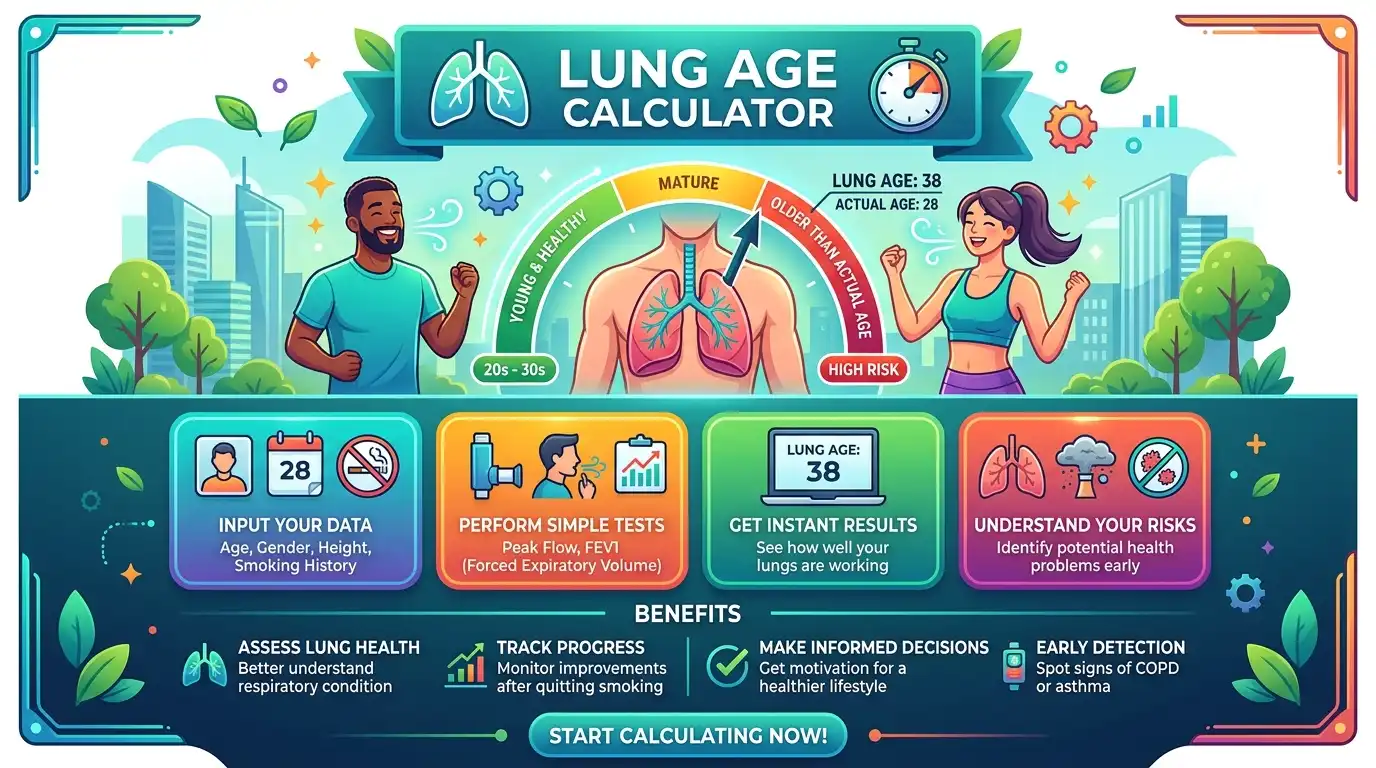
This Lung Age Calculator estimates the age at which a healthy reference population would be expected to have a similar FEV₁ result to yours. Enter your sex, height, chronological age, and measured FEV₁ from a spirometry report to see an estimated lung age, FEV₁ percentage predicted, and the difference between lung age and actual age.
Calculate Your Lung Age
Your Calculation Breakdown
Lung Age Chart for Your Height
The table below shows the FEV₁ value predicted by the same Morris–Temple reference equation at selected ages for your entered height. It is a reference chart, not a diagnostic normal-range table.
| Reference Age | Predicted FEV₁ | Your FEV₁ Compared With It |
|---|
How This Calculator Works
A lung-age estimate is derived from spirometry, particularly the forced expiratory volume in one second (FEV₁). FEV₁ is the volume of air a person can forcibly exhale during the first second of a maximal breath out. Spirometry also measures FVC and the FEV₁/FVC ratio, but the original lung-age method was developed around FEV₁.
The original Morris–Temple method was published in 1985 as a way of expressing spirometric lung function in a more understandable age-based format. Instead of simply saying that FEV₁ is lower or higher than a reference value, the calculation asks: what age would correspond to this measured FEV₁ in the reference equation?
Morris–Temple Formula for Men
Lung age = [0.0414 × height(cm) − 2.190 − measured FEV₁] ÷ 0.0244
Morris–Temple Formula for Women
Lung age = [0.0342 × height(cm) − 1.578 − measured FEV₁] ÷ 0.0255
The calculator also estimates FEV₁ % predicted by dividing measured FEV₁ by the predicted FEV₁ for your chronological age and multiplying by 100. Your age difference is calculated as estimated lung age minus chronological age. A positive value means the calculated lung age is older than your actual age; a negative value means it is younger.
Formula source: Morris JF and Temple W, Spirometric “lung age” estimation for motivating smoking cessation, Preventive Medicine, 1985. The published method uses FEV₁, height and sex to estimate lung age.
Step-by-Step Example Calculation
Consider a 50-year-old man who is 175 cm tall and has a measured FEV₁ of 3.50 L on spirometry.
-
Calculate predicted FEV₁:
0.0414 × 175 − 0.0244 × 50 − 2.190 = approximately 3.84 L. -
Calculate FEV₁ percentage predicted:
3.50 ÷ 3.84 × 100 = approximately 91%. -
Calculate lung age:
[0.0414 × 175 − 2.190 − 3.50] ÷ 0.0244 = approximately 64 years. -
Calculate the age difference:
64 − 50 = approximately +14 years.
In this example, the formula translates the measured FEV₁ into a reference lung age of about 64 years. That does not mean the person’s lungs are biologically 64 years old or that the person has COPD. It means the measured FEV₁ corresponds to the FEV₁ predicted by this particular historical equation at approximately age 64 for a person of the same sex and height.
What Affects Your Lung Age Result?
FEV₁ Measurement
FEV₁ is the most important input because the calculation is highly sensitive to the volume exhaled during the first second. A small change in measured FEV₁ can produce a noticeable change in calculated lung age. This is why a clinically performed spirometry test is preferable to an unvalidated home estimate. The test requires a maximal inhalation followed by a forceful, sustained exhalation, and technique can affect the result.
Height
Height matters because larger lungs generally produce higher absolute spirometric volumes. Entering height incorrectly can therefore shift the estimated lung age. Use your measured standing height without shoes rather than guessing from an old medical record.
Sex and Reference Equation
The Morris–Temple equations use separate coefficients for men and women. More broadly, modern spirometry interpretation uses reference equations that account for age, height and sex, with contemporary systems also addressing population characteristics. Research has demonstrated that lung-age equations can give different answers in different populations. A result should therefore always be interpreted alongside the reference equation used by the laboratory.
Age and the Lung Age Gap
Chronological age does not directly enter the Morris–Temple lung-age equation once measured FEV₁ is being converted into lung age. Instead, your actual age is used to calculate predicted FEV₁ and the age gap. This distinction is important: a lung-age result is not a replacement for standard spirometry interpretation.
Smoking and Tobacco Exposure
Smoking status is useful context but is not mathematically inserted into the basic Morris–Temple calculation. Cigarette smoking is a major cause of COPD and can accelerate loss of lung function, but low FEV₁ should not automatically be attributed to smoking. People who have never smoked can also develop respiratory disease, and other exposures such as secondhand smoke, occupational dusts, fumes and indoor pollutants may matter.
Spirometry Quality and Test Conditions
Poor technique, inadequate effort, an improperly fitted mouthpiece or an incomplete exhalation can affect FEV₁. Acute respiratory illness, medication timing and bronchodilator status can also affect how a test is interpreted. For clinical assessment, the complete spirometry report is more informative than one number copied into an online calculator.
Why the Lung Age Chart Is Only a Reference
A lung age chart can make the relationship between height, age and FEV₁ easier to understand, but it should not be confused with a modern diagnostic reference range. Current clinical interpretation considers multiple spirometric measurements and appropriate reference equations. In particular, COPD diagnosis requires assessment of airflow obstruction in the appropriate clinical context rather than relying on lung age alone.
Lung Age Chart: What the Numbers Mean
The interactive lung age chart in the calculator is personalized to the height and sex you enter. For example, a 175 cm man’s predicted FEV₁ at age 50 under the Morris–Temple equation is about 3.84 L. If his measured FEV₁ is 3.50 L, the calculator finds the reference age at which the same equation predicts approximately 3.50 L.
| Concept | Meaning |
|---|---|
| Chronological age | Your actual age in years. |
| Measured FEV₁ | The FEV₁ recorded by your spirometry test. |
| Predicted FEV₁ | The value calculated for your age, height and sex using the selected reference equation. |
| Lung age | The age corresponding to your measured FEV₁ within the Morris–Temple reference equation. |
| Age difference | Lung age minus chronological age. |
How Should You Interpret a Lung Age Higher Than Your Actual Age?
A lung age higher than chronological age means your measured FEV₁ is lower than the value predicted by the historical reference equation for your actual age and height. It is a signal to look at the complete spirometry report rather than a diagnosis by itself.
If you have persistent cough, wheezing, breathlessness, reduced exercise tolerance, repeated chest infections, or substantial tobacco or workplace exposure, discuss the findings with a healthcare professional. Modern clinical assessment can include FEV₁, FVC, FEV₁/FVC, symptoms, exposure history and other tests when appropriate.
Smoking cessation is particularly important for people who smoke. The CDC notes that quitting reduces the risk of COPD and benefits people who already have COPD. Avoiding tobacco smoke and staying physically active are also important components of maintaining respiratory health.
Authoritative References
- Morris and Temple’s original lung-age publication: Preventive Medicine — Spirometric “lung age” estimation
- Current COPD and spirometry guidance: Global Initiative for Chronic Obstructive Lung Disease (GOLD)
- Information about lung function and aging: American Lung Association
Frequently Asked Questions
What is lung age?
Lung age is a statistical estimate based mainly on spirometry FEV₁. It expresses your measured FEV₁ as the approximate age at which a reference equation predicts a similar value. It is not the biological age of your lungs and should not be used by itself to diagnose COPD, asthma or other respiratory conditions.
How is lung age calculated?
The traditional Morris–Temple approach uses sex, height and measured FEV₁. The appropriate sex-specific regression equation is rearranged so that age becomes the unknown variable. The calculator then compares that estimated lung age with chronological age to show the lung-age gap.
What is a normal lung age?
There is no single universal “normal lung age.” A useful comparison is whether the calculated result is reasonably consistent with chronological age under the selected reference equation. Modern spirometry uses population-based reference equations and limits of normal rather than treating one lung-age number as a universal normal value.
Does smoking make your lung age older?
Smoking can damage the lungs and accelerate loss of lung function, so smokers may have lower FEV₁ and consequently an older calculated lung age. However, smoking status is not part of the basic Morris–Temple formula, and an older lung age does not prove that smoking caused the result. Other medical and environmental factors can also affect FEV₁.
What FEV₁ do I need for a lung age calculation?
You need a measured FEV₁ in liters from a spirometry test. FEV₁ is the amount of air forcefully exhaled during the first second of the test. If your report gives only FEV₁ percent predicted without the measured volume, this calculator cannot reliably reconstruct the original measurement without knowing the exact reference equation and inputs used by the laboratory.
Can a lung age calculator diagnose COPD?
No. A lung age calculation cannot diagnose COPD. COPD assessment relies on clinical history, symptoms and spirometry, including the FEV₁/FVC relationship. Current GOLD guidance emphasizes spirometry for confirming airflow obstruction in the appropriate clinical context. A lung-age estimate is better viewed as an educational way to communicate one aspect of lung function.
Why is my calculated lung age over 100 years?
Historical lung-age equations can produce extreme results when measured FEV₁ falls outside the range represented well by the original reference population. Research has specifically identified this limitation. An unusually high calculated lung age should therefore not be interpreted literally. Ask a clinician to review your complete spirometry report and determine whether repeat or additional testing is appropriate.
Can lung age be younger than my actual age?
Yes. If measured FEV₁ is higher than the value predicted for your chronological age, the traditional equation can produce a younger lung age. This does not mean your lungs are biologically younger or that you have exceptionally low disease risk. It simply reflects where your measured FEV₁ falls on the selected regression equation.
Related Health & Medical Calculators
Medical Disclaimer
This calculator is provided for educational and informational purposes only. It does not provide medical advice, diagnosis or treatment. The lung-age estimate is based on the historical Morris–Temple reference equations and should not replace interpretation of a complete spirometry test by a qualified healthcare professional. If you have significant or worsening breathing difficulty, chest pain, coughing blood, severe wheezing, or another urgent symptom, seek appropriate medical care rather than relying on an online calculator.
Author: Asrar Ahmad
Website: CalculatorSuiteHub.com

Asrar Ahmad
Founder of CalculatorSuiteHub.com and Rankify SEO & AI Agency. Specializes in SEO, technical content writing, WordPress development, and AI-powered digital solutions. Builds accurate calculators and helps businesses grow online.