Best Mental Age Calculator: Calculate Mental Age in 1 Minute
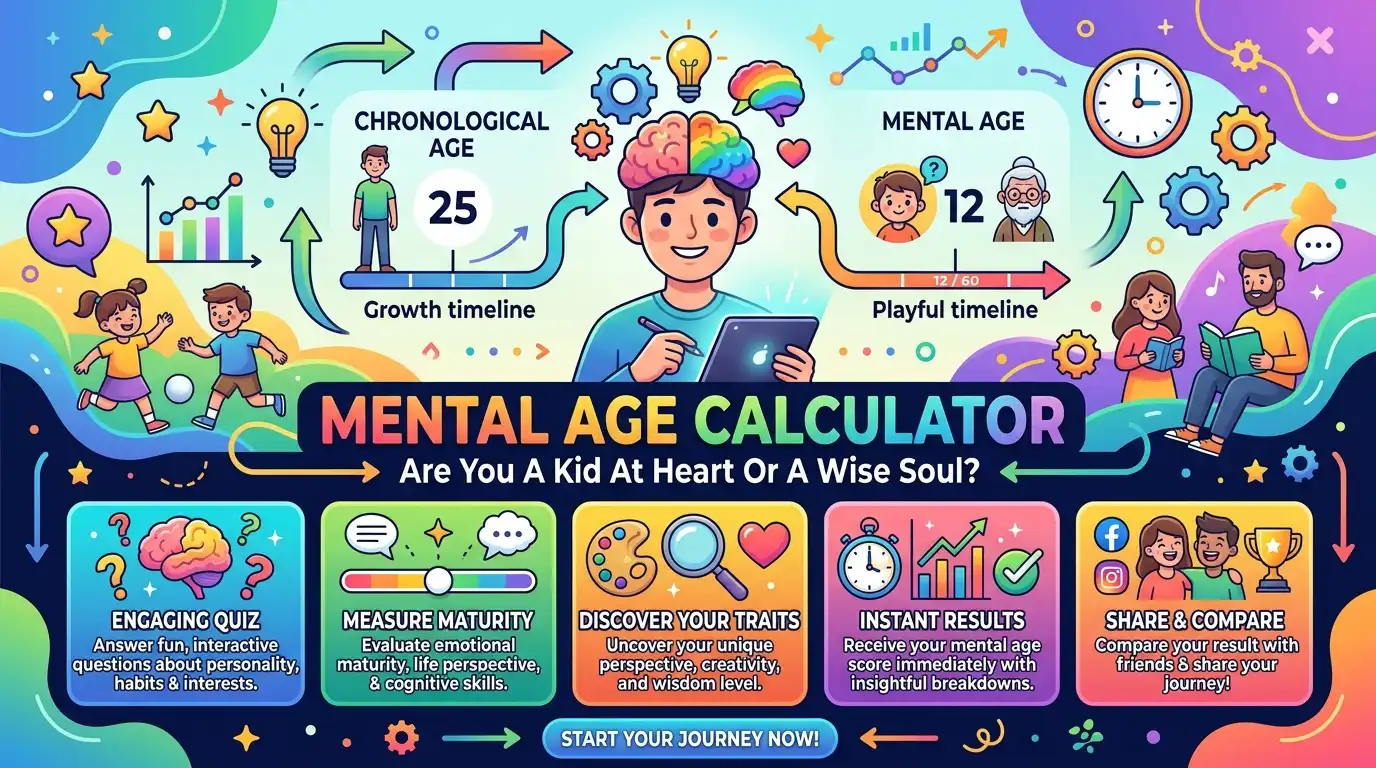
Mental Age Calculator: Calculate Mental Age From IQ
This mental age calculator is designed for anyone who wants to understand the historical relationship between chronological age, IQ, and mental age. Enter an actual age and an IQ score to calculate the mental-age value produced by the traditional ratio-IQ formula. The tool is especially useful for students, teachers, researchers, parents, and people studying the history of intelligence testing. Accuracy matters because the calculation is mathematical, but the interpretation is not the same as a modern clinical IQ assessment. Modern intelligence tests generally use standardized or deviation-IQ scoring rather than treating mental age as a direct measure of an adult’s cognitive maturity.
Free Mental Age Calculator
Calculate the historical mental-age equivalent from chronological age and IQ.
Calculation Breakdown
How This Mental Age Calculator Works
The calculator uses the traditional relationship between mental age, chronological age, and ratio IQ. Historically, the formula was expressed as IQ = mental age ÷ chronological age × 100. Rearranging that equation gives the formula needed when the IQ and actual age are already known.
Chronological age is the person’s actual age. For greater precision, the calculator converts additional months into a decimal fraction of a year. IQ is the score entered by the user. Multiplying chronological age by IQ and dividing by 100 produces the historical mental-age equivalent.
This formula is historically important, but it should not be confused with how contemporary intelligence tests normally generate IQ scores. The American Psychological Association describes modern deviation IQ as a standardized score centered around a mean of 100, rather than the old mental-age ratio approach.
For background, see the APA Dictionary of Psychology definition of IQ, the APA explanation of deviation IQ, and Pearson’s information on the WAIS-5.
Step-by-Step Example Calculation
Example: A child is 10 years old and has an IQ score of 115.
First, identify the chronological age: 10 years.
Next, identify the IQ: 115.
Apply the historical formula:
Mental Age = 11.5 years
Therefore, the historical formula produces a mental-age equivalent of 11 years 6 months. The result is 1.5 years higher than the chronological age.
This does not mean that the child is literally functioning exactly like an average 11-year-6-month-old in every cognitive or emotional area. It is simply the mathematical result of the historical ratio formula.
What Affects Your Mental Age Result?
A calculated mental age depends directly on two inputs: chronological age and IQ. However, the meaning of the result depends heavily on how the IQ score was obtained and which scoring system was used. This distinction is one of the most important issues that many simple online mental age calculators fail to explain.
Mental Age Test vs. IQ-Based Calculation
A mental age test can mean different things online. Some websites use short personality quizzes and ask about preferences, habits, decision-making, entertainment, or lifestyle. Those quizzes can be enjoyable, but they are not equivalent to a standardized intelligence assessment. A mathematical calculator, by contrast, only converts an existing IQ score into the historical mental-age equivalent.
If you search for a mental age test free, check what the test is actually measuring. A quiz that asks six or ten lifestyle questions may be a personality or entertainment quiz rather than a validated intelligence assessment. The difference matters if you intend to use the result for education, clinical decisions, or formal evaluation.
How to Calculate Mental Age From IQ
To understand how to calculate mental age, start with the historical ratio-IQ equation:
Rearranging it gives:
For example, a chronological age of 12 years and an IQ of 110 produces: 12 × 110 ÷ 100 = 13.2 years, or approximately 13 years 2 months.
How to Find Mental Age When You Know Your IQ
If you already have a suitable IQ score, you can use the calculator above to check mental age using the historical formula. You do not need another online quiz to perform the arithmetic. The important question is whether the IQ score itself came from a reliable, appropriately administered assessment.
An online IQ score can be useful for curiosity or practice, but it should not automatically be treated as equivalent to a professionally administered assessment. Standardized testing uses controlled administration, scoring rules, and age-based norms.
How to Calculate Mental Age Without IQ
If you are asking how to calculate mental age without IQ, there is no single scientifically established equation that can produce a valid mental age from ordinary lifestyle questions alone. Historically, mental age was derived from performance on standardized intelligence tasks. Today, psychologists generally interpret standardized cognitive scores rather than assigning a literal mental age to an adult.
Online mental age quizzes may estimate a playful or personality-based “mental age,” but that is a different construct. It should be labeled as an entertainment estimate rather than presented as a clinical intelligence score.
What Is My Mental Age?
If you are wondering what is my mental age, first decide which definition you mean. If you have an IQ score and want the historical ratio result, enter your age and IQ above. If you mean emotional maturity, personality, interests, or how youthful your behavior feels, an IQ formula cannot measure those traits.
Why Modern IQ Scores Are Different
Modern intelligence testing generally uses deviation IQ. The score indicates how an individual’s performance compares with an age-referenced normative group. The conventional mean is 100, and many widely used intelligence tests use a standard deviation of 15.
This is why the historical formula should not be used to claim that an adult with an IQ of 120 has the cognitive functioning of someone who is 20% older. The ratio formula was developed in a different testing framework. Modern tests such as the Wechsler scales use standardized scoring and multiple cognitive domains instead.
Why Chronological Age Matters
Chronological age is not just a number entered for convenience. It is one of the two mathematical variables in the historical formula. If the age changes while the IQ stays constant, the calculated mental age changes proportionally.
For example, an IQ of 120 produces a historical ratio of 1.20. At age 10, the calculation gives 12 years. At age 20, it gives 24 years. That illustrates both the usefulness and the limitation of the historical formula: it describes a mathematical ratio rather than a modern clinical interpretation of cognitive development.
Why the Source of Your IQ Score Matters
The calculator does not change its answer based on whether the IQ came from a professional test, online test, or educational exercise. The arithmetic remains identical. However, the reliability of the final interpretation depends on the quality of the input.
If the result will influence a school placement, developmental assessment, disability determination, or health-related decision, a qualified professional should interpret the underlying standardized assessment rather than relying on an online mental age calculator.
Mental Age Calculation Range Table
The table below shows how the historical formula changes as IQ changes while chronological age remains fixed. These are mathematical examples, not clinical ability classifications.
| Chronological Age | IQ | Historical Mental Age | Difference |
|---|---|---|---|
| 10 years | 85 | 8 years 6 months | -1 year 6 months |
| 10 years | 100 | 10 years | Same age |
| 10 years | 115 | 11 years 6 months | +1 year 6 months |
| 10 years | 130 | 13 years | +3 years |
| 15 years | 110 | 16 years 6 months | +1 year 6 months |
Mental Age Chart: Understanding the Historical Formula
A simple mental age chart can help explain the arithmetic. When IQ is 100, the calculated mental age equals chronological age. When IQ is above 100, the historical formula produces a mental age above chronological age. When IQ is below 100, it produces a mental age below chronological age.
This relationship is mathematical rather than a modern diagnostic rule. In contemporary practice, a person’s cognitive profile can include different strengths and weaknesses in areas such as verbal comprehension, working memory, processing speed, visual-spatial reasoning, and fluid reasoning. A single mental-age number cannot represent all of these domains.
Frequently Asked Questions
What is mental age?
Mental age is a historical concept describing the level of cognitive performance associated with a particular age group. In the old ratio-IQ model, it was compared with chronological age to calculate IQ. Modern intelligence tests generally use standardized deviation scores instead of treating mental age as a direct measure of overall intelligence.
How do I calculate mental age from IQ?
Use the historical formula: mental age = chronological age × IQ ÷ 100. For example, a 10-year-old with an IQ of 115 has a calculated mental age of 11.5 years. This is a historical mathematical conversion and should not be interpreted as a modern clinical assessment of cognitive development.
What is my mental age if my IQ is 120?
It depends on your chronological age. Under the historical ratio formula, multiply your actual age by 1.20. For example, an actual age of 10 years and an IQ of 120 produces a mental-age equivalent of 12 years. The result should not be treated as a literal prediction of cognitive maturity, especially for adults.
Can I calculate my mental age without an IQ test?
There is no single scientifically established formula that calculates a valid mental age from ordinary personality or lifestyle questions. Online mental age quizzes can provide entertainment-based estimates, but they are different from standardized cognitive assessments. For a meaningful cognitive evaluation, professional testing is more appropriate.
Is a free mental age test accurate?
Accuracy depends on what the test measures and how it was developed. Many free mental age quizzes are designed for entertainment and are not validated measures of intelligence. A professionally administered standardized intelligence test follows controlled procedures and age-based norms, making it substantially different from a short online quiz.
Is a mental age calculator the same as an IQ test?
No. A mental age calculator performs arithmetic using an existing IQ score and chronological age. It does not administer cognitive tasks or generate a standardized IQ score. An IQ test measures performance through a structured assessment, while this calculator converts an IQ into a historical mental-age equivalent.
Can adults use an IQ mental age calculator?
Adults can enter their age and IQ and obtain the historical mathematical result. However, the result should be interpreted cautiously because modern adult IQ assessments use deviation scoring rather than the old mental-age ratio. Therefore, the calculated number is best viewed as a historical or educational conversion, not as an adult cognitive-age diagnosis.
What does an IQ of 100 mean in the mental age formula?
In the historical ratio formula, an IQ of 100 makes mental age equal chronological age. For example, a 12-year-old with an IQ of 100 produces a calculated mental age of 12. Modern IQ testing also centers scores around 100, but that does not mean modern tests calculate IQ by dividing mental age by chronological age.
Related Calculators

Asrar Ahmad
Founder of CalculatorSuiteHub.com and Rankify SEO & AI Agency. Specializes in SEO, technical content writing, WordPress development, and AI-powered digital solutions. Builds accurate calculators and helps businesses grow online.