Blood Pressure by Age Calculator 2026 : Check Your BP
Blood Pressure by Age Calculator
Enter your age and blood pressure reading to check the adult BP category and calculate MAP and pulse pressure.
MAP ≈ Diastolic + [(Systolic − Diastolic) ÷ 3]
Pulse Pressure = Systolic − Diastolic
Adult BP categories follow current American Heart Association guidance. Age is used to identify whether adult interpretation is appropriate; it does not create a higher “normal” BP threshold for older adults.
Blood Pressure by Age Calculator: Check Your BP
The blood pressure by age calculator helps you understand a blood pressure reading using your age, systolic blood pressure, and diastolic blood pressure. It also calculates mean arterial pressure (MAP) and pulse pressure so you can see more than just the two numbers displayed on your blood pressure monitor. The important point is that age should be interpreted correctly. Adults do not automatically have a higher “normal” blood pressure limit simply because they are older.
Blood pressure can change because of physical activity, stress, caffeine, smoking, medications, illness, pain, sleep, and measurement technique. Therefore, an online calculator should be used as an educational tool rather than a diagnosis. If your readings repeatedly fall outside the normal range, discuss them with a healthcare professional.
How This Blood Pressure by Age Calculator Works
A blood pressure reading contains two numbers, such as 120/80 mm Hg. The upper number is systolic blood pressure, which represents pressure in the arteries when the heart contracts. The lower number is diastolic blood pressure, representing pressure while the heart relaxes between beats.
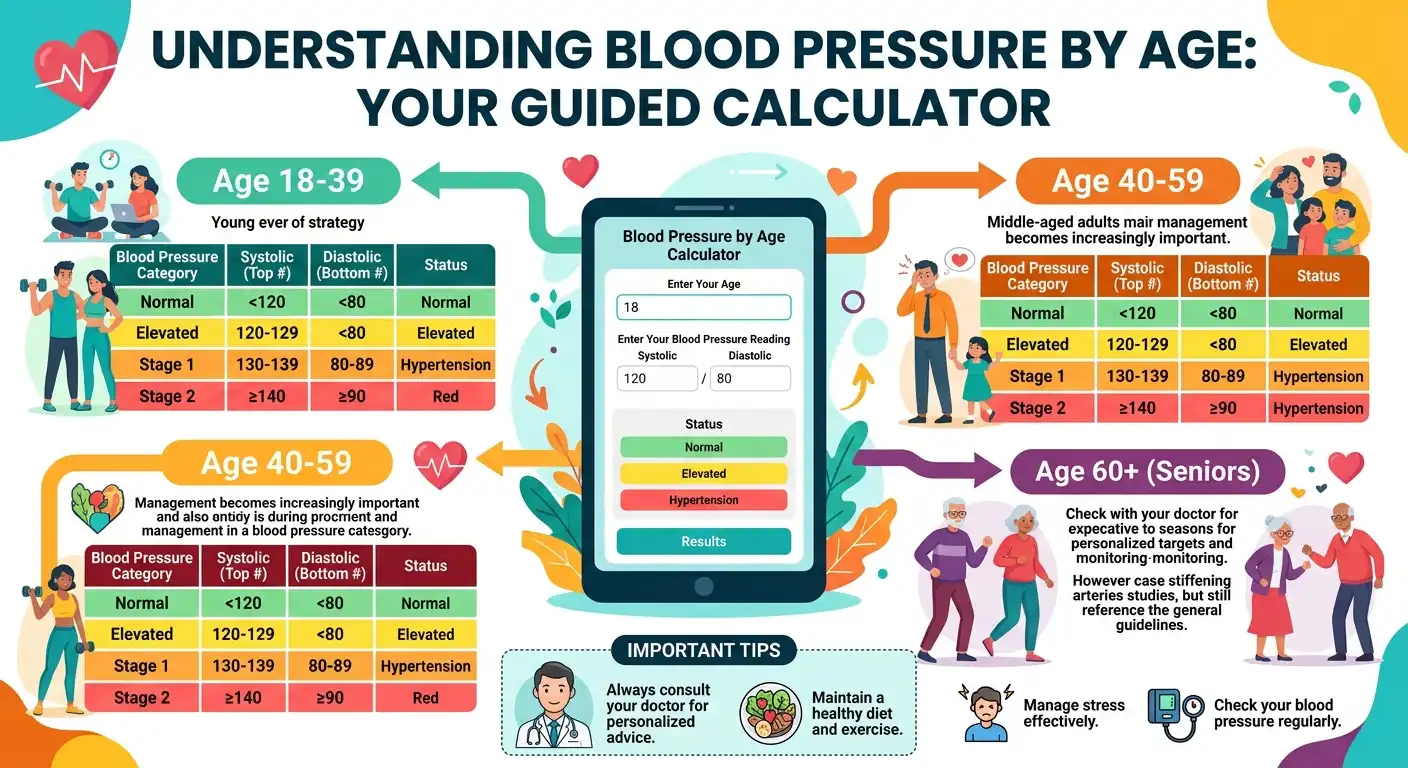
For adults, current American Heart Association categories classify readings below 120/80 mm Hg as normal. A systolic value of 120–129 with a diastolic value below 80 is elevated. Stage 1 hypertension begins at 130–139 systolic or 80–89 diastolic, while stage 2 begins at 140 systolic or 90 diastolic. :contentReference[oaicite:1]{index=1}
The calculator also calculates MAP and pulse pressure. These are mathematical measurements that provide additional context but should not be treated as standalone diagnostic tests.
Blood Pressure Calculator Formula
Mean Arterial Pressure
A commonly used approximation for mean arterial pressure is:
For a reading of 125/78:
MAP ≈ 78 + 15.67
MAP ≈ 93.67 mm Hg
The calculator rounds this to approximately 94 mm Hg.
Pulse Pressure
Pulse pressure is calculated by subtracting diastolic pressure from systolic pressure:
For 125/78:
Step-by-Step Example Calculation
Suppose a 45-year-old adult records a blood pressure of 125/78 mm Hg.
Enter 45 years. This identifies the person as an adult for the calculator’s BP classification.
Enter 125 mm Hg as the upper blood pressure number.
Enter 78 mm Hg as the lower number.
125 systolic with diastolic below 80 falls into the adult elevated category.
The MAP is approximately 94 mm Hg.
The pulse pressure is 47 mm Hg.
How Age Affects Blood Pressure
Age matters when interpreting blood pressure, but it is frequently misunderstood. Blood pressure often increases with age, particularly systolic pressure, but this does not mean that older adults should automatically consider higher readings normal.
For example, a 40-year-old and a 70-year-old with a reading of 145/92 mm Hg are both in the adult stage 2 category. Their overall cardiovascular risk and treatment decisions may differ, but age does not automatically convert the same high reading into a normal one.
Adult Blood Pressure Categories
| Category | Systolic | Diastolic |
|---|---|---|
| Normal | Less than 120 | Less than 80 |
| Elevated | 120–129 | Less than 80 |
| Stage 1 Hypertension | 130–139 | 80–89 |
| Stage 2 Hypertension | 140 or higher | 90 or higher |
| Severe Hypertension | Higher than 180 | and/or higher than 120 |
When systolic and diastolic values fall into different categories, the higher category is generally used for classification. For example, 135/92 has a systolic value in stage 1 but a diastolic value in stage 2, so the higher category applies. :contentReference[oaicite:2]{index=2}
Blood Pressure by Age for Children
A simple adult blood pressure chart should not be used to diagnose young children. Pediatric blood pressure interpretation is different because age, sex, and height are important factors.
For children, a healthcare professional may use age-, sex-, and height-specific percentile tables to determine whether a reading is within the expected range. Therefore, parents should not use adult thresholds to interpret a young child’s blood pressure.
What Can Affect Your Blood Pressure Result?
Measurement Technique
The quality of the blood pressure measurement matters. Sitting incorrectly, talking during measurement, using an unsuitable cuff, or taking a reading immediately after activity can affect the result.
Caffeine, Smoking and Exercise
Caffeine, nicotine and physical activity can temporarily affect blood pressure. The American Heart Association recommends avoiding smoking, caffeine and exercise for about 30 minutes before a home measurement. :contentReference[oaicite:3]{index=3}
Body Position
For a reliable home reading, sit with your back supported, keep both feet flat on the floor, avoid crossing your legs, and support your arm at heart level. The cuff should be placed on the bare upper arm according to the monitor instructions. :contentReference[oaicite:4]{index=4}
Stress and Anxiety
Stress and anxiety can temporarily increase blood pressure. This is one reason a single measurement should not automatically be interpreted as a long-term representation of your usual blood pressure.
Medications and Health Conditions
Medications, kidney disease, diabetes, sleep disorders, cardiovascular disease and other health factors can influence blood pressure. An online calculator cannot account for all of these variables.
How to Get a More Accurate Blood Pressure Reading
Your calculator result is only as useful as the blood pressure reading you enter. The American Heart Association recommends several steps for more reliable home measurements. :contentReference[oaicite:5]{index=5}
1. Rest for at Least Five Minutes
Sit quietly before taking your measurement. Avoid conversation and unnecessary movement while the monitor is operating.
2. Use a Properly Sized Cuff
Use the cuff size recommended for your arm circumference and the specific monitor. A poor cuff fit can affect the accuracy of the measurement.
3. Keep Your Back and Feet Supported
Sit upright with your back supported and both feet flat on the floor. Do not cross your legs.
4. Support Your Arm
Rest your arm on a flat surface with the middle of the upper arm approximately at heart level.
5. Take Multiple Readings
The AHA home measurement instructions recommend taking at least two readings, generally one minute apart, and recording the measurements. :contentReference[oaicite:6]{index=6}
Blood Pressure Reading Examples
| Reading | Adult Category | Reason |
|---|---|---|
| 115/75 | Normal | Both numbers are below the normal thresholds. |
| 125/78 | Elevated | Systolic is 120–129 and diastolic is below 80. |
| 130/80 | Stage 1 | Systolic reaches 130 and diastolic reaches 80. |
| 135/85 | Stage 1 | Both values fall within the stage 1 range. |
| 150/95 | Stage 2 | Systolic is at least 140 and diastolic is at least 90. |
| 185/125 | Severe | The reading exceeds 180 systolic and 120 diastolic. |
Why There Is No Single Normal Blood Pressure by Age
Many online charts claim that normal blood pressure should become progressively higher as a person gets older. That approach can be misleading. Population averages may increase with age, but an average is not the same thing as a clinical target.
Current adult BP categories continue to use established systolic and diastolic thresholds. Age is important when evaluating a person’s overall cardiovascular risk, but it should not be used to make a high blood pressure reading appear automatically normal.
When Is Blood Pressure Dangerously High?
A blood pressure reading higher than 180 systolic and/or 120 diastolic is considered severely high. If you obtain such a reading, repeat it after a short period of rest and seek appropriate medical guidance.
If a very high reading occurs together with symptoms such as chest pain, shortness of breath, back pain, weakness, numbness, vision changes, or difficulty speaking, seek emergency medical care. :contentReference[oaicite:7]{index=7}
Common Blood Pressure Calculator Mistakes
Using Only the Systolic Number
Both systolic and diastolic values matter. A person can have a systolic number in one category and a diastolic number in another.
Assuming High BP Is Normal With Age
Blood pressure may rise with age, but this does not mean that hypertension becomes normal. Current adult categories should still be considered.
Using One Reading as a Diagnosis
One measurement is a snapshot. Repeated readings taken correctly provide more useful information about a person’s typical blood pressure.
Using Adult Charts for Children
Children require pediatric interpretation. Adult thresholds should not be used as a substitute for pediatric assessment.
Frequently Asked Questions
What is normal blood pressure by age?
For adults, normal blood pressure is below 120/80 mm Hg. There is not a separate higher normal threshold simply because someone is older. Children require age-, sex-, and height-specific pediatric interpretation.
Does normal blood pressure increase with age?
Average blood pressure often increases with age, particularly systolic pressure. However, this does not mean that older adults automatically have a higher clinical normal range.
What is a good blood pressure for a 60-year-old?
There is no single BP number that is automatically ideal for every 60-year-old. Under current adult categories, below 120/80 mm Hg is normal. Individual treatment goals depend on overall health and cardiovascular risk.
Is 130/80 high blood pressure?
Yes. A reading of 130/80 reaches the adult stage 1 hypertension category under current AHA categories. A diagnosis should not be based on one isolated measurement.
Is 120/80 normal blood pressure?
Exactly 120/80 is not classified as normal under current adult categories. Normal is below 120 systolic and below 80 diastolic. A systolic value from 120–129 with diastolic below 80 is classified as elevated.
What blood pressure is considered high?
For adults, 130–139 systolic or 80–89 diastolic reaches stage 1 hypertension. A systolic value of 140 or higher or a diastolic value of 90 or higher reaches stage 2 hypertension.
Can children use an adult blood pressure chart?
No. Young children require pediatric assessment using age-, sex-, and height-specific information. An adult BP chart can produce a misleading interpretation for a child.
Can one high reading mean I have hypertension?
Not necessarily. Blood pressure can temporarily change because of stress, exercise, caffeine, smoking, illness, pain and measurement technique. Repeated properly measured readings provide better information.
Related Health & Medical Calculators
Final Takeaway
The blood pressure by age calculator gives you a convenient way to interpret an adult blood pressure reading, calculate mean arterial pressure, and calculate pulse pressure. The most important point is that age should provide context rather than be used to justify an automatically higher normal BP.
For the most useful results, take your blood pressure correctly, preferably using a validated upper-arm monitor, and consider more than one reading. Home monitoring can be useful when performed with appropriate technique. :contentReference[oaicite:8]{index=8}
If your readings repeatedly fall into an elevated or hypertension category, discuss the pattern with a healthcare professional. If you obtain a severely high reading, especially with concerning symptoms, seek appropriate medical care rather than relying on an online calculator.
Medical Sources
American Heart Association – 2025 High Blood Pressure Guideline
American Heart Association – Monitoring Blood Pressure at Home
American Heart Association – Blood Pressure Categories
Medical disclaimer: This calculator is provided for general educational purposes only. It does not diagnose, treat, cure, or prevent any medical condition. Always consult a qualified healthcare professional for individualized medical advice.

Asrar Ahmad
Founder of CalculatorSuiteHub.com and Rankify SEO & AI Agency. Specializes in SEO, technical content writing, WordPress development, and AI-powered digital solutions. Builds accurate calculators and helps businesses grow online.