Best AP Physics C Mechanics Score Calculator 2026 : Predict 1–5
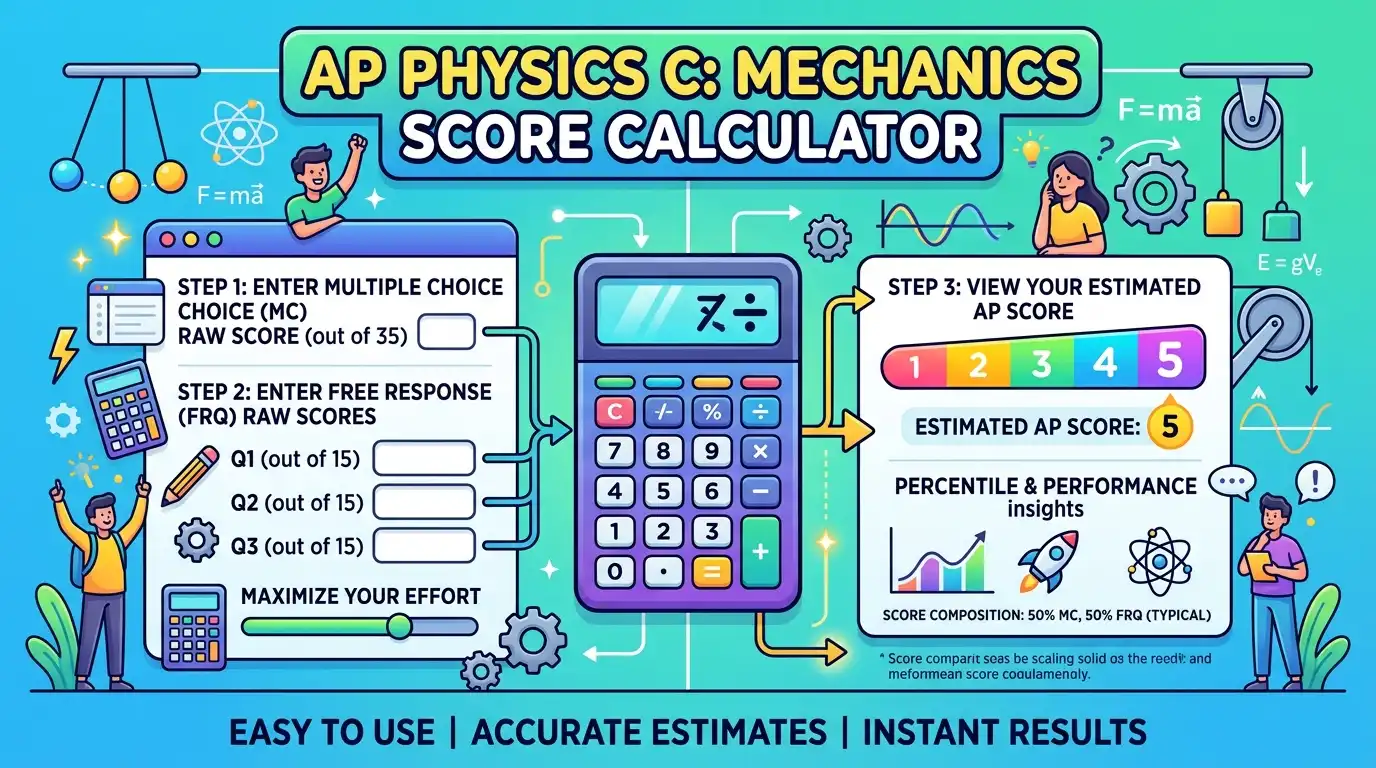
AP Physics C Mechanics Score Calculator
The AP Physics C: Mechanics exam combines a 40-question multiple-choice section with a 40-point free-response section, and both sections contribute equally to the final AP score.
This calculator helps students turn practice-test results into an estimated 1–5 score without pretending that College Board publishes a permanent yearly “curve.”
Enter your MCQ total and the points earned on each of the four FRQs to see your raw composite, percentage, estimated AP score, and section-by-section breakdown.
Because College Board uses statistical score-setting rather than a fixed public conversion table, the result is a planning estimate—not an official AP score.
Predict Your AP Physics C: Mechanics Score
Enter your practice-exam points. Results update instantly when you click the calculation button.
How This Calculator Works
The current AP Physics C: Mechanics assessment has two equally weighted sections. Section I contains 40 multiple-choice questions and represents 50% of the exam score.
Section II contains four free-response questions representing the other 50%. The current FRQ structure assigns 10 points to Mathematical Routines, 12 points to Translation Between Representations, 10 points to Experimental Design and Analysis, and 8 points to Qualitative/Quantitative Translation.
Together, the four FRQs provide 40 possible rubric points.
Because the MCQ section has 40 possible points and the FRQ section also totals 40 points, this calculator can use a straightforward raw composite:
Maximum Raw Composite = 40 + 10 + 12 + 10 + 8 = 80
Composite Percentage = Raw Composite ÷ 80 × 100
The important distinction is the conversion from that composite to the final AP score of 1–5.
College Board does not publish a permanent “AP Physics C curve” that can be applied unchanged every year. Instead, AP score-setting uses research and statistical procedures to establish cut points.
Therefore, the 1–5 bands in this calculator are estimates based on commonly used recent benchmark ranges, not official 2026 cut scores.
College Board AP Physics C: Mechanics Exam
Step-by-Step Example Calculation
Suppose a student completes a full AP Physics C: Mechanics practice exam and gets 30 of the 40 multiple-choice questions correct.
On the free-response section, the student earns 7/10 on Mathematical Routines, 9/12 on Translation Between Representations, 7/10 on Experimental Design and Analysis, and 5/8 on Qualitative/Quantitative Translation.
- MCQ points: 30 out of 40.
- FRQ points: 7 + 9 + 7 + 5 = 28 out of 40.
- Raw composite: 30 + 28 = 58 out of 80.
- Percentage: 58 ÷ 80 × 100 = 72.5%.
- Estimated AP score: using the calculator’s current benchmark bands, 58 falls in the estimated 5 range.
This example also illustrates why looking only at MCQ accuracy can be misleading.
A student with 30 correct answers has a strong Section I result, but the final estimate also depends on the ability to earn rubric points across four different FRQ formats.
A student preparing for a 5 should therefore track both section totals and individual FRQ weaknesses.
What Affects Your AP Physics C Mechanics Score?
AP Physics C Mechanics Score Calculator Inputs
A useful AP mechanics score calculator should accept more than one generic “raw score” because the modern exam separates performance into multiple components.
Entering each FRQ separately makes it easier to identify whether the problem is mathematical execution, representation changes, experimental reasoning, or qualitative-to-quantitative reasoning.
AP Physics C Mechanics Score Calculator: Multiple Choice
Section I currently contains 40 multiple-choice questions and counts for half of the exam score. Each correct response contributes one raw MCQ point.
There is no benefit to leaving a question blank when you can make an educated selection because incorrect answers do not receive a negative-point penalty.
For practice analysis, record both your raw number correct and the topics behind the missed questions.
AP Mechanics Score Calculator: Free Response
The FRQ section is equally important but behaves differently from multiple choice. The scoring rubric awards points for specific elements of the response.
Correct setup, equations, diagrams, reasoning, data analysis, and justified conclusions can all matter.
This means an incomplete numerical solution can still contain valuable rubric points. A calculator that treats the FRQ section as a single percentage hides useful information.
AP Physics C Curve: Why the Estimate Can Change
Students often search for an “AP Physics C curve” as though College Board publishes one fixed table that applies forever.
That is not how AP score setting works. College Board explains that composite scores are translated to the 1–5 scale through statistical processes designed to maintain comparable standards between years.
Consequently, unofficial calculators may produce different boundaries, especially near the transition between a 3 and 4 or a 4 and 5.
The practical lesson is simple: do not treat a predicted 4.0 or 5.0 as guaranteed.
If your practice composite sits close to a boundary, improving even a few rubric points can materially strengthen your position.
FRQ 1: Mathematical Routines
This 10-point question rewards the ability to apply physics and mathematics systematically. Calculus can appear through derivatives, integrals, or relationships involving motion and changing quantities.
A common mistake is jumping directly to a numerical answer without defining variables, establishing the physical relationship, or showing enough mathematical work for the rubric.
FRQ 2: Translation Between Representations
This 12-point question has the largest point allocation among the four FRQs. Students may need to move between diagrams, equations, graphs, numerical information, and written descriptions.
The key skill is recognizing that different representations describe the same physical system. Losing points here can have a noticeable effect because it is the highest-value FRQ.
FRQ 3: Experimental Design and Analysis
The 10-point experimental question tests whether you can design a measurable procedure, identify variables, reduce uncertainty, analyze data, and connect a graph or mathematical relationship to a physical quantity.
Vague statements such as “measure the variables several times” are less useful than specifying what changes, what remains controlled, what is measured, and how the resulting data will be analyzed.
FRQ 4: Qualitative/Quantitative Translation
The final FRQ is worth 8 points and asks students to connect conceptual reasoning with quantitative analysis.
The biggest trap is treating every part like a calculation. When a prompt asks for a qualitative justification, explain the physical principle directly. When it asks for a derivation, show the mathematical connection clearly.
Exam Format and Timing
For the 2026 exam structure, Section I is 40 questions in 80 minutes, while Section II has four FRQs in 100 minutes.
Both sections contribute 50% of the final score. Calculators are permitted, and students should become comfortable using one without allowing calculator work to replace physical reasoning.
AP Physics C Mechanics Score Range Table
The following ranges are practical estimates used by this calculator for the current 80-point structure.
They should not be described as official College Board cut scores. The exact boundaries used by AP score setting are not published as a permanent yearly curve.
| Estimated AP Score | Raw Composite | Approx. Percentage | College Board Description |
|---|---|---|---|
| 5 | 52–80 | 65%–100% | Extremely well qualified |
| 4 | 40–51 | 50%–63.75% | Well qualified |
| 3 | 31–39 | 38.75%–48.75% | Qualified |
| 2 | 21–30 | 26.25%–37.5% | Possibly qualified |
| 1 | 0–20 | 0%–25% | No recommendation |
These benchmark bands are intentionally labeled as estimates. They are useful for practice planning, but they should not be confused with an official College Board conversion table.
For perspective, College Board’s published 2025 AP Physics C: Mechanics distribution was 21.7% scoring 5, 24.0% scoring 4, 27.5% scoring 3, 16.0% scoring 2, and 10.8% scoring 1.
The 2026 score-distribution page should be treated separately from an unofficial raw-score conversion because distribution percentages do not reveal the exact composite cut points.
AP Physics C Mechanics Score Calculator FAQs
What is a good AP Physics C Mechanics score?
A 3 is classified by College Board as qualified, while a 4 is well qualified and a 5 is extremely well qualified.
Whether a 3, 4, or 5 earns college credit depends on the individual college or university. Always check the institution’s current AP credit and placement policy.
How is AP Physics C Mechanics scored?
The current exam has 40 multiple-choice questions and four free-response questions worth 40 rubric points in total.
Section I and Section II each account for 50% of the final exam score. The raw results are combined into a composite before the 1–5 AP scale is applied.
Is there an AP Physics C Mechanics curve?
There is no permanent public “curve” that works identically every year. College Board uses statistical processes to set score cut points and maintain consistency across exam administrations.
That is why unofficial AP Physics C Mechanics score calculators can disagree, especially near score boundaries.
How many questions are on AP Physics C Mechanics?
The current AP Physics C: Mechanics format has 40 multiple-choice questions plus four free-response questions.
The FRQs are Mathematical Routines, Translation Between Representations, Experimental Design and Analysis, and Qualitative/Quantitative Translation.
How many points do I need for a 5 on AP Physics C Mechanics?
There is no officially published permanent raw-score requirement that guarantees a 5 for every administration.
This calculator currently uses 52 out of 80 as a practical estimated benchmark for a 5. Treat 52 as an estimate rather than an official cutoff.
Can I calculate my AP Mechanics score from FRQ points?
Yes. Enter the points earned on all four FRQs: up to 10 for Mathematical Routines, 12 for Translation Between Representations, 10 for Experimental Design and Analysis, and 8 for Qualitative/Quantitative Translation.
Add those 40 possible FRQ points to your 40 possible MCQ points to obtain the calculator’s 80-point raw composite.
Does AP Physics C Mechanics have negative marking for wrong MCQ answers?
No. Multiple-choice scoring is based on the number of correct answers, and points are not deducted for incorrect or unanswered responses.
For practice tests, analyze why an answer was wrong, but a wrong response does not subtract an additional point from the MCQ total.
Why does my predicted AP score differ between calculators?
Different websites may use different historical exam structures, projected curves, composite scales, or unofficial cut points.
This calculator separates the four FRQs and uses the current 40-MCQ plus 40-FRQ structure. It labels the final 1–5 conversion as an estimate.
Related AP Math & Science Calculators

Asrar Ahmad
Founder of CalculatorSuiteHub.com and Rankify SEO & AI Agency. Specializes in SEO, technical content writing, WordPress development, and AI-powered digital solutions. Builds accurate calculators and helps businesses grow online.