The Ultimate Time and a Half Calculator – Free Online
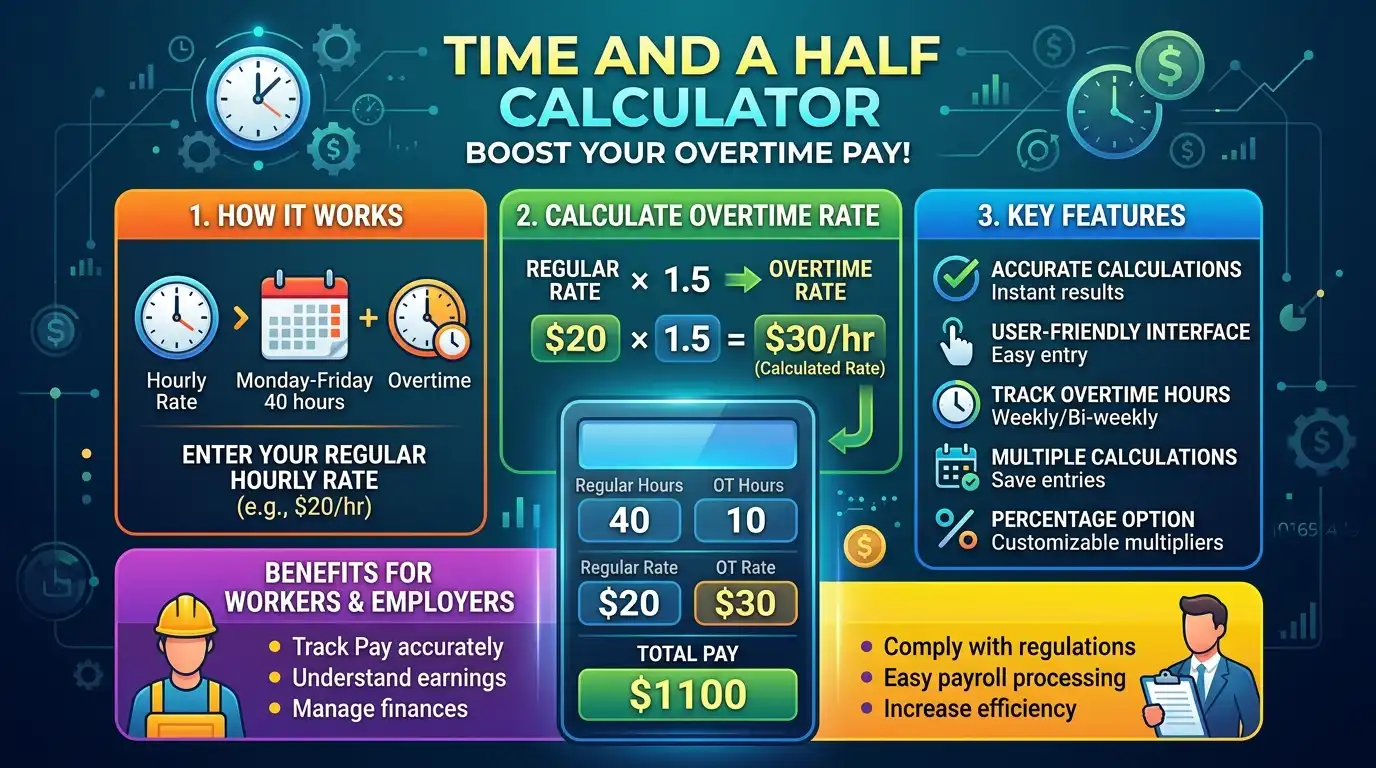
Time and a Half Calculator
If you’re checking whether a paycheck is right, this time and a half calculator is built for hourly workers, payroll clerks, and small-business owners who need an exact number, not a rough guess.
Unlike most tools that only handle a single overtime rate, this one also covers double-time hours, holiday premium pay, and an estimated take-home figure. Enter your numbers below for an instant, itemized breakdown.
Minimum: $1,283.40 · Typical: $1,395.00 · Maximum: $1,506.60
Pay breakdown by category
Planning estimate only: this time and a half calculator provides a gross-pay and take-home estimate based on the figures you enter and a typical deduction rate. It does not account for your specific tax filing status, state tax brackets, benefit deductions, or your employer’s exact pay policy. Verify final figures with your pay stub, payroll department, or a licensed accountant before relying on them.
How This Calculator Works: Formula & Explanation
The core math behind any time and a half calculator is simple, but real paychecks stack several formulas together. Here is each piece this tool uses, based on the federal overtime formula recognized under the Fair Labor Standards Act (FLSA).
Time-and-a-Half Pay = Hourly Rate × 1.5 × Overtime Hours
Double-Time Pay = Hourly Rate × 2 × Double-Time Hours
Holiday Premium Pay = Hourly Rate × 1.5 × Holiday/Weekend Hours
Total Gross Pay = Regular Pay + Time-and-a-Half Pay + Double-Time Pay + Holiday Premium Pay
Hourly rate is your standard, pre-overtime wage. Overtime hours are any hours beyond the legal threshold — 40 per week under federal law, or 8 per day in states with daily overtime rules.
Double-time hours apply in a smaller set of cases, most commonly California’s rule for shifts longer than 12 hours in one day.
Holiday or weekend premium hours aren’t a legal requirement nationally, but many employers pay them at 1.5× as policy. This calculator keeps that bucket separate from legally mandated overtime.
Step-by-Step Example Calculation
Example: A warehouse associate earning $19.75/hour
Maria works a 47-hour week: 40 regular hours, plus 7 hours of overtime, with no double-time or holiday shifts that week.
- Regular pay: $19.75 × 40 = $790.00
- Time-and-a-half rate: $19.75 × 1.5 = $29.63/hr
- Overtime pay: $29.63 × 7 = $207.38
- Total gross pay for the week: $790.00 + $207.38 = $997.38
Plug these same numbers into the calculator above to confirm the result and see the full visual breakdown.
What Affects Your Time and a Half Pay
A time and a half calculator is only as accurate as the rules behind it. These are the factors that most often change the final number, and the ones generic calculators tend to skip.
State Overtime Rules Change the Time and Half Calculator Math
Federal law only counts hours worked beyond 40 in a single workweek. California, Alaska, and Nevada go further and require time and a half after just 8 hours in one workday, no matter the weekly total.
California also requires double time after 12 hours in a single day, or after 8 hours on a seventh consecutive workday.
If you work irregular daily schedules in one of these states, a purely weekly calculation will understate what you’re owed — which is why this tool separates a dedicated double-time field instead of folding everything into one multiplier.
Salaried Employees Need a Converted Hourly Rate
Salary alone doesn’t tell you whether time and a half applies. Only non-exempt salaried employees qualify.
To find their effective hourly rate, divide the weekly salary by the standard number of hours it’s meant to cover (commonly 40), then apply the usual 1.5× multiplier to hours worked beyond that. A $1,000 weekly salary over 40 hours works out to a $25/hour base rate, and a $37.50 time and a half rate for overtime.
Exempt employees — many salaried managers and certain professional roles — aren’t entitled to overtime pay under federal law regardless of hours worked. If you’re tracking tenure in a role for raise or benefits purposes, our years of service calculator can help separately.
Multiple Pay Rates Require a Blended Rate
Workers who split a single workweek between two different jobs or pay rates for the same employer don’t simply use the higher or lower rate for overtime.
Federal rules require a weighted average: add total earnings across both rates, divide by total hours worked, and pay half of that blended rate for every overtime hour on top of straight-time pay already earned.
Skipping this step is one of the most common payroll errors in workplaces with mixed-rate scheduling.
Tipped Employees and Time in a Half Calculator Adjustments
For tipped workers paid a reduced cash wage plus a tip credit, the overtime multiplier still applies to the full minimum wage, not the lower cash wage the employer pays directly.
Employers cannot apply the tip credit again to overtime hours the same way they do to regular hours — a detail that trips up many restaurant and hospitality payroll calculations.
Holidays, Weekends, and Shift Differentials
Extra pay for working a holiday or weekend is a company policy or union benefit, not a federal requirement.
Where it applies, it’s usually layered on top of — not instead of — any legally required overtime, which is why this calculator tracks holiday premium hours in their own field rather than merging them into standard overtime hours.
Overtime Multiplier Comparison
| Pay Type | Multiplier | Typically Applies When | Example at $20/hr base |
|---|---|---|---|
| Regular pay | 1.0× | First 40 hours/week (or per employer policy) | $20.00/hr |
| Time and a half | 1.5× | Hours beyond 40/week (federal minimum) | $30.00/hr |
| Daily overtime (CA/AK/NV) | 1.5× | Beyond 8 hours in one workday | $30.00/hr |
| Double time | 2.0× | Beyond 12 hrs/day in CA, or by employer policy | $40.00/hr |
| Holiday/weekend premium | 1.5× (typical) | Company policy or union contract, not federal law | $30.00/hr |
Frequently Asked Questions
What is time and a half pay?
Time and a half pay is one and a half times an employee’s standard hourly rate. Non-exempt employees must receive it for every hour worked beyond 40 in a single workweek under federal law. A $20 base rate becomes a $30 time and a half rate for those overtime hours.
How do I calculate time and a half for $18 an hour?
Multiply $18 by 1.5 to get a $27/hour time and a half rate. Six overtime hours at that rate comes to $162, which gets added to your regular pay for the first 40 hours to reach your total for the week.
Does time and a half apply to salaried employees?
Only non-exempt salaried employees qualify. Divide the weekly salary by standard hours to find an equivalent hourly rate, then apply the 1.5× multiplier to hours beyond 40. Exempt employees, typically salaried managers and certain professionals, aren’t entitled to overtime pay.
Which states require daily overtime instead of just weekly overtime?
California, Alaska, and Nevada require time and a half after 8 hours in a single day, regardless of the weekly total. California also requires double time after 12 hours in one day, or after 8 hours on a seventh consecutive workday.
Is time and a half required after 8 hours in a day?
Only in states with daily overtime laws. Federal law counts only hours past 40 in a workweek, so an 8-hour daily trigger isn’t universal. Always confirm your specific state’s labor code, since some states set stricter daily rules than federal law requires.
How do you calculate a blended overtime rate for two jobs at different pay?
Add total earnings from both rates for the week, divide by total hours worked to get a weighted-average rate, then pay half of that blended rate for every overtime hour. Federal law requires this weighted method whenever someone works at two or more rates in one workweek.
Does time and a half include bonuses or commissions?
Often yes. Non-discretionary bonuses and commissions tied to production or attendance usually get folded into the regular rate before overtime is calculated, raising the effective rate above a simple hourly multiplication. Purely discretionary bonuses are typically excluded.
Is holiday pay the same as time and a half?
Not legally. Many employers voluntarily pay time and a half or double time for holiday shifts as a benefit, since federal law doesn’t require extra holiday pay. Holiday premium pay is a policy or contract term, while overtime time and a half is a legal requirement for non-exempt workers.
Related Calculators
Sources: overtime thresholds and rules referenced from the U.S. Department of Labor, Wage and Hour Division, the Fair Labor Standards Act overview, and the U.S. Bureau of Labor Statistics wage concepts guide. This page is for general planning purposes and is not legal or tax advice.

Asrar Ahmad
Founder of CalculatorSuiteHub.com and Rankify SEO & AI Agency. Specializes in SEO, technical content writing, WordPress development, and AI-powered digital solutions. Builds accurate calculators and helps businesses grow online.