Best Planetary Age Calculator: Find Your Age on 8 Planets
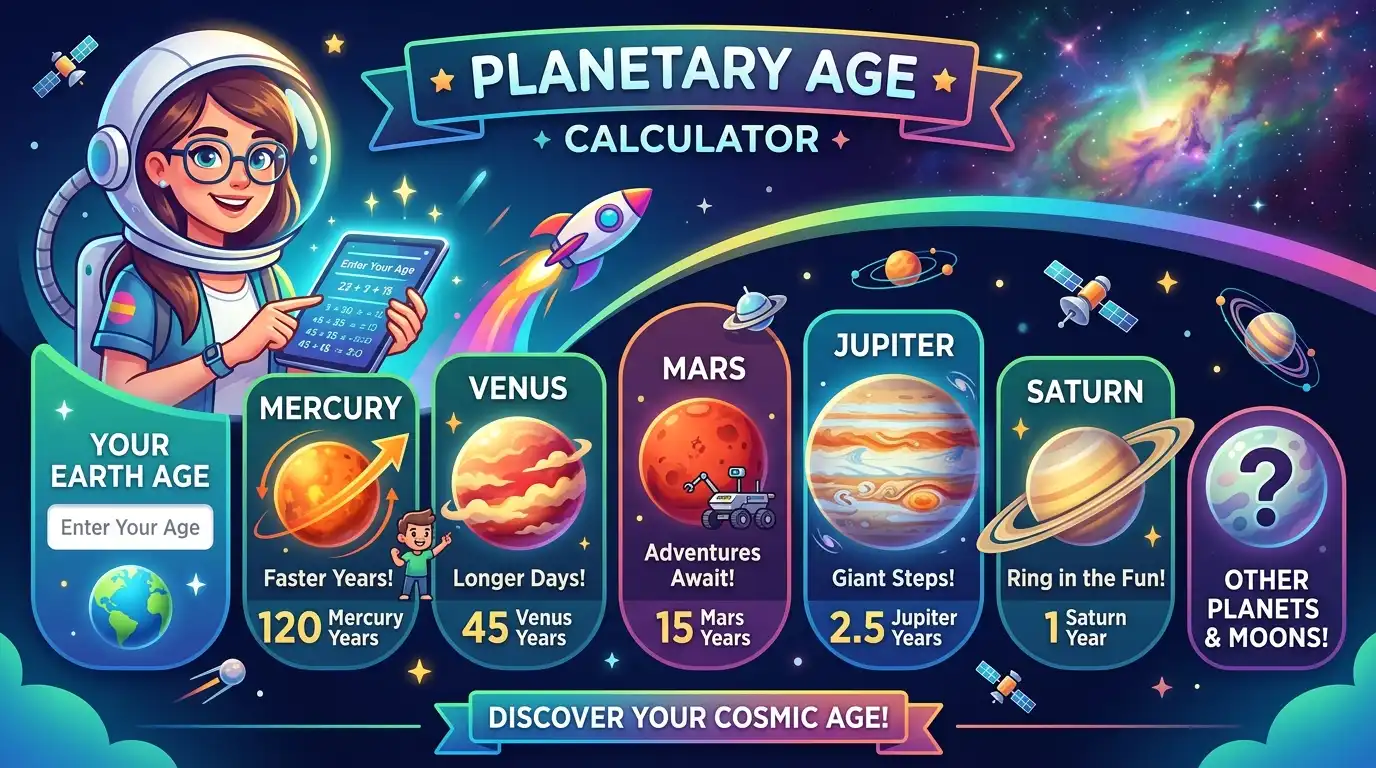
Planetary Age Calculator
Discover how old you would be on Mercury, Venus, Earth, Mars, Jupiter, Saturn, Uranus, and Neptune. This planet age calculator converts the time you have lived on Earth into planetary years using each planet’s actual sidereal orbital period around the Sun.
Calculate Your Age on Other Planets
How Planetary Age Calculator Works
A planetary age calculator does not change your actual chronological age. Instead, it asks how many times another planet has completed an orbit around the Sun during your lifetime.
Because each planet has a different orbital period, your numerical age changes from one planet to another. Mercury has a much shorter year than Earth, while Neptune takes almost 165 Earth years to orbit the Sun.
This tool first determines the elapsed time between your date of birth and today’s date. It then divides that time by the selected planet’s sidereal orbital period.
The same elapsed Earth time is also converted for all eight planets. This lets you compare your planetary ages at once.
NASA/JPL lists Mercury’s orbital period as about 0.2408467 Earth years. Earth’s is about 1.0000174 years, while Mars takes about 1.8808476 years.
Jupiter takes about 11.862615 years, Saturn about 29.447498 years, Uranus about 84.016846 years, and Neptune about 164.79132 years.
Formula & Explanation
The calculation uses the planet’s orbital period rather than its rotation period. This distinction matters because a planetary year means one complete orbit around the Sun.
- Elapsed Earth Time: the number of days between your birth date and today.
- Earth year: the Earth-year reference used to express elapsed time.
- Planetary orbital period: the time a planet takes to orbit the Sun once.
- Planetary age: elapsed Earth years divided by the planet’s orbital period.
For practical purposes, the calculator uses 365.2425 days as the length of an Earth year. This keeps the day-based calculation consistent across the planets.
The underlying orbital periods come from NASA/JPL planetary data. They are used as the astronomical basis for the conversion.
Step-by-Step Example Calculation
Suppose someone was born on January 1, 1990. If the elapsed time is approximately 36.62 Earth years, their Mars age can be calculated.
Mars has an orbital period of approximately 1.8808476 Earth years. The calculation therefore becomes:
The same person would be approximately 152.02 Mercury years. Mercury completes its orbit in only about 0.2408467 Earth years.
The same elapsed time would represent only about 0.22 Neptune years. Neptune needs roughly 164.79 Earth years to complete one orbit.
This shows why planetary ages can look dramatically different. The difference comes from the orbital clock used for the comparison.
What Affects Your Planetary Age Result?
Planet’s Orbital Period
The most important factor is the length of the planet’s year. A shorter orbital period produces a larger numerical age.
Mercury is the clearest example because its year lasts only about 0.241 Earth years. A person who is 30 Earth years old would be more than 124 Mercury years old.
Neptune produces the opposite result because one Neptune year lasts nearly 165 Earth years. This makes the numerical Neptune age much smaller.
Planet Age Calculator Precision
A basic calculator may divide your age in whole years by a rounded orbital period. That approach is simple but can introduce small differences.
This calculator works from elapsed days first. It then converts the result using the selected planet’s orbital period.
This preserves fractions of a year and provides a more consistent result. It is especially useful when your birthday has not occurred exactly on today’s date.
Birth Date and Leap Years
Your birth date matters because chronological age is not always an exact whole number. Leap years and the number of days in each month affect total elapsed time.
For that reason, entering a complete date of birth is more precise than entering only a birth year. The calculator uses the exact date to determine elapsed days.
Planetary Year vs. Planetary Day
One common mistake is confusing a planet’s day with its year. A planet’s rotation period describes how quickly it spins on its axis.
Its orbital period describes how long it takes to travel around the Sun. A planet age calculator uses the orbital period.
Why Your Weight Does Not Enter the Calculation
Your mass, height, body weight, and gravity-related measurements are not required. They do not affect the conversion from elapsed time to planetary years.
Gravity matters for questions about how much you would weigh on another world. It does not determine your planetary age.
Planetary Age Is Not Biological Aging
If you are 40 Earth years old and 169 Mercury years old, you have not physically aged 169 times. Your body and life history are still based on the same elapsed duration.
The number is simply another way to count the same time. It uses Mercury’s orbital cycle instead of Earth’s orbital cycle.
Earth Is the Reference Planet
Earth provides the reference because your birth date and current date are normally measured using Earth-based civil time.
NASA’s planetary comparison data identifies Earth’s orbital period as approximately one Earth year. It also provides the corresponding periods for the other planets.
Planetary Age Comparison Table
| Planet | Orbital Period (Earth Years) | Approximate Planet Years for 30 Earth Years | Relative Year Length |
|---|---|---|---|
| Mercury | 0.2408467 | 124.56 | Very short |
| Venus | 0.61519726 | 48.76 | Short |
| Earth | 1.0000174 | 30.00 | Reference |
| Mars | 1.8808476 | 15.95 | Long |
| Jupiter | 11.862615 | 2.53 | Very long |
| Saturn | 29.447498 | 1.02 | Very long |
| Uranus | 84.016846 | 0.36 | Extremely long |
| Neptune | 164.79132 | 0.18 | Extremely long |
The orbital-period figures above are based on NASA/JPL planetary parameters. NASA’s Solar System resources also describe the eight planets and their orbital characteristics.
Planet Age Calculator: Quick Interpretation
Mercury gives the largest numerical age because it has the shortest year. Venus also produces a higher age than Earth.
Mars produces an age of roughly half your Earth age. Jupiter, Saturn, Uranus, and Neptune produce progressively smaller numbers.
The result is best understood as an orbital comparison rather than a prediction. It does not represent biological aging.
If your calculator shows 20 Mars years, Mars has completed approximately 20 orbital cycles during your lifetime. It does not mean you are biologically 20 years old.
Frequently Asked Questions
How does a planetary age calculator work?
A planetary age calculator divides your elapsed Earth time by another planet’s orbital period. Because each planet takes a different amount of time to orbit the Sun, the numerical age changes.
What is a planet age calculator?
A planet age calculator converts your Earth age into the equivalent number of years on another planet. It uses that planet’s orbital period around the Sun.
How old would I be on Mars?
Your Mars age is your elapsed Earth time divided by approximately 1.8808476 Earth years. For example, someone who is 30 Earth years old would be about 15.95 Mars years old.
How old would I be on Mercury?
Mercury has an orbital period of approximately 0.2408467 Earth years. As a result, your Mercury age is about 4.15 times your Earth age.
Which planet gives the highest planetary age?
Mercury gives the highest numerical planetary age among the eight planets. This is because it has the shortest orbital period.
Which planet gives the lowest planetary age?
Neptune gives the lowest numerical planetary age among the eight planets. Its orbital period is approximately 164.79 Earth years.
Does my age really change on another planet?
No. Your actual chronological and biological age does not change. Planetary age is simply another way of counting the same elapsed time.
Does this calculator use real planetary data?
Yes. The calculation uses published planetary orbital periods from NASA/JPL. These values provide the astronomical basis for the planetary age conversion.
Related Calculators
Scientific Sources
Planetary orbital periods and physical parameters are based on NASA/JPL Solar System Dynamics data. NASA’s Solar System resources are also used for planetary information.


Asrar Ahmad
Founder of CalculatorSuiteHub.com and Rankify SEO & AI Agency. Specializes in SEO, technical content writing, WordPress development, and AI-powered digital solutions. Builds accurate calculators and helps businesses grow online.