IRS RMD Age Calculator 2026: Easily Find RMD Age & Deadline
How This IRS RMD Age Calculator Works
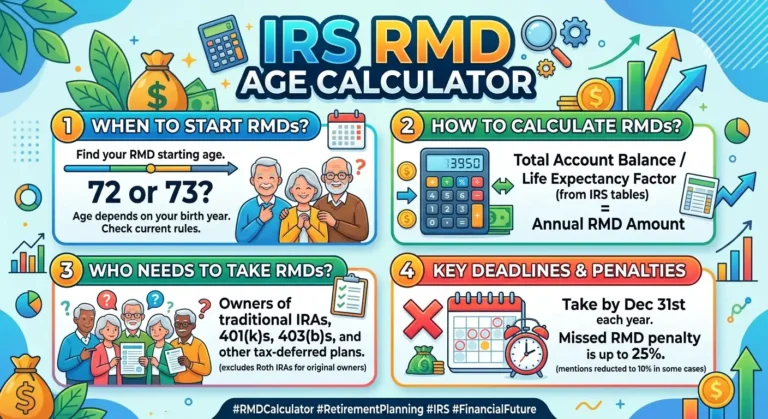
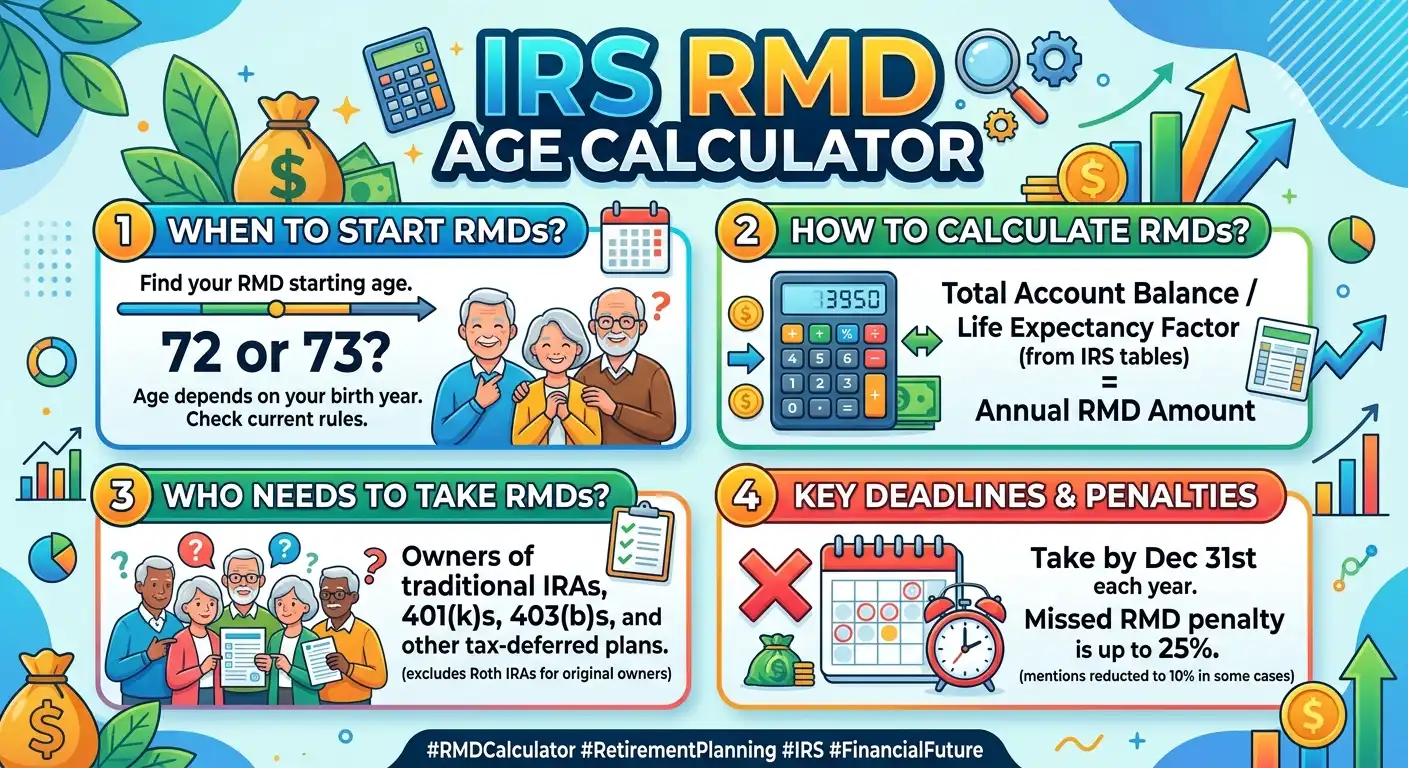
This IRS RMD Age Calculator helps you find the age when required minimum distributions begin and estimate your first RMD amount. It works for traditional IRAs, 401(k), 403(b), SEP IRA, SIMPLE IRA and similar retirement accounts.
Your date of birth matters most, since the RMD starting age has changed over time. People born 1951–1959 generally start RMDs at 73, while those born 1960 or later generally start at 75.
RMD Formula and Calculation
For most original account owners, the basic RMD formula uses your prior year-end balance and an IRS life-expectancy factor from the applicable distribution table.
For example, with a $500,000 December 31 balance and a distribution period of 26.5, the estimated RMD would be:
Account balance: $500,000
IRS distribution factor: 26.5
Calculation: $500,000 ÷ 26.5
Estimated RMD: approximately $18,867.92
The distribution factor shrinks as you age, so RMDs generally represent a larger percentage of your balance each year.
RMD Age 73 vs. RMD Age 75
A key recent change is the higher RMD starting age. Older articles may still say 70½ or 72, but current rules have raised it for many taxpayers.
| Birth Date | General RMD Starting Age | General Planning Rule |
|---|---|---|
| Before July 1, 1949 | 70½ | Older RMD rules generally apply |
| July 1, 1949 – December 31, 1950 | 72 | SECURE Act transition group |
| January 1, 1951 – December 31, 1959 | 73 | Current age-73 group |
| January 1, 1960 or later | 75 | Current age-75 group |
There’s no single RMD age for everyone — your birth year is the first thing to check when determining your required beginning date.
Step-by-Step RMD Example
Suppose Sarah was born on June 15, 1953 and has $500,000 in a traditional IRA. She wants to estimate her RMD for 2026.
- Sarah was born in 1953.
- Her applicable RMD starting age is generally 73.
- She reaches age 73 during 2026.
- Therefore, 2026 is generally her first RMD year.
- Assume her December 31, 2025 IRA balance was $500,000.
- The Uniform Lifetime Table factor at age 73 is 26.5.
- $500,000 ÷ 26.5 = approximately $18,867.92.
Sarah’s estimated first RMD would therefore be approximately $18,867.92 under this simplified standard calculation.
Her first RMD has a special deadline — she can generally delay it to April 1, 2027, but her 2027 RMD is still due by December 31, 2027. Delaying can mean two taxable distributions in one year.
What Affects Your RMD Result?
Your Date of Birth
Your date of birth determines which RMD starting-age rule applies, which is why an accurate calculator needs your full birth date, not just your current age.
Someone born in 1955 and someone born in 1960 can have different RMD starting ages, so an incorrect birth year can shift your first RMD year by two years.
Traditional IRA RMD Rules
Traditional IRAs become subject to RMDs once you reach the applicable starting age. Unlike some employer plans, still working doesn’t normally let you postpone an IRA RMD.
SEP IRAs and SIMPLE IRAs also have RMD requirements, although account owners should still verify the rules applicable to their particular circumstances.
401(k) RMD Age
A 401(k) differs from an IRA here — employees still working for the employer sponsoring an eligible plan may qualify for a still-working exception that delays RMDs.
This exception isn’t automatic. Plan rules matter, and it generally doesn’t apply if you own more than 5% of the business sponsoring the plan.
403(b) and 457(b) Plans
403(b) and 457(b) plans don’t always follow the same RMD treatment as an IRA — some have specific aggregation and distribution rules.
If you have multiple retirement accounts, check whether each account’s RMD must be calculated and distributed separately or whether aggregation is permitted.
Roth IRA RMD Rules
The original owner of a Roth IRA generally does not have lifetime required minimum distributions. This is one of the major differences between Roth IRAs and traditional IRAs.
Inherited Roth IRAs are different, though — beneficiaries can face distribution requirements even without lifetime RMDs for the original owner.
Spouse More Than 10 Years Younger
If your spouse is your sole beneficiary and more than 10 years younger, the Joint and Last Survivor Table can generally replace the standard Uniform Lifetime Table.
This special table can mean a larger distribution period and smaller RMD, so age and balance alone may not give a complete estimate for every taxpayer.
December 31 Account Balance
The standard RMD calculation generally uses the value of the applicable account at the close of December 31 of the previous year.
For a 2026 RMD, that means using your December 31, 2025 balance — using today’s value instead would give a different result from the standard IRS calculation.
Inherited IRA RMD Rules
Inherited IRAs are where a basic calculator falls short — rules depend on the beneficiary’s relationship to the owner, the owner’s required beginning date, and the date of death.
If you inherited an IRA or retirement plan, do not rely on a standard original-owner RMD calculator without checking the specific inherited-account rules.
IRS RMD Distribution Factors
These examples show distribution factors from the Uniform Lifetime Table for original owners. The percentage equals 1 divided by the distribution factor.
| Age | Distribution Period | Approximate RMD Percentage |
|---|---|---|
| 73 | 26.5 | 3.77% |
| 74 | 25.5 | 3.92% |
| 75 | 24.6 | 4.07% |
| 76 | 23.7 | 4.22% |
| 77 | 22.9 | 4.37% |
| 78 | 22.0 | 4.55% |
| 79 | 21.1 | 4.74% |
| 80 | 20.2 | 4.95% |
| 85 | 16.0 | 6.25% |
| 90 | 12.2 | 8.20% |
These percentages help illustrate the calculation but aren’t fixed — your actual RMD depends on the applicable IRS factor and your prior year-end balance.
When Is the First RMD Due?
Your first RMD gets special treatment — you can generally take it in the year you reach your RMD age, or delay it until April 1 of the following year.
For example, if 2026 is your first RMD year, the first distribution can generally be delayed until April 1, 2027. But your 2027 RMD would generally still be required by December 31, 2027.
How Much Is My RMD?
Your RMD depends mainly on your balance and IRS distribution factor. For example, a $300,000 balance with a 26.5 factor gives roughly $11,320.75.
At $1 million with the same 26.5 factor, the RMD would be about $37,735.85 — it scales directly with your balance when the same factor applies.
| Account Balance | Factor | Estimated RMD |
|---|---|---|
| $250,000 | 26.5 | $9,433.96 |
| $500,000 | 26.5 | $18,867.92 |
| $750,000 | 26.5 | $28,301.89 |
| $1,000,000 | 26.5 | $37,735.85 |
Common RMD Mistakes to Avoid
1. Using an outdated RMD age
Older websites may still list age 72. Current rules have changed, so check your birth year against the current RMD age schedule.
2. Using the current account balance
The standard calculation uses your prior December 31 balance — this year’s market gains or losses don’t replace that starting figure.
3. Forgetting the younger-spouse rule
If your spouse is your sole beneficiary and more than 10 years younger, the standard Uniform Lifetime Table may not be the correct table.
4. Treating an inherited IRA like your own IRA
Inherited retirement accounts can have significantly different distribution requirements. The beneficiary’s status and the original owner’s circumstances can affect the rules.
5. Assuming all workplace plans are identical
A 401(k), 403(b), and 457(b) can have different plan provisions. Always check your plan administrator’s rules when the account is employer-sponsored.
RMDs and Taxes
An RMD is generally included in taxable income unless an exception applies. There’s no separate “RMD tax rate” — it simply adds to your taxable income for the year.
That makes RMD planning important for retirees with large balances, since timing can interact with other income, Medicare thresholds and Roth conversions.
A calculator can estimate the distribution amount, but it cannot determine your complete tax liability without information about your entire financial situation.
Can an RMD Be Donated to Charity?
Eligible IRA owners can use a qualified charitable distribution (QCD) as part of a giving strategy — it’s paid directly from an IRA to an eligible charity and can receive favorable tax treatment.
A QCD has its own eligibility rules and annual limits — it’s different from taking a normal distribution and donating it yourself. Confirm current rules with the IRS and your IRA custodian.
Frequently Asked Questions About RMD Age
What is the RMD age for someone born in 1955?
Someone born in 1955 generally starts RMDs at age 73, in the year they reach that age. The first distribution can be delayed to April 1 of the next year, though that can mean two RMDs in one calendar year.
What is the RMD age for someone born in 1960?
Someone born in 1960 generally starts RMDs at age 75 under current rules. Exact requirements can still depend on the account type and any special circumstances.
Is the RMD age 73 or 75?
Both, depending on your birth year. People born 1951–1959 generally start at 73, while those born 1960 or later generally start at 75.
How do I calculate my RMD?
Divide your prior December 31 balance by the IRS distribution period for your age, generally using the Uniform Lifetime Table — unless your spouse is your sole beneficiary and over 10 years younger.
When does my first RMD have to be taken?
Your first RMD is generally due by April 1 of the year after you reach RMD age; later RMDs are due by December 31. Delaying the first can mean two distributions the next year.
Can I delay my RMD if I am still working?
You may delay RMDs from an eligible employer plan if you’re still working there. This doesn’t apply to traditional, SEP or SIMPLE IRAs, and ownership rules can limit it.
Do Roth IRAs have RMDs?
The original Roth IRA owner generally has no lifetime RMDs. Inherited Roth IRAs are different, though — beneficiaries can face distribution requirements.
What happens if I miss my RMD?
Missing or under-taking an RMD can trigger an excise tax on the shortfall. Rules can reduce penalties for a prompt correction, so fix it quickly and get professional guidance.
Related Tax & Finance Calculators
Official IRS RMD Resources
For the latest details, compare your calculator result with official IRS guidance and explore the related tools below.

Asrar Ahmad
Founder of CalculatorSuiteHub.com and Rankify SEO & AI Agency. Specializes in SEO, technical content writing, WordPress development, and AI-powered digital solutions. Builds accurate calculators and helps businesses grow online.