Best Metabolic Age Calculator 2026: Find Your Body Age Free
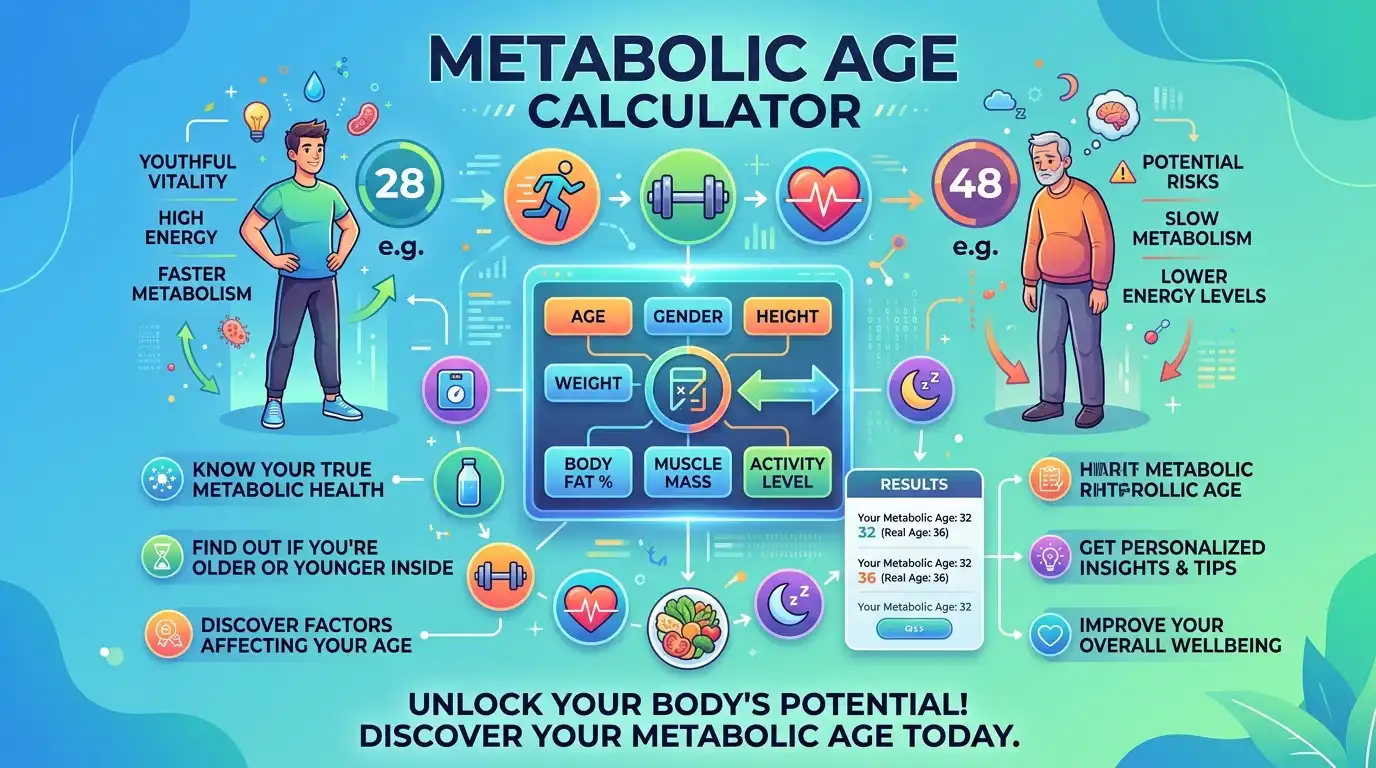
Table of Contents
ToggleMetabolic Age Calculator
A metabolic age estimate is a way of expressing how your estimated resting metabolism compares with an age-based reference. This free calculator uses your age, sex, height and weight to estimate resting energy expenditure with the Mifflin-St Jeor equation, then provides a transparent BMR-based age estimate. It is useful for people who want a simple snapshot of their metabolism, but it should not be treated as a medical diagnosis or a laboratory measurement.
Calculate Your Metabolic Age
“`How This Metabolic Age Calculator Works
“`The important distinction is that metabolic age does not have one universally accepted medical formula. Different smart scales, body-composition analyzers and apps can produce different numbers because their reference populations and algorithms vary. For that reason, this calculator separates the scientifically established part of the calculation from the estimate.
The core calculation uses the Mifflin-St Jeor equation, a widely used predictive equation for resting energy expenditure. The original 1990 study derived the equation from 498 healthy adults and compared predicted resting energy expenditure with measurements obtained using indirect calorimetry.
Men: BMR = (10 × weight in kg) + (6.25 × height in cm) − (5 × age) + 5
Women: BMR = (10 × weight in kg) + (6.25 × height in cm) − (5 × age) − 161
The resulting BMR is then compared with a transparent age-equivalent model to produce the calculator’s estimated metabolic age. Because no universal reference standard exists for metabolic age, this number should be interpreted as a relative tracking estimate, not as a clinically validated biological-age test. BMR itself is more useful when followed alongside weight, body composition, physical activity and other health indicators.
Primary formula source: Mifflin-St Jeor research on PubMed. For additional energy and weight-management context, see the NIH/NIDDK Body Weight Planner.
What Each Input Means
Age is required because resting energy expenditure changes with age in the Mifflin-St Jeor equation. Sex selects the corresponding equation. Weight and height are used directly to estimate BMR. The optional body-fat percentage provides useful context because muscle and fat tissue do not contribute equally to resting energy expenditure, although body fat is not inserted into the Mifflin-St Jeor equation itself.
Resting heart rate and activity level are also contextual indicators. They should not be mistaken for validated inputs to a universal metabolic-age formula. Activity level is particularly useful for understanding estimated daily energy needs, while resting heart rate can provide additional fitness context.
“`Step-by-Step Example Calculation
“`Suppose a 35-year-old man is 175 cm tall and weighs 75 kg. His optional resting heart rate is 72 bpm and his activity level is moderately active.
First, calculate BMR:
BMR = 750 + 1,093.75 − 175 + 5
BMR ≈ 1,674 kcal/day
This means the equation estimates approximately 1,674 calories per day for resting energy expenditure. It does not mean the person should automatically eat 1,674 calories. Daily energy requirements also include movement, exercise, digestion and other energy expenditure.
The calculator then considers the BMR result in relation to the person’s chronological age and reports an estimated metabolic age. Because the reference model behind consumer metabolic-age numbers is not standardized, the age should be used mainly for comparison and trend tracking rather than as a diagnosis.
“`What Affects Your Metabolic Age Result?
“`A metabolic age result can move because of changes in body weight, height assumptions, body composition and the reference algorithm used by the device or calculator. Two calculators can therefore give different answers for the same person without either calculation necessarily containing an arithmetic error.
BMR and Resting Energy Expenditure
BMR is the central measurable concept behind most metabolic-age estimates. The Mifflin-St Jeor equation uses weight, height, age and sex to estimate resting energy expenditure. A person with more metabolically active lean tissue may have a different energy requirement from another person with the same scale weight. That is one reason a single “metabolic age” number cannot fully describe metabolic health.
Body Weight and Body Composition
Body weight has a direct role in the Mifflin-St Jeor equation. However, two people weighing 80 kg can have substantially different amounts of muscle and fat. A body-composition assessment can therefore provide context that a basic weight-only calculator cannot. If you use a smart scale, remember that hydration, food intake, exercise and measurement conditions can affect estimated body-fat readings.
Physical Activity
Regular physical activity can affect energy expenditure, fitness and body composition. The activity selector in this calculator is primarily contextual rather than a hidden claim that exercise directly changes the Mifflin-St Jeor BMR formula. For planning daily calorie needs, activity is commonly incorporated after estimating resting energy expenditure.
Resting Heart Rate
Resting heart rate can provide useful fitness context, but it should not be treated as a direct metabolic-age measurement. A temporary increase can occur because of stress, illness, dehydration, poor sleep, caffeine or recent exercise. For meaningful tracking, measurements should be taken under similar conditions.
Age and the Meaning of “Younger” Metabolic Age
A metabolic age below chronological age is often marketed as a favorable result, while a higher number is presented as something to improve. There is no official medical cutoff that defines a “good” metabolic age, however. The more useful question is whether measurable factors such as fitness, body composition, strength and healthy eating patterns are improving over time.
Metabolic Age Calculator UK: Does Location Change the Formula?
A UK user can use the same calculator because the Mifflin-St Jeor equation itself is expressed using kilograms, centimeters and years rather than a special UK-specific metabolic-age formula. What can change between countries is the reference population, device algorithm, food-label conventions and health guidance. Therefore, a metabolic age calculator UK search does not necessarily imply a different underlying BMR equation.
Metabolic Age vs Chronological Age
Chronological age is simply the amount of time since birth. Metabolic age is an estimated comparison based on metabolism or body-composition data. They are not interchangeable. A person’s chronological age is objective; metabolic age depends on the measurement method and reference model.
BRIGANCE Age Calculator and Chronological Age
A BRIGANCE age calculator is a different type of tool. BRIGANCE uses chronological age to help determine the appropriate age-specific screening materials. The official BRIGANCE tool asks for date of birth, screening date and, for children under 2, weeks premature.
Therefore, a BRIGANCE chronological age calculator should not be confused with a metabolic age calculator. BRIGANCE age is calculated from calendar dates for educational assessment, whereas metabolic age is an estimated health-related comparison derived from metabolic or body-composition information.
“`Metabolic Age Result: Practical Interpretation
“`| Result compared with chronological age | What it may suggest | What to focus on |
|---|---|---|
| Lower | Estimated resting metabolism is relatively favorable under the selected model | Maintain strength, activity and sustainable nutrition |
| Similar | Estimated metabolic profile is broadly aligned with the reference | Track trends rather than chasing a specific number |
| Higher | Estimated result is less favorable under the selected model | Review activity, body composition, sleep and nutrition |
These categories are descriptive rather than medical thresholds. There is no universally accepted clinical definition of a healthy metabolic age. The best use of the number is to monitor change while paying attention to the underlying measurements.
“`Frequently Asked Questions
“`What is metabolic age?
Metabolic age is an estimated age-equivalent intended to show how a person’s metabolism compares with an age-based reference. It is commonly derived from BMR or body-composition information. Unlike chronological age, it is not a standardized clinical measurement, and different devices can produce different results.
How accurate is a metabolic age calculator?
Accuracy depends on the underlying BMR equation, the quality of the inputs and the reference model. The Mifflin-St Jeor equation is a validated predictive equation for resting energy expenditure, but metabolic age itself has no universal clinical standard. Treat the result as an estimate and use trends in weight, fitness and body composition for broader context.
What is a good metabolic age?
There is no official medical cutoff for a good metabolic age. Consumer health products often describe a metabolic age below chronological age as favorable, but that interpretation depends on the device’s algorithm. A healthier approach is to track measurable factors such as strength, physical activity, body composition and sustainable weight management.
Does metabolic age equal biological age?
No. Metabolic age is generally a simplified estimate based on metabolism or body composition. Biological age is a broader concept that may use multiple physiological or molecular biomarkers. Neither should be assumed to represent your overall health or predict lifespan without appropriate clinical context.
What formula does this metabolic age calculator use?
The calculator uses the Mifflin-St Jeor equation to estimate resting energy expenditure. For men, BMR is 10 × weight + 6.25 × height − 5 × age + 5. For women, the same equation ends with −161. The resulting BMR is then used for a transparent age-equivalent estimate rather than claiming a universal medical metabolic-age formula.
Can I use this metabolic age calculator in the UK?
Yes. The calculator accepts metric measurements, including kilograms and centimeters, so it can be used in the UK as well as other countries. There is no separate universally accepted UK metabolic-age equation. Differences between calculators usually come from their reference populations and proprietary algorithms.
What is a BRIGANCE chronological age calculator?
A BRIGANCE chronological age calculator determines a child’s chronological age from a birth date and screening date. BRIGANCE uses chronological age to select the appropriate age-specific screening materials. It is unrelated to metabolic age, which is an estimated health or body-composition measure.
Can I lower my metabolic age?
You should not focus on lowering a single estimated age number. Improvements in regular physical activity, resistance training, adequate protein and overall nutrition can support healthy body composition and energy expenditure. Consistent sleep and sustainable weight management also matter. If a health concern is driving your interest, discuss the underlying issue with a healthcare professional.
Related Calculators
“` “`Sources and Methodology
“`The BMR component is based on the Mifflin-St Jeor predictive equation published in the American Journal of Clinical Nutrition. The original research used measured resting energy expenditure from 498 healthy adults to develop the prediction equation.
The PubMed record for the Mifflin-St Jeor study provides the original equations and research details. The NIH/NIDDK Body Weight Planner also demonstrates the practical use of estimated energy expenditure and physical-activity information in adult weight-management planning.
For BRIGANCE-related age calculations, use the official BRIGANCE Chronological Age Calculator. It is specifically designed to determine rounded chronological age for selecting age-specific BRIGANCE screening materials.
“`
Asrar Ahmad
Founder of CalculatorSuiteHub.com and Rankify SEO & AI Agency. Specializes in SEO, technical content writing, WordPress development, and AI-powered digital solutions. Builds accurate calculators and helps businesses grow online.