Best AP Physics C Grade Calculator: Free 2026 Score Tool
AP Physics C Grade Calculator
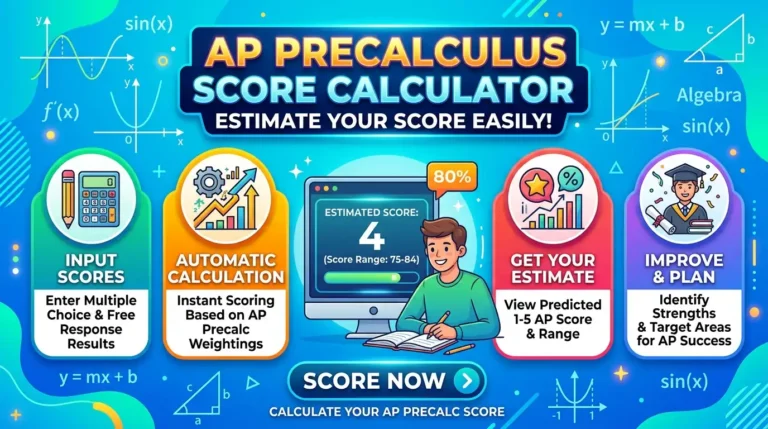
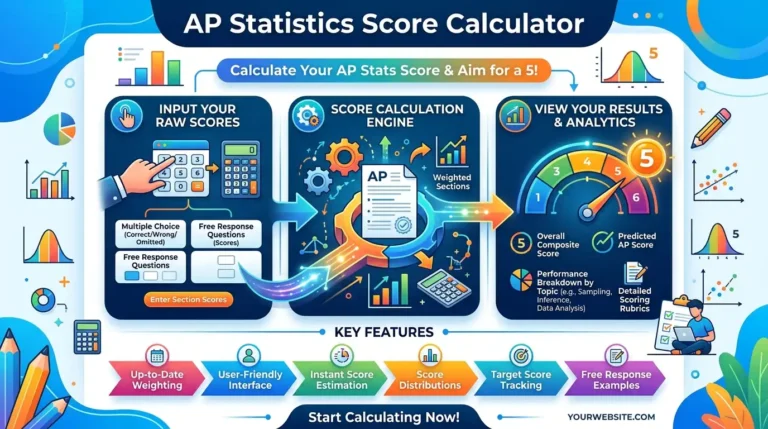
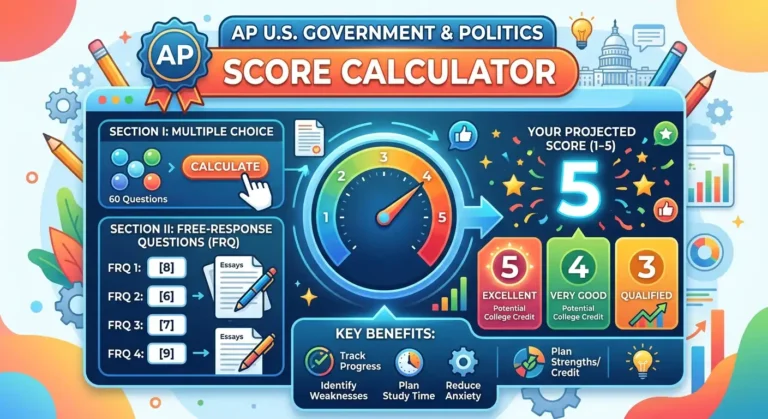
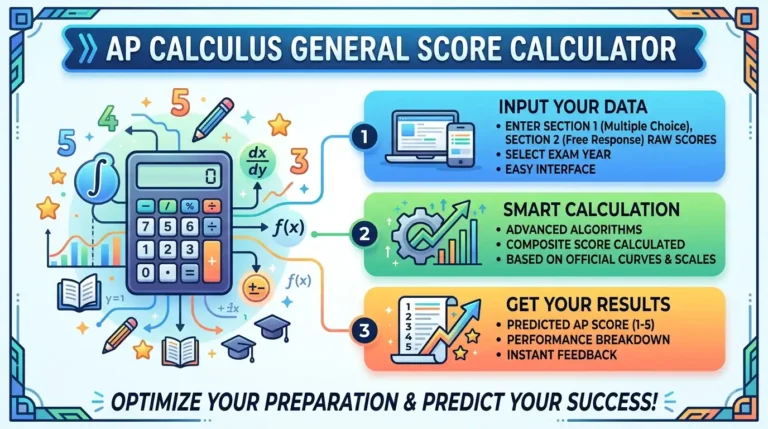
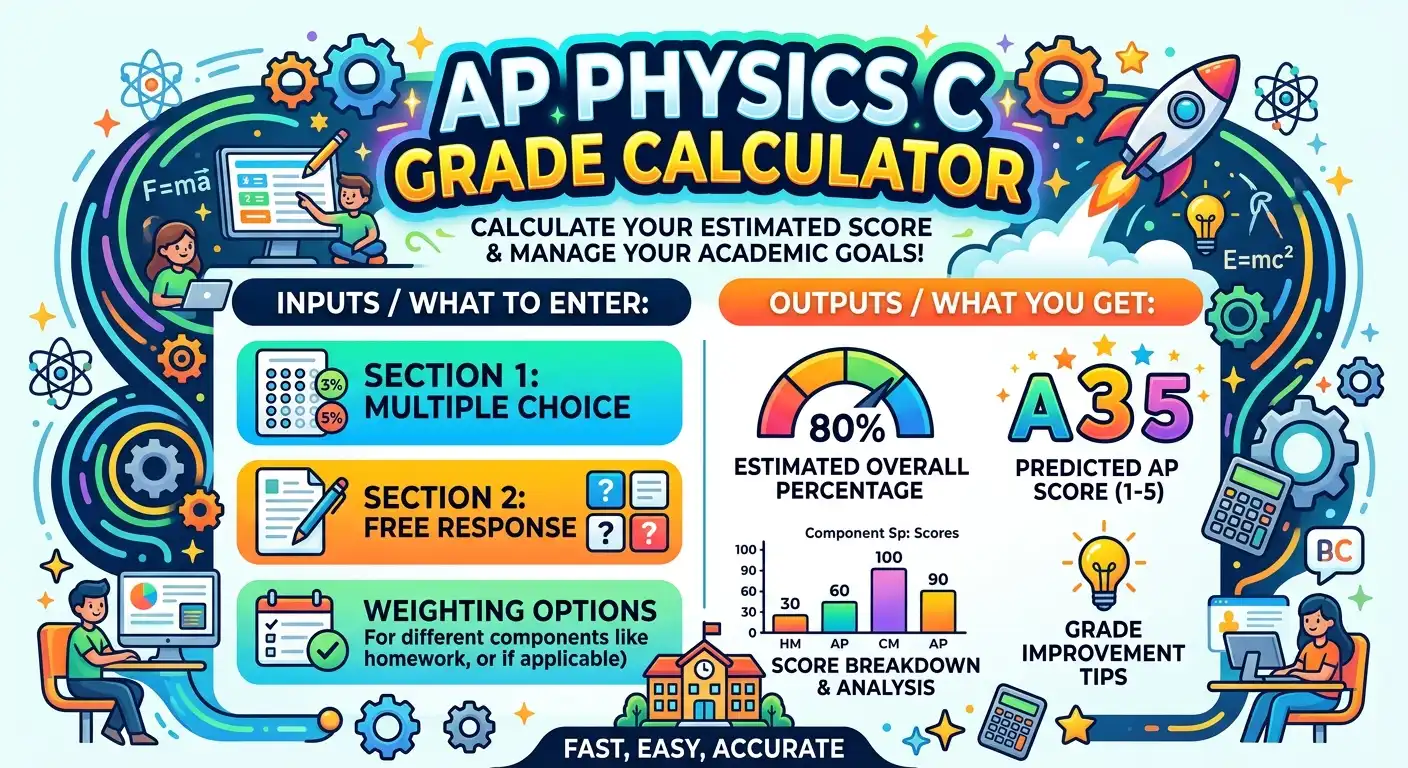
Estimate your AP Physics C composite percentage and likely 1–5 AP score from multiple-choice and free-response performance. Choose Mechanics or Electricity and Magnetism and enter your actual or practice-test results.
Optional: calculate a target
How This AP Physics C Grade Calculator Works
This AP Physics C grade calculator separates the two scored sections of the current exam and then combines them using the official section weighting.
AP Physics C: Mechanics and AP Physics C: Electricity & Magnetism are calculus-based AP physics courses.
For the current exam format, Section I contains 40 multiple-choice questions and represents 50% of the score, while Section II contains four free-response questions and represents the other 50%.
That means a strong multiple-choice performance cannot completely compensate for weak free-response work, and vice versa. The calculator therefore shows both section contributions instead of hiding everything behind one percentage.
FRQ Contribution = (FRQ Points ÷ 40) × 50
Composite % = MC Contribution + FRQ Contribution
What each variable means
- MC Correct: the number of multiple-choice questions answered correctly, from 0 to 40.
- FRQ Points: the total rubric points earned across the four free-response questions, from 0 to 40.
- 50: each section’s contribution to the overall exam because the two sections are equally weighted.
- Composite %: the weighted percentage before any College Board conversion to the reported AP score of 1–5.
The AP score estimate is deliberately separated from the composite calculation. A raw percentage is not itself an official AP score.
College Board determines AP scores using exam-specific scoring procedures, and a single permanent conversion chart should not be treated as authoritative for every year or form.
Step-by-Step Example Calculation
Suppose a student is practicing AP Physics C: Mechanics and gets 28 of 40 multiple-choice questions correct. Across the four FRQs, the student earns 28 of 40 available rubric points.
First calculate the multiple-choice percentage: 28 ÷ 40 = 70%. Because multiple choice is worth 50% of the exam, its weighted contribution is 70% × 0.50 = 35 percentage points.
Next calculate the FRQ percentage: 28 ÷ 40 = 70%. The free-response contribution is therefore 70% × 0.50 = 35 percentage points.
Finally, add the two weighted contributions: 35 + 35 = 70% composite.
The calculator can then compare that composite with broad historical planning bands to provide an estimated AP score. That estimate should be treated as directional rather than as a guaranteed College Board score.
What Affects Your AP Physics C Result
AP Physics C Mechanics score performance
Mechanics tests calculus-based ideas involving kinematics, forces, energy, momentum, rotation, and other physical systems.
The most important scoring distinction is that free-response questions are not simply graded on whether the final numerical answer is correct.
Rubrics award points for appropriate physical principles, representations, equations, reasoning, and calculations. A student who understands the setup but makes a later arithmetic mistake may still earn meaningful partial credit.
This makes FRQ practice especially important when using an AP Physics C grade calculator.
A multiple-choice percentage can look excellent while a student’s ability to communicate a derivation or experimental analysis remains weaker.
Conversely, students who are comfortable writing equations and explaining assumptions can sometimes earn substantial FRQ credit even when their final numerical result is imperfect.
AP Physics grade calculator versus a classroom grade
An AP exam score and a school course grade are different measurements. A classroom grade may include homework, laboratory reports, quizzes, projects, attendance, and unit tests.
The AP Physics C exam score is based on the standardized AP assessment.
This tool is intended for the latter, not for converting a semester average such as 87% into a school letter grade.
AP Physics C Electricity & Magnetism
Electricity & Magnetism is also calculus-based and includes electrostatics, electric potential, conductors and capacitors, circuits, magnetic fields, electromagnetic induction, and related mathematical reasoning.
Its current exam structure also uses 40 multiple-choice questions worth 50% and four free-response questions worth 50%.
The same composite formula therefore works for E&M. What changes is the content you must master.
A student preparing for E&M should pay particular attention to field and potential relationships, Gauss’s law, circuit reasoning, magnetic forces and fields, Faraday’s law, and the mathematical routines expected by the FRQ scoring rubrics.
Why FRQ points matter so much
Since the free-response section represents half of the exam, every rubric point has a direct effect on the composite.
With 40 FRQ points available, one additional FRQ point changes the composite by 1.25 percentage points: 1 ÷ 40 × 50 = 1.25.
That makes recovering one or two missed rubric points through clearer setup, units, diagrams, equations, or justification potentially meaningful.
Exam year and changing score distributions
Do not assume that the same raw percentage always produces the same AP score. Exam difficulty, scoring standards, and the statistical process used to establish score categories can differ between administrations.
College Board’s published score distributions show that the proportion of students receiving each AP score changes from year to year.
AP Physics C Score Range Reference
| Composite range | Planning interpretation | What to focus on next |
|---|---|---|
| 70%–100% | Very strong practice performance | Protect accuracy and reduce avoidable FRQ losses |
| 55%–69% | Strong practice performance | Target the weaker section and improve consistency |
| 40%–54% | Middle planning range | Prioritize high-frequency concepts and FRQ rubric technique |
| 30%–39% | Developing performance | Build fundamentals before chasing speed |
| 0%–29% | Early preparation range | Review concepts, equations, representations, and worked problems |
These ranges are planning ranges rather than official AP score boundaries. They are useful for practice-test interpretation, but they should not be presented as guaranteed thresholds.
The College Board’s official score distribution data is the better source for understanding how students performed in a particular year.
Common AP Physics C Calculator Questions
What is the AP Physics C exam weighted?
The current AP Physics C: Mechanics and Electricity & Magnetism exams use two equally weighted sections. Multiple choice contributes 50% of the exam score and free response contributes 50%.
The current format has 40 multiple- choice questions and four free-response questions.
How do I calculate my AP Physics C composite score?
Divide your multiple-choice correct answers by 40, multiply by 50, then divide your total FRQ points by 40 and multiply by 50. Add those two results.
For example, 30/40 MC and 26/40 FRQ gives 37.5 + 32.5 = a 70% weighted composite.
Does a 70% mean I definitely earned a 5?
No. A 70% composite can be a useful practice benchmark, but it is not an official guarantee of a 5.
College Board does not provide one permanent raw-score conversion that applies to every AP Physics C exam form.
Use this calculator for planning and use your official AP result for the final score.
How many points is each FRQ worth in AP Physics C?
The four current free-response questions together provide 40 scoring points.
Individual questions can have different point totals, so the most useful input for this calculator is your combined FRQ score out of 40 rather than assuming every question is worth the same number of points.
Is an AP Physics grade calculator the same as an AP score calculator?
They can describe similar tools, but an AP exam score calculator estimates the standardized 1–5 AP score, while a school grade calculator may estimate a percentage or letter grade from assignments and tests.
This tool is designed specifically for AP Physics C exam performance.
Can I use this for AP Physics C Electricity & Magnetism?
Yes. Select Electricity & Magnetism in the calculator. Its current exam also uses 40 multiple-choice questions for 50% and four free-response questions for 50%. The content and rubrics differ from Mechanics, but the section-weighting calculation is the same.
What does BC score mean in AP testing?
If you mean an AP Calculus BC score, that is a different AP exam and should not be calculated with this Physics C tool.
AP Physics C is its own pair of calculus-based physics exams. If “BC” was intended to mean something else, check the name of the practice exam before applying a score conversion.
Where can I verify AP Physics C scoring information?
Use College Board’s official AP Central and AP Students pages for the current exam structure, released questions, scoring information, and published score distributions.
Released FRQs are particularly useful because their scoring guidelines show how individual rubric points are awarded.
Official AP Physics C Resources
For authoritative information, consult College Board’s official AP Physics C course and exam pages, including the current exam format and released scoring materials.
The current Mechanics exam and the current Electricity & Magnetism exam both use the 40-question multiple-choice / four-question free-response structure described above.
- College Board AP Central — AP Physics C: Mechanics exam information and current exam format.
- College Board — AP Physics C: Electricity & Magnetism exam information and current exam format.
- College Board — official AP score distributions and released scoring information.
Related Calculators

Asrar Ahmad
Founder of CalculatorSuiteHub.com and Rankify SEO & AI Agency. Specializes in SEO, technical content writing, WordPress development, and AI-powered digital solutions. Builds accurate calculators and helps businesses grow online.