How This Calculator Works
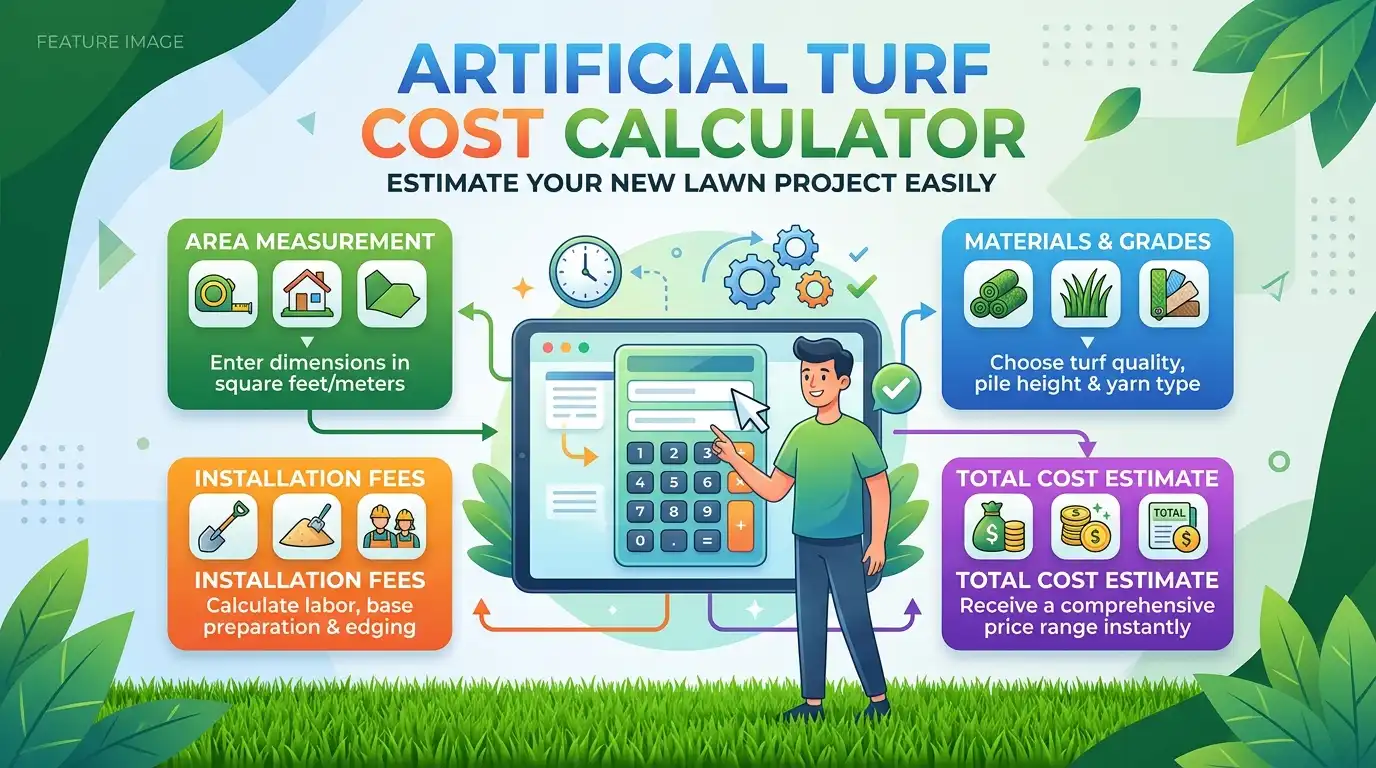
The calculator starts with the finished lawn area, calculated from length × width.
It then adds the selected waste allowance because synthetic turf is normally purchased in fixed-width rolls.
The resulting ordered area is used for turf material, base aggregate and infill.
Professional labor is calculated from the installed area and adjusted for the selected region and layout complexity.
Area = Length × Width
Turf Order Area = Area × (1 + Waste %)
Total Cost = Turf + Base + Infill + Labor + Site Preparation + Edging
Turf material, base, infill and labor are separated so the result shows where the budget is going.
The method reflects the common unit-cost approach used for installation estimating rather than multiplying area by one unexplained price.
Current 2026 artificial-lawn cost data published by Homewyse also uses a unit-cost method and reports a national
installation range that varies with project size, location, labor and options.
View the 2026 artificial lawn cost methodology and reference data.
Step-by-Step Example Calculation
Consider a rectangular backyard that measures 30 feet by 20 feet.
The finished area is 30 × 20 = 600 square feet.
With a 10% waste allowance, the turf order area becomes 600 × 1.10 = 660 square feet.
This accounts for trimming, roll layout and ordinary installation waste.
A standard residential selection might use approximately $4.50 per square foot for turf,
$2.50 for the base, and $0.50 for infill under the calculator’s planning assumptions.
Professional labor is modeled separately because preparation, cutting, seaming, anchoring and cleanup
are not represented by turf material pricing alone.
The example also assumes about 100 linear feet of perimeter edging.
Combining these components produces an estimated project cost near $9,430 before optional site work.
The actual bid can be higher or lower because soil, drainage, access, minimum crew charges,
product availability and local labor conditions are project-specific.
What Affects Your Artificial Turf Cost?
Artificial Turf Estimate and Lawn Size
Area is usually the biggest starting point because turf, base aggregate and infill are purchased according to coverage.
Larger installations can sometimes achieve lower per-square-foot pricing because fixed mobilization and setup costs are spread across more area.
Small side yards can therefore look surprisingly expensive on a per-square-foot basis.
A contractor may still need to mobilize a crew, transport equipment and meet a minimum labor charge.
Artificial Turf Estimate by Turf Quality
Budget landscape turf can reduce the initial material cost, while premium products may use denser fibers,
higher face weights, improved backing or longer warranties.
Pet-focused turf can require different infill and drainage considerations.
The right product should match traffic, pets, appearance expectations, climate and the manufacturer’s installation requirements.
Base Preparation and Drainage
The surface below the turf is a major part of a durable installation.
Aggregate base provides structural support and helps water move through the system.
The Synthetic Turf Council identifies soil conditions, drainage patterns, stone selection,
subgrade planarity and the proposed drainage system as important design variables for synthetic turf base systems.
Poor preparation can lead to settlement, uneven areas or drainage problems.
A calculator can budget a base allowance, but an installer should determine the appropriate construction depth for the actual site.
Waste, Roll Width and Seams
Artificial grass is commonly supplied in rolls, so the theoretical square footage of a yard does not always equal
the amount of material that must be purchased.
Straight rectangular yards generally have less waste than curved layouts, narrow strips and yards with trees,
planting beds, steps or multiple obstacles.
Old Lawn Removal and Ground Preparation
Removing existing grass, roots, soil or unsuitable material can add both labor and disposal costs.
The amount of excavation required also depends on the finished elevation and the existing surface.
If the existing yard is already stable and properly graded, preparation may be simpler.
Uneven soil, heavy clay, poor drainage or extensive roots can require additional work before turf installation.
Regional Labor and Access
Labor costs vary between metropolitan markets and smaller communities.
Delivery distance, local wage levels, disposal fees and contractor availability can all influence a written estimate.
Difficult access can also increase labor because crews may need to move aggregate and turf through narrow gates,
stairs or long paths instead of bringing equipment directly to the work area.
Edging, Infill and Special Features
Perimeter edging helps secure the turf and create a clean transition to concrete, planting beds or other surfaces.
The cost depends on the edging material, perimeter length and installation method.
Infill helps support turf fibers and can affect performance, feel and maintenance.
Product manufacturers may specify different infill quantities, so the calculator’s allowance should be replaced by product-specific specifications when available.
Pet Areas and High-Traffic Zones
Pet applications deserve special attention to drainage, odor management and cleaning.
High-traffic areas may also require a more durable turf system or additional preparation.
For sports or highly specialized installations, residential landscape assumptions are not sufficient.
Sports fields can require engineered drainage, specialized base construction, shock attenuation and performance testing.
Artificial Turf Cost Calculator FAQs
How much does artificial turf cost per square foot?
A professionally installed residential artificial turf project can commonly fall around $8–$22 per square foot,
depending on turf quality, preparation, labor and site conditions. Small or difficult yards may cost more per square foot,
while larger uncomplicated areas can receive better unit pricing.
How accurate is an artificial turf estimate calculator?
An artificial turf estimate calculator is useful for budgeting but cannot replace a site inspection.
The biggest unknowns are soil conditions, drainage, access, excavation, local labor rates and the exact turf product.
Use the result to compare bids and create a preliminary budget before requesting written quotes.
Does artificial turf pricing include the base?
Some advertised turf prices only cover the synthetic grass itself.
A complete installation may also require aggregate base, compaction, infill, edging, labor and site preparation.
This calculator separates those components so the estimated installed cost is easier to understand.
How much turf should I order for waste?
A simple rectangular yard may work with roughly 5–10% additional material, while curved or obstacle-heavy layouts
can need 10–15% or more. Roll width and pile direction matter because pieces cannot always be rotated without creating
visible differences or additional seams.
Is artificial turf cheaper to install as a DIY project?
DIY installation can reduce the labor portion, but it still requires turf, base aggregate, compaction,
infill, edging, seam materials and suitable equipment. The largest DIY risk is underestimating excavation,
base preparation and drainage rather than the visible turf material itself.
What is included in an artificial turf installation?
A typical residential installation can include removing unsuitable surface material, grading, aggregate base,
compaction, turf cutting, seams, anchoring, infill and cleanup. The exact scope varies by contractor.
Drainage systems, retaining walls, irrigation modifications and unusual excavation may be separate line items.
Does the region change artificial turf installation cost?
Yes. Labor rates, delivery distances, disposal charges, contractor demand and local material pricing can vary considerably.
The regional setting in this calculator adjusts the planning labor component, while unusual site conditions should be discussed directly with local installers.
How can I reduce artificial turf installation costs?
Start with accurate measurements and compare itemized quotes rather than turf-only prices.
A simple layout can reduce cutting and seams, while good site access can reduce labor.
Do not remove necessary base or drainage work simply to lower the initial quote because those components affect long-term performance.