Best AP Physics 1 Score Calculator: Predict Your 1–5 Score
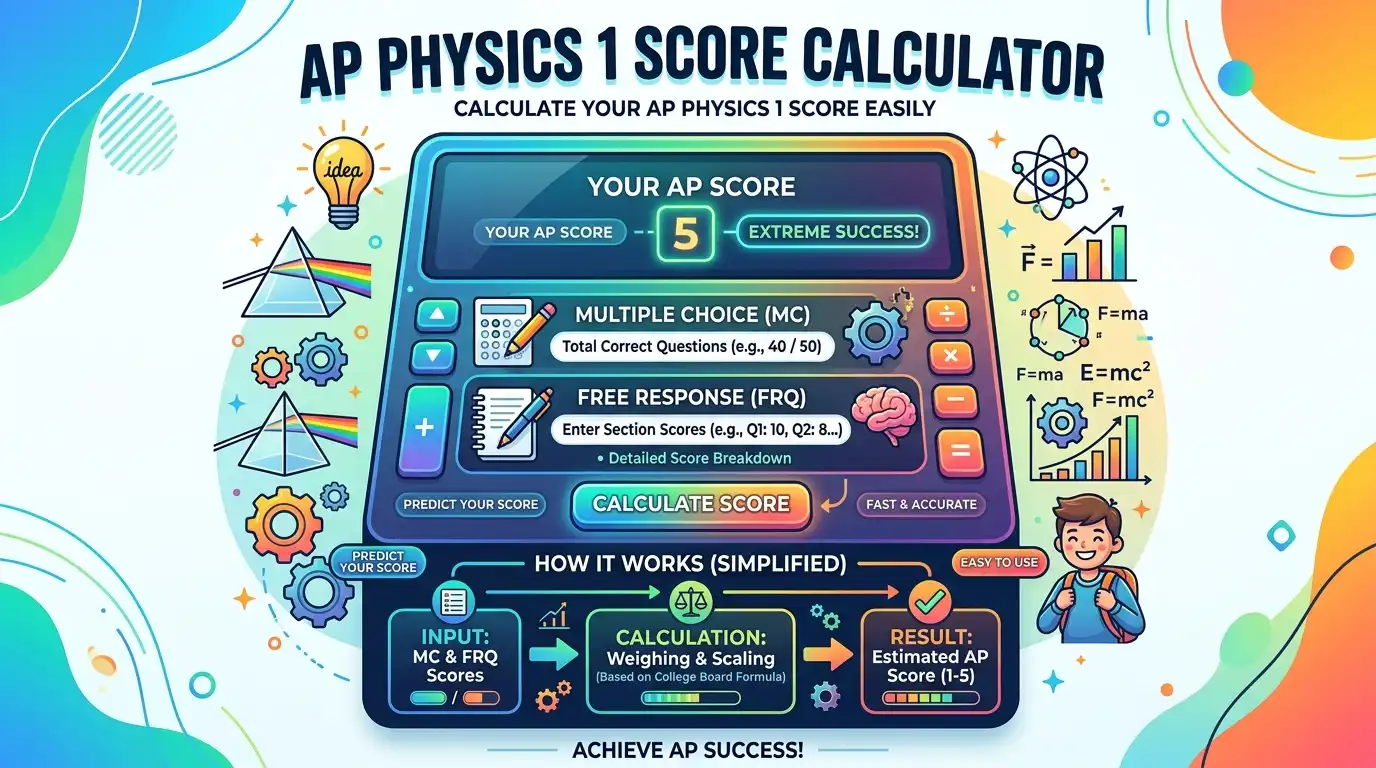
AP Physics 1 Score Calculator
Estimate your AP Physics 1 score from your multiple-choice and free-response performance using the current 2025–2026 exam structure.
This tool separates each FRQ skill, scales both sections to 50 points, and gives an estimated AP score from 1 to 5.
Calculate Your AP Physics 1 Score
Enter your practice-test results or estimate how you performed on exam day.
How This Calculator Works
The current AP Physics 1 exam is divided equally between multiple choice and free response.
Section I contains 40 multiple-choice questions and represents 50% of the exam. Section II contains four free-response questions and represents the other 50%.
The exam is three hours long, with 80 minutes for multiple choice and 100 minutes for free response.
The four current FRQ types are Mathematical Routines, Translation Between Representations, Experimental Design and Analysis, and Qualitative/Quantitative Translation.
Their raw maximums are 10, 12, 10, and 8 points respectively. Together, they create a 40-point FRQ section.
        MCQ scaled = (MCQ correct ÷ 40) × 50

        FRQ scaled = (FRQ raw total ÷ 40) × 50

        Composite score = MCQ scaled + FRQ scaled
Because both raw sections have a 40-point maximum and each contributes 50% of the exam, one raw MCQ point and one raw FRQ point each contribute 1.25 composite points.
For example, 28 correct multiple-choice answers contribute 35 composite points. A total of 27 FRQ points contributes 33.75 composite points.
This produces a composite score of 68.75, which rounds to 68.8.
The College Board does not publish a permanent universal conversion such as “exactly 70 always equals a 5.”
Difficulty and equating can affect the final conversion, so this calculator presents the composite calculation separately from the estimated 1–5 prediction.
What Each Input Means
| Input | Maximum | How It Contributes |
|---|---|---|
| Multiple Choice | 40 correct | Scaled to 50 composite points |
| Mathematical Routines | 10 points | Scaled within the 50-point FRQ section |
| Translation Between Representations | 12 points | Scaled within the 50-point FRQ section |
| Experimental Design & Analysis | 10 points | Scaled within the 50-point FRQ section |
| Qualitative/Quantitative Translation | 8 points | Scaled within the 50-point FRQ section |
The exam structure and weighting are based on the official AP Physics 1 exam information .
Step-by-Step Example Calculation
Suppose a student completes a current-format AP Physics 1 practice exam and gets 28 of 40 multiple-choice questions correct.
The student estimates 7/10 points on Mathematical Routines and 9/12 on Translation Between Representations.
They also estimate 6/10 on Experimental Design and Analysis and 5/8 on Qualitative/Quantitative Translation.
Step 1: Calculate the MCQ Contribution
(28 ÷ 40) × 50 = 35.00 composite points
Step 2: Add the Four FRQ Scores
7 + 9 + 6 + 5 = 27 FRQ raw points
Step 3: Scale the FRQ Result
(27 ÷ 40) × 50 = 33.75 composite points
Step 4: Find the Composite
35.00 + 33.75 = 68.75 ≈ 68.8 / 100
Under the estimated bands used by this tool, a 68.8 composite falls in the estimated AP 4 range.
It is also close to the estimated 70-point benchmark used for a 5. Improving either section can move the student closer to the next band.
For instance, increasing the MCQ result from 28 to 30 adds 2.5 composite points.
What Affects Your AP Physics 1 Score
A strong AP Physics 1 result is not simply about memorizing equations. The redesigned exam emphasizes interpreting representations and explaining physical relationships.
It also emphasizes analyzing experiments and connecting mathematical work to physical meaning.
That makes the distribution of your points important. Two students with the same number of total raw points may have different strengths.
Physics 1 Multiple-Choice Performance
The multiple-choice section contains 40 questions and contributes half of the exam score.
Because every correct answer contributes equally to the raw MCQ total, improving from 20 to 24 correct adds 5 composite points.
Practice should focus on both conceptual accuracy and pacing.
Questions involving graphs, diagrams, proportional reasoning, force models, energy, momentum, rotation, oscillations, and fluids can require different approaches.
Physics 1 Free-Response Performance
The free-response section is equally important and is divided into four distinct skill types.
Mathematical Routines reward correct mathematical setup and reasoning. Translation Between Representations requires movement between different representations.
Experimental Design and Analysis focuses on variables, procedures, data, uncertainty, graphs, and conclusions.
Qualitative/Quantitative Translation combines physical reasoning with quantitative work.
A student who is excellent at calculations but weak at written justification can leave substantial FRQ points on the table.
Conversely, a student with moderate MCQ performance can compensate with strong free-response points because both sections are weighted equally.
AP Physics 1 Exam Format and Timing
Time management matters because the current exam gives 80 minutes for 40 MCQs and 100 minutes for four FRQs.
The free-response section averages 25 minutes per question, but the four questions do not have identical point values.
Mathematical Routines and Experimental Design are worth 10 points each. Translation Between Representations is worth 12 points.
Qualitative/Quantitative Translation is worth 8 points. Use scoring weight as one factor when allocating practice time.
AP Physics 1 Calculator Use
Calculators are permitted on both sections of the current exam. That does not make the exam a calculator test.
A calculator can evaluate numerical expressions, but it cannot decide which physical principle applies.
It also cannot determine whether momentum or energy should be conserved, interpret a graph, or justify an experimental conclusion.
Students should practice setting up the physics before reaching for numerical computation.
AP Physics 1 Score Calculator 2023 vs. the Current Exam
Search results for an AP Physics 1 score calculator 2023 can be misleading because the exam was substantially different before the 2025 revision.
The 2023 exam had 50 multiple-choice questions and five free-response questions.
The current exam has 40 MCQs and four FRQs. A 2023 practice test should therefore not be entered directly into this calculator.
Students using older practice material should check the year before interpreting a calculated score.
Recent AP Physics 1 Score Distribution
Official College Board data shows how much the overall distribution can change from year to year.
In 2025, 19.8% of AP Physics 1 students earned a 5, 24.7% earned a 4, 22.9% earned a 3, 13.4% earned a 2, and 19.2% earned a 1.
The 3-or-higher rate was 67.3%. In 2026, the published distribution was 19% for a 5, 24% for a 4, and 25% for a 3.
The 2026 distribution was 15% for a 2 and 17% for a 1. These figures demonstrate why a calculator should estimate rather than promise an exact final AP score.
AP Physics 1 Composite Score Range Table
| Estimated AP Score | Composite Range | General Interpretation |
|---|---|---|
| 5 | 70–100 | Extremely well qualified |
| 4 | 54–69 | Well qualified |
| 3 | 40–53 | Qualified |
| 2 | 25–39 | Possibly qualified |
| 1 | 0–24 | No recommendation |
Your calculated composite is more certain than the predicted 1–5 label. Treat the AP score as a preparation estimate.
Frequently Asked Questions About AP Physics 1 Scoring
How does the AP Physics 1 score calculator work?
The calculator scales the 40-question multiple-choice section to 50 points.
It scales the 40-point free-response section to another 50 points. The two values create a composite score from 0 to 100.
An estimated 1–5 AP score is then assigned using the practical score bands shown on this page.
How many questions are on the current AP Physics 1 exam?
The current AP Physics 1 exam has 40 multiple-choice questions and four free-response questions.
Multiple choice is worth 50% of the exam and free response is worth the other 50%.
The four FRQs have a combined raw maximum of 40 points.
What score do I need for a 5 on AP Physics 1?
This calculator uses an estimated composite threshold of about 70 out of 100 for an AP 5.
That is a planning benchmark rather than an official guaranteed cutoff. The College Board equates exams, so the exact relationship can vary.
What is a passing score on AP Physics 1?
A 3 is generally considered the minimum qualifying AP score.
Individual colleges decide how they award credit or placement. This calculator uses approximately 40 composite points as an estimated 3-level benchmark.
Always check the specific college’s current AP credit policy.
How many points is each AP Physics 1 FRQ worth?
Mathematical Routines is worth 10 points. Translation Between Representations is worth 12 points.
Experimental Design and Analysis is worth 10 points. Qualitative/Quantitative Translation is worth 8 points.
Together, the four FRQs create a 40-point raw section.
Can I use this AP Physics 1 calculator for a 2023 exam?
Not directly. The 2023 AP Physics 1 exam used 50 multiple-choice questions and five free-response questions.
The exam was revised beginning in 2025, so historical practice exams should be scored using their original format.
Does AP Physics 1 allow a calculator?
Yes. The current AP Physics 1 exam permits an approved four-function, scientific, or graphing calculator on both sections.
Calculator access does not replace conceptual reasoning. Students still need to select appropriate physical models and interpret representations.
How accurate is an AP Physics 1 exam score calculator?
The section-weighting calculation is deterministic when your raw scores are known.
The predicted 1–5 score is less certain because the College Board does not publish a permanent fixed conversion table for every live exam.
Treat the predicted AP score as a preparation estimate, especially when your composite is close to a boundary.
Related Calculators
Explore these related AP score calculators to compare different AP subjects and physics courses.
About This AP Physics 1 Calculator
CalculatorSuiteHub provides free calculators designed to turn complicated scoring systems into practical, understandable results.
This AP Physics 1 calculator is designed for students checking practice-test performance, teachers reviewing class results, and families understanding estimated AP performance.
The best use of the tool is not simply to see a predicted number. Look at the breakdown and identify which section is limiting your result.
If your MCQ contribution is strong but your FRQ contribution is weak, spend more time practicing written explanations, graphs, and experimental reasoning.
If your FRQ performance is strong but your MCQ score is limiting the composite, focus on timed conceptual practice and question interpretation.
Most importantly, do not confuse an estimated score band with an official AP result.
Use your composite score to measure progress, identify weaknesses, and set a realistic target for your next practice test.

Asrar Ahmad
Founder of CalculatorSuiteHub.com and Rankify SEO & AI Agency. Specializes in SEO, technical content writing, WordPress development, and AI-powered digital solutions. Builds accurate calculators and helps businesses grow online.