French Drain Cost Calculator – Free Online Calculator 2026
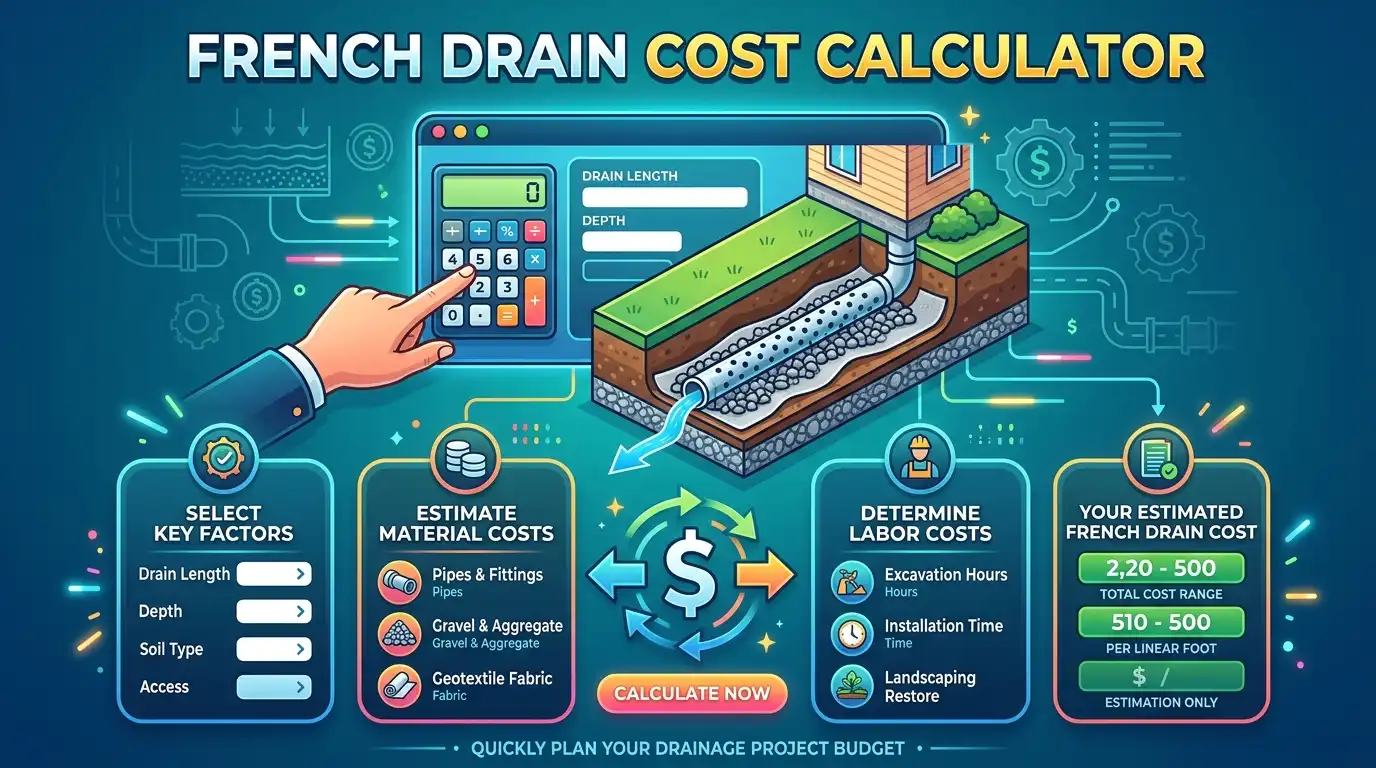
French Drain Cost Calculator: Estimate Your 2026 Project
A French drain can solve recurring yard water, foundation drainage, and runoff problems.
Project cost changes with trench size, soil, access, materials, and labor.
This french drain cost calculator estimates material quantities and an installation budget.
Enter your trench dimensions, pipe size, local prices, labor rate, and site conditions.
You will get a low-to-high planning range before requesting contractor quotes.
Free French Drain Cost & Gravel Calculator
Estimate gravel, pipe, fabric, excavation labor, finishing, and total project cost.
How French Drain Cost Calculator Works
The calculator starts with the physical volume of the trench.
It then removes the space occupied by the perforated pipe.
A waste allowance is added after the net gravel volume is calculated.
This approach uses the standard relationship of trench volume minus pipe displacement.
Gravel is then converted from cubic feet to cubic yards and estimated tons.
Pipe Volume = π × (Pipe Diameter ÷ 24)² × Length
Net Gravel = Trench Volume − Pipe Volume
Order Gravel = Net Gravel × (1 + Waste ÷ 100)
Gravel Cubic Yards = Order Gravel ÷ 27
Gravel Tons ≈ Cubic Yards × 1.4
Fabric Area = Length × [(Width + 2 × Depth + Overlap) ÷ 12] × 1.10
The 1.4-ton-per-cubic-yard conversion is a planning assumption for washed drainage stone.
Actual bulk density varies with stone size, moisture, gradation and supplier.
The estimate is itemized instead of using one generic price per foot.
This lets you replace example material and labor prices with local numbers.
For foundation drainage, the 2024 International Residential Code foundation drainage guidance describes approved drainage systems, perforated pipe, washed gravel or crushed stone, and filter membrane considerations.
Step-by-Step Example Calculation
Consider a 50-foot exterior yard drain with a 12-inch-wide trench.
The trench is 18 inches deep and uses a 4-inch pipe.
Assume 10% gravel allowance and 6 inches of fabric overlap.
First, calculate trench volume: 50 × 1 × 1.5 = 75 cubic feet.
The 4-inch pipe occupies about 4.36 cubic feet.
That leaves approximately 70.64 cubic feet of net gravel space.
Add 10% waste and divide by 27 to get about 2.88 cubic yards of gravel.
At 1.4 tons per cubic yard, that equals approximately 4.03 tons.
Fabric wraps the trench bottom and sidewalls with the selected overlap.
The example requires about 247.5 square feet of filter fabric.
Assume gravel at $55 per ton, pipe at $1.50 per foot, and fabric at $0.60 per square foot.
Base installation labor is assumed at $35 per linear foot.
The tool then produces a transparent itemized budget from those inputs.
Labor adjustments account for project type, excavation difficulty, and regional cost level.
These multipliers are planning controls, not published contractor rates.
What Affects Your French Drain Cost?
French drain pricing depends on physical quantity and installation difficulty.
A long, shallow yard drain differs from a deep foundation system.
French Drain Gravel Calculator: Trench Size Matters
Trench width and depth directly control gravel volume.
Increasing either dimension also increases excavation requirements.
A 12-inch-wide, 18-inch-deep trench needs less material than a larger trench.
Measure finished trench dimensions instead of estimating gravel from pipe length alone.
Pipe Diameter and Displacement
The pipe occupies part of the trench, so its cylindrical volume is removed.
The effect is modest for many residential 4-inch pipes.
Using the actual outside diameter improves the material estimate.
Pipe length normally follows the drain run.
Fittings, cleanouts, connections, bends and outlets may require additional material.
Washed Gravel and Stone Type
Drainage stone needs open void space so water can move through the trench.
Dense fill and fine-heavy aggregate should not automatically be treated as drainage stone.
Gravel pricing varies by stone size, delivery distance, supplier, season and quantity.
Entering a local delivered price gives a more useful estimate.
Excavation, Soil and Accessibility
Labor can become the largest cost category on a French drain project.
Digging, grading, pipe installation, backfilling and restoration require crew time.
Clay, compacted soil, roots, rock and restricted access can increase excavation effort.
Deep trenches may also create additional safety requirements.
A drain beside a foundation needs more site-specific planning than a shallow yard trench.
Filter Fabric and Overlap
Fabric quantity depends on trench geometry rather than pipe length alone.
The calculator wraps the planned width and both sidewalls.
It then adds the selected overlap and a material allowance.
Fabric selection should match the soil and drainage application.
The U.S. Natural Resources Conservation Service notes that filter materials and geotextiles depend on soil conditions and drainage needs.
Outlet, Slope and Landscape Restoration
A drain needs somewhere for collected water to go.
Outlet work, fittings, daylight discharge and drainage connections can change the final quote.
Landscape repair is another commonly overlooked line item.
Sod, seed, mulch, edging, concrete replacement and planting beds may need separate allowances.
French Drain Cost Range by Project Size
The table uses standard planning assumptions for width, depth, pipe, gravel, fabric and labor.
Assumptions include 12-inch width, 18-inch depth, 4-inch pipe and 10% gravel allowance.
It also uses $55/ton gravel, $1.50/ft pipe, $0.60/sq ft fabric and $35/ft labor.
| Drain Length | Gravel | Approx. Tons | Planning Cost | Typical Use |
|---|---|---|---|---|
| 25 ft | 1.44 yd³ | 2.01 tons | About $1,350 | Small yard problem |
| 50 ft | 2.88 yd³ | 4.03 tons | About $2,450 | Typical medium run |
| 75 ft | 4.32 yd³ | 6.04 tons | About $3,550 | Larger yard drainage |
| 100 ft | 5.76 yd³ | 8.06 tons | About $4,650 | Long perimeter or yard run |
These figures are calculator examples, not market quotes.
Actual installation prices can change with depth, access, soil and discharge requirements.
Common French Drain Cost Mistakes
Estimating Gravel From Length Alone
Pipe length shows system length but not the surrounding stone volume.
Width and depth must be included because trench volume determines aggregate needs.
Ignoring Pipe Displacement
The difference may be modest, but subtracting pipe volume improves material accuracy.
The calculator handles pipe displacement automatically.
Forgetting Waste and Supplier Ordering
Excavated trenches are rarely perfect rectangles.
Waste allowances help cover uneven walls, spillage, cuts and ordering requirements.
Using a Generic Per-Foot Quote Without Checking Scope
A per-foot number can hide major differences between drainage projects.
Ask what excavation, stone, pipe, fabric, outlet work and restoration are included.
Frequently Asked Questions
How much does a French drain cost?
The total depends on length, trench depth, soil, access, drain type, materials and discharge requirements.
Use local material and labor prices in the calculator for a project-specific planning estimate.
How much gravel do I need for a French drain?
Calculate trench volume, subtract pipe volume, convert to cubic yards, and add a material allowance.
A 50-foot, 12-inch-wide, 18-inch-deep trench with a 4-inch pipe needs about 2.88 cubic yards with 10% allowance.
What is the formula for a French drain gravel calculator?
The core formula is net gravel volume = trench volume minus pipe volume.
After subtraction, add waste and divide by 27 to convert cubic feet to cubic yards.
How deep should a French drain be?
There is no single depth for every drainage problem.
Required depth depends on the water source, grade, soil and discharge point.
How much does French drain gravel cost?
Gravel cost depends on stone type, supplier pricing, delivery distance and quantity.
Enter your delivered local price into the calculator for a more useful estimate.
Should I use landscape fabric around a French drain?
Filter fabric is commonly used to reduce surrounding soil movement into drainage aggregate and pipe.
The correct material depends on soil conditions and the drainage application.
Is a French drain worth installing for standing water?
A French drain can help when the route, grade, collection point and discharge method are appropriate.
Poor outlet design, unsuitable soil or inadequate slope can leave the water problem unresolved.
How long does a French drain last?
Service life depends on soil movement, sediment, pipe quality, fabric, installation and maintenance.
Periodic inspection and keeping the outlet clear can help identify problems early.
Related Calculators
Explore these related CalculatorSuiteHub tools for outdoor, construction and property-maintenance estimates.

Asrar Ahmad
Founder of CalculatorSuiteHub.com and Rankify SEO & AI Agency. Specializes in SEO, technical content writing, WordPress development, and AI-powered digital solutions. Builds accurate calculators and helps businesses grow online.





One Comment